
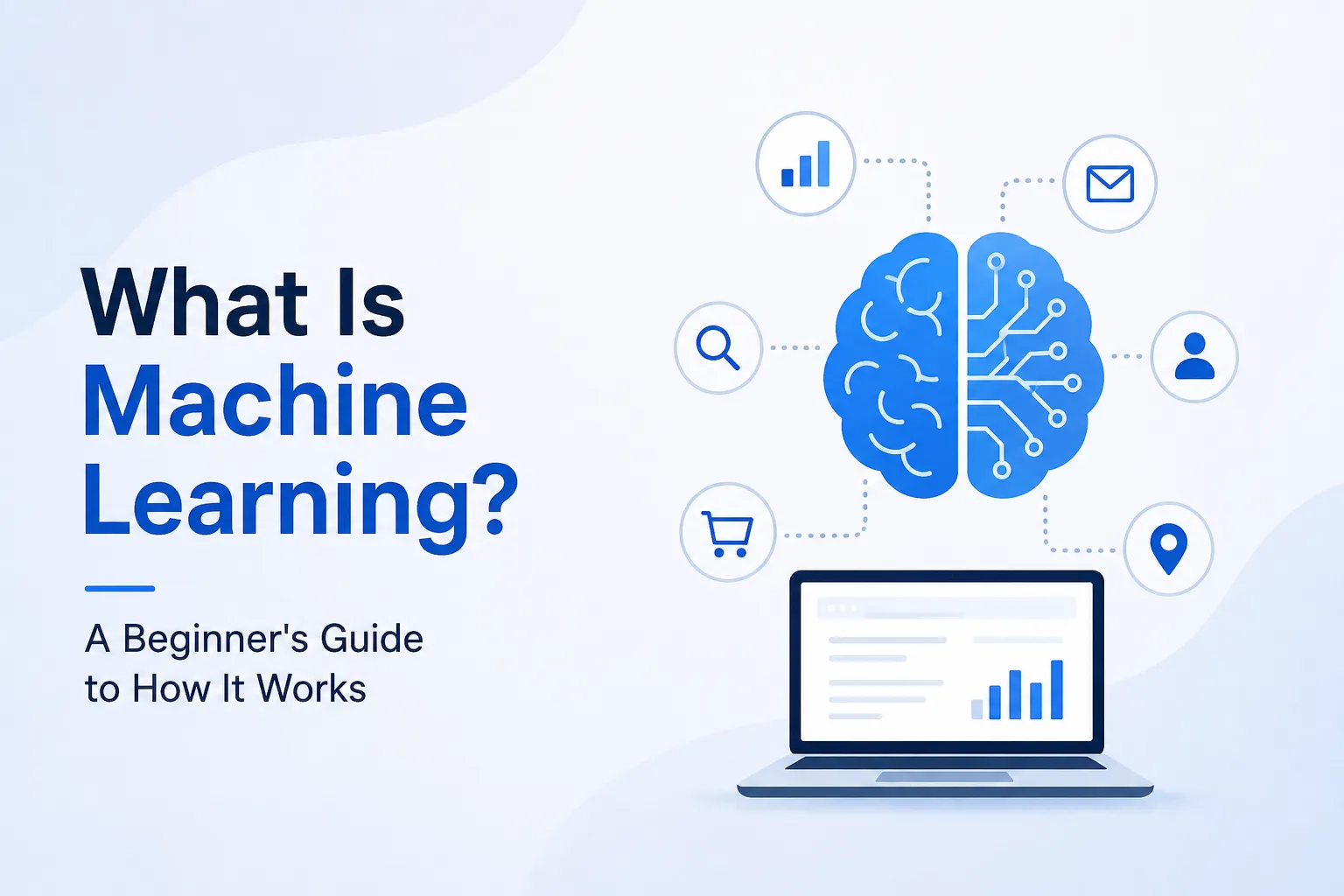
Machine learning is becoming an increasingly important part of everyday technology. In fact, many people use machine learning every day without realizing it. Movie recommendations, email spam filters, voice assistants, navigation apps, online shopping suggestions, and personalized social media feeds can all use machine learning technology.
Machine learning is closely connected to artificial intelligence (AI). While artificial intelligence is the broader idea of creating systems that can perform tasks associated with human intelligence, machine learning is one of the ways computers can become better at certain tasks by learning patterns from data.
In this beginner’s guide, you’ll learn what machine learning is, how machine learning works, the main types of machine learning, where it is used, and how it differs from artificial intelligence.
Want to understand the broader concept behind machine learning? Read our complete guide: Artificial Intelligence (AI): A Complete Beginner’s Guide.
What Is Machine Learning?
Machine learning is a branch of artificial intelligence that enables computer systems to learn patterns from data and improve their performance without being explicitly programmed with instructions for every possible situation.
In simple terms, instead of giving a computer a separate rule for every situation, developers provide data and a learning process that helps the system identify useful patterns.
For example, consider an email spam filter. It would be difficult to manually write rules for every possible spam message. A machine learning system can instead study examples of spam and legitimate emails, identify common patterns, and use what it has learned to help classify new messages.
That does not mean the system understands email in the same way a person does. It identifies patterns in data and uses those patterns to make predictions or decisions.
How Does Machine Learning Work?
Machine learning can sound complicated, but its basic process can be understood in a few steps.
Step 1: Collect Data
Machine learning systems need relevant data to learn from. Depending on the task, this might include text, images, numbers, customer information, sensor readings, or other types of data.
Step 2: Prepare the Data
Real-world data is often incomplete, inconsistent, or poorly organized. Before training a machine learning system, data may need to be cleaned, organized, and checked for errors.
Step 3: Train the Model
A machine learning model is a system that learns relationships and patterns from data.
During training, the model processes examples and adjusts its internal parameters to perform a particular task more effectively, such as recognizing spam or estimating a price.
Step 4: Identify Patterns
The model looks for relationships within the data. For example, it may identify that certain combinations of words, email addresses, or message characteristics are often associated with spam.
Step 5: Test the Model
Testing is important because a model may perform well on data it has already seen but poorly on new information.
Testing helps developers evaluate whether the model can make useful predictions on previously unseen data.
Step 6: Make Predictions or Decisions
Once trained and evaluated, a machine learning model can be used with new data.
For example:
Data → Training → Pattern Recognition → Prediction
A model trained on previous house sales might use patterns from that data to estimate the price of another house.
Simple Machine Learning Example
Imagine a system designed to recommend movies.
The process might look like this:
- The system collects information about movies users watch or rate.
- It identifies patterns in viewing preferences.
- It finds similarities between users, movies, or viewing behavior.
- It uses those patterns to suggest movies a person may be interested in.
Recommendations are predictions based on patterns in available data, so they are not always correct. This is one reason you may occasionally receive a recommendation that does not match your interests.
Types of Machine Learning
There are three widely recognized categories of machine learning.
Supervised Learning
Supervised learning uses labeled data, meaning the training examples include both the input and the correct output.
For example, a model can study previous house sales where information such as location and size is paired with the actual selling price. It can then learn patterns that may help estimate the price of another property.
Unsupervised Learning
Unsupervised learning works with unlabeled data. Instead of being given the correct answers, the system looks for hidden patterns or groups.
For example, a business might use it to identify groups of customers with similar purchasing behavior.
Reinforcement Learning
Reinforcement learning involves learning through feedback, rewards, and trial and error.
A system takes actions and receives feedback based on the results. Over time, it can learn which actions are more useful for achieving a particular goal.
Examples include some robotics systems, game-playing systems, and decision-making applications.
| Type of Machine Learning | How It Learns | Simple Example |
| Supervised Learning | Learns from labeled examples | Predicting house prices |
| Unsupervised Learning | Finds patterns in unlabeled data | Customer segmentation |
| Reinforcement Learning | Learns through rewards and feedback | Games and robotics |
Artificial Intelligence vs Machine Learning
Artificial intelligence and machine learning are closely related, but they are not exactly the same thing.
AI is the broader field. Machine learning is one approach used to build AI systems. AI can include multiple approaches, and not every AI system works in exactly the same way as a machine learning system.
| Artificial Intelligence | Machine Learning |
| Broader concept | Part of AI |
| Focuses on intelligent systems | Focuses on learning from data |
| Includes multiple approaches | Uses algorithms and data to learn patterns |
Everyday Examples of Machine Learning
Machine learning applications are already common in everyday technology. Examples include:
- Netflix and YouTube content recommendations
- Email spam filters
- Voice assistants
- Online shopping recommendations
- Navigation and traffic predictions
- Fraud detection systems
- Social media content recommendations
- Image recognition
These systems can analyze data and use learned patterns to provide predictions, classifications, or personalized experiences.
To explore how AI and machine learning are already influencing daily activities, see How Artificial Intelligence Is Transforming Everyday Life.
Common Applications of Machine Learning
Healthcare
Machine learning can help analyze patterns in medical data, support research, and assist with certain analytical tasks. However, it does not remove the need for qualified healthcare professionals and appropriate human judgment.
Finance
Financial organizations can use machine learning for fraud detection, risk analysis, and identifying unusual patterns in transactions.
E-commerce
Online businesses use machine learning to personalize product recommendations and better understand customer behavior.
Transportation
Machine learning can support traffic prediction, route planning, and intelligent transportation technologies.
Business
Businesses may use machine learning for forecasting, customer insights, demand analysis, and other data-driven decision support.
Cybersecurity
Machine learning may help cybersecurity systems identify unusual activity or patterns that could indicate potential threats. However, automated systems can make mistakes and should be supported by appropriate security practices and human oversight.
To strengthen your everyday online safety habits, read Cybersecurity Tips Everyone Should Know.
Machine Learning and AI Tools
Many modern AI tools rely on machine learning technologies. Users can interact with AI-powered tools without understanding every technical process happening behind the scenes.
This makes machine learning increasingly relevant to students, professionals, and business owners, even if they do not plan to become machine learning engineers.
Looking for practical ways to explore AI technology? Check out Best Free AI Tools You Should Try.
Benefits of Machine Learning
Machine learning can offer several important benefits:
- Automation of repetitive pattern-based tasks
- Improved predictions for suitable problems
- More personalized user experiences
- The ability to analyze large amounts of data
- Faster data-driven decision support
- Continuous improvement when systems are appropriately updated and monitored
However, machine learning is not the best solution for every problem. Its usefulness depends on the quality of the data, the design of the system, and whether the technology is appropriate for the task.
Limitations and Challenges of Machine Learning
Machine learning also has important limitations and challenges.
These include:
- Poor-quality or incomplete data
- Bias present in training data
- Privacy concerns
- Security risks
- Incorrect predictions
- High computing requirements for some systems
- Limited transparency in complex models
A machine learning system can produce incorrect or unfair results. Its performance depends heavily on data quality, system design, testing, monitoring, and responsible human oversight.
Machine Learning and the Future
Machine learning will likely continue to influence automation, personalized services, scientific research, and data-driven decision-making.
At the same time, responsible development will become increasingly important. Questions involving privacy, security, bias, transparency, and accountability will remain important as machine learning technology becomes more widely used.
For a broader look at the technologies shaping the years ahead, explore Top 10 Emerging Technologies That Will Shape the Future.
How Can Beginners Start Learning Machine Learning?
Beginners do not need to master advanced mathematics or programming before understanding the basics. A practical learning path is:
- Understand basic AI and machine learning concepts.
- Learn mathematics gradually, focusing on concepts as needed.
- Learn Python if you want to explore technical machine learning.
- Experiment with beginner-friendly datasets.
- Practice small projects and simple examples.
- Learn about responsible AI, privacy, and data security.
The most important first step is understanding the concepts. Technical skills can be developed gradually through practice.
Frequently Asked Questions
1. What is machine learning in simple words?
Machine learning is a type of AI that helps computers learn patterns from data so they can make predictions or perform tasks without needing a separate rule for every situation.
2. Is machine learning the same as artificial intelligence?
No. Artificial intelligence is the broader field, while machine learning is one approach used to create systems that can learn from data.
3. What are the three main types of machine learning?
The three main types are supervised learning, unsupervised learning, and reinforcement learning.
4. Where is machine learning used?
Machine learning is used in recommendations, spam filtering, fraud detection, healthcare research, e-commerce, transportation, cybersecurity, and many other areas.
5. Do I need coding to understand machine learning?
No. You can understand the basic concepts without coding. Programming becomes more useful when you want to build and experiment with machine learning systems.
6. Can beginners learn machine learning?
Yes. Beginners can start by learning basic AI concepts, understanding data and patterns, and gradually developing technical skills.
7. How does machine learning learn from data?
Machine learning uses training data to identify relationships and patterns. These learned patterns can then help the system make predictions or decisions about new data.
8. What is an example of machine learning in daily life?
A common example is a movie recommendation system that suggests content based on viewing patterns and similarities between users or items.
Conclusion
Machine learning may sound complex, but its basic concept is straightforward: it helps computer systems identify patterns in data and use those patterns to improve their performance on specific tasks.
From spam filters and recommendations to fraud detection and traffic prediction, machine learning is already influencing many technologies people use every day. At the same time, these systems can make mistakes and require careful design, testing, monitoring, and human oversight.
Understanding what machine learning is and how it works provides a useful foundation for understanding modern AI and the technologies that will continue to shape the way we live and work.