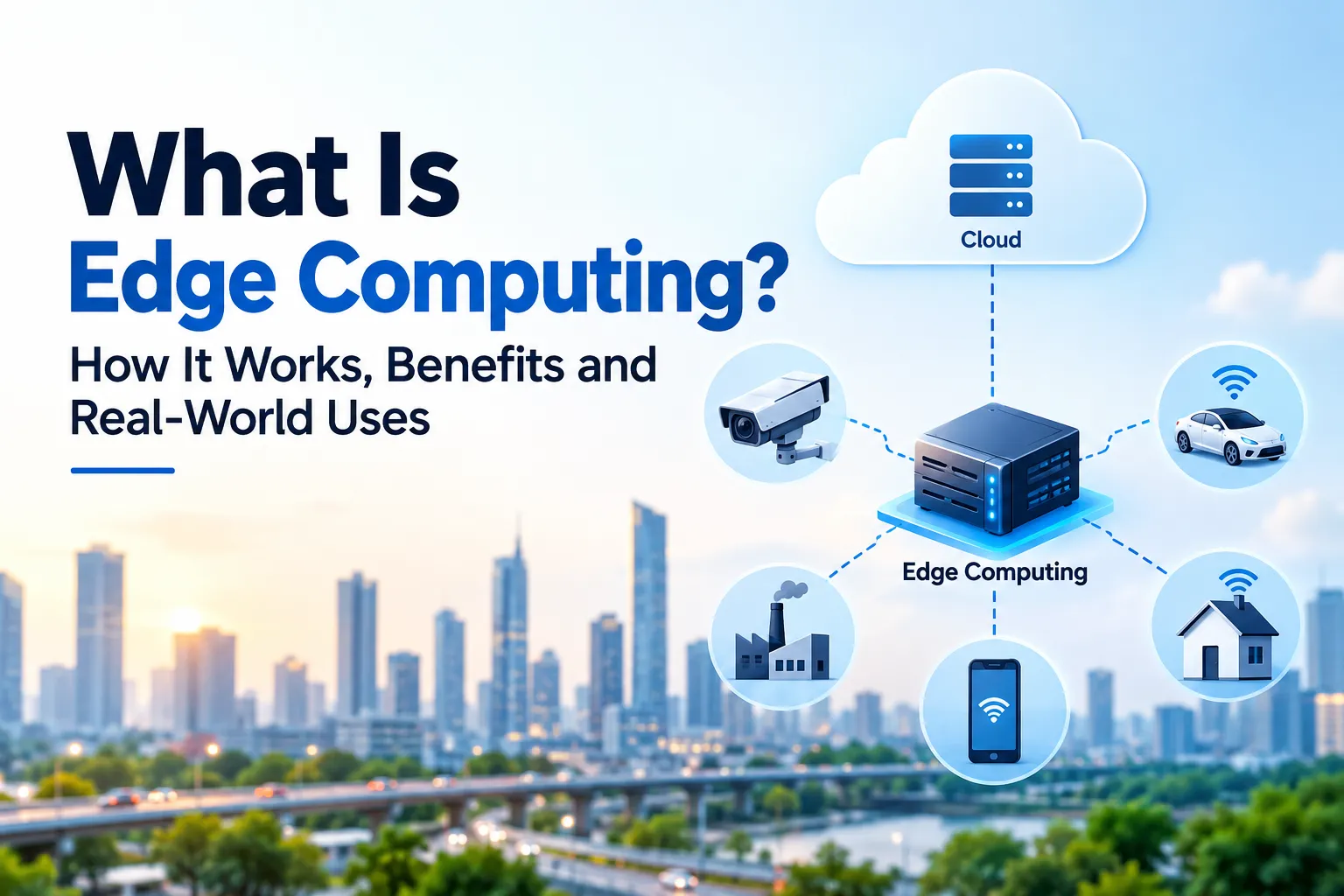
Modern devices generate enormous amounts of data every second. Smartphones, security cameras, vehicles, industrial machines, and smart home devices constantly collect information.
Many applications send this data to cloud data centers for storage and analysis. Cloud computing offers powerful processing capabilities, but sending every piece of data to a distant data center can create delays and consume network bandwidth.
Edge computing takes a different approach. It moves some computing and data processing closer to the device or location that generates the data.
This approach can help applications respond faster and use network resources more efficiently. Today, businesses and technology providers use edge computing across areas such as smart cities, autonomous vehicles, healthcare, manufacturing, retail, and the Internet of Things (IoT).
What Is Edge Computing?
Edge computing is a distributed computing approach that processes data closer to where the data originates instead of sending all of it to a centralized cloud or data center.
In simple terms, the edge refers to the locations where devices generate and collect data.
These locations can include a factory, retail store, vehicle, hospital, smartphone, or smart home.
Edge devices can include sensors, cameras, industrial computers, smartphones, routers, gateways, and other connected equipment. Some devices process information directly, while nearby edge servers handle more demanding workloads.
Consider a security camera as an example.
A traditional setup might send a continuous video stream to a cloud server. An edge-enabled system can analyze the video locally. It might detect a person or unusual activity and send only the relevant information to the cloud.
This approach reduces unnecessary data transfers.
Edge computing does not replace cloud computing. Instead, many modern systems use both. The edge handles tasks that need quick local responses, while the cloud handles centralized storage, large-scale analytics, backups, and application management.
How Does Edge Computing Work?
How edge computing works becomes easier to understand when we break the process into four steps.
1. Data Is Generated
Connected devices constantly create data.
Common examples include:
- Smartphones
- Sensors
- Security cameras
- Industrial machines
- Vehicles
- Smart home devices
- Medical equipment
A smart factory, for example, may use thousands of sensors to measure temperature, vibration, pressure, speed, and machine performance.
2. Edge Systems Process the Data
Instead of sending every data point to a distant cloud server, an edge device or nearby edge server processes some information locally.
The system might filter data, detect an event, perform calculations, or run an AI model.
For example, an industrial computer could monitor a machine and identify unusual vibration patterns immediately.
3. The System Sends Important Data to the Cloud
After local processing, the edge system can send selected information to a cloud platform.
For example, a factory sensor may generate thousands of readings throughout the day. The edge system can analyze those readings locally and send only important events, summaries, or alerts to the cloud.
This approach can reduce unnecessary network traffic.
4. The Application Makes Faster Decisions
Local processing can reduce the distance that data needs to travel before an application responds.
Imagine an autonomous vehicle approaching an obstacle. The vehicle needs to analyze sensor information quickly. Local computing can help the vehicle process that information without relying entirely on a distant cloud server.
Edge Computing Architecture
A basic edge computing architecture contains several layers that work together.
End Devices
End devices generate data. Examples include cameras, sensors, smartphones, vehicles, machines, and IoT devices.
Edge Devices and Edge Nodes
These systems sit close to the data source. They can filter information, perform calculations, and handle time-sensitive tasks.
Edge Servers
Edge servers provide more computing power when individual devices cannot handle a workload on their own.
Network
The network connects end devices, edge systems, cloud platforms, and data centers.
Cloud or Data Center
Cloud infrastructure handles tasks that benefit from centralized computing. These tasks can include long-term storage, large-scale analytics, backups, application management, and training some AI models.
Organizations can arrange these layers in different ways depending on their applications and technical requirements.
Benefits of Edge Computing
Lower Latency
One of the biggest edge computing benefits involves latency.
When a system processes data close to its source, the data usually travels a shorter distance. This can help an application respond more quickly.
Low latency matters for industrial automation, connected vehicles, robotics, gaming, computer vision, and other time-sensitive applications.
Edge computing cannot eliminate latency completely. Network conditions, hardware performance, software design, and other factors still affect response times.
Reduced Bandwidth Usage
Large numbers of connected devices can generate enormous amounts of data.
Sending all that raw information to the cloud can consume significant network bandwidth. Edge systems can filter, analyze, compress, or summarize data locally.
The system can then send only useful information to centralized infrastructure.
Improved Reliability
Edge systems can keep certain applications running even when the connection to a central cloud platform becomes unavailable.
For example, a factory can continue monitoring equipment locally during a temporary network outage.
The exact level of offline functionality depends on the system design.
Better Privacy and Security
Edge computing can reduce unnecessary data transmission. An organization can process certain sensitive information locally instead of sending all raw data to a remote server.
However, edge computing does not automatically make a system secure.
Organizations still need strong authentication, encryption, access controls, monitoring, patching, and device security.
Real-Time Processing
Many applications need to analyze data and respond within a short time.
Edge computing supports these requirements by moving some processing closer to the data source.
That makes the technology useful for real-time monitoring, industrial automation, robotics, computer vision, and connected devices.
Edge Computing vs Cloud Computing
| Feature | Edge Computing | Cloud Computing |
| Data processing location | Near the data source | Centralized cloud/data centers |
| Latency | Usually lower | Can be higher depending on network conditions |
| Bandwidth usage | Can reduce data transfer | May require more data transfer |
| Best for | Real-time and local processing | Large-scale storage and processing |
| Connectivity dependency | Some local tasks can continue offline | Usually depends more heavily on network connectivity |
| Typical role | Immediate processing and decisions | Centralized analytics, storage, and management |
Edge computing vs cloud computing does not have to be an either-or choice.
Many organizations combine both technologies.
For example, a manufacturing company can use edge computers to monitor machines and detect problems immediately. The company can then send selected information to the cloud for long-term analysis and reporting.
Real-World Uses of Edge Computing
Smart Cities
Smart cities use cameras, traffic sensors, environmental sensors, and connected infrastructure to collect data.
Edge systems can analyze some of this information locally. For example, a traffic management system can process information from nearby cameras and sensors to identify congestion and support faster responses.
Autonomous Vehicles
Vehicles generate large amounts of information through cameras, radar, lidar, GPS, and other sensors.
Local computing can help vehicles analyze their surroundings and support time-sensitive decisions.
The vehicle does not need to send every sensor reading to a distant cloud service before it reacts.
Healthcare
Healthcare organizations use connected medical devices and monitoring systems to collect patient information.
Edge computing can help process certain data close to the patient or medical device. This approach can support applications that need quick analysis while reducing unnecessary data transfers.
Healthcare systems still need to follow appropriate privacy, security, and regulatory requirements.
Manufacturing
Manufacturing represents one of the most practical edge computing applications.
Factories can use edge systems to monitor machines, detect unusual behavior, support predictive maintenance, and control industrial processes.
For example, an edge computer can analyze machine vibration and alert operators when the readings indicate a possible problem.
Retail
Retail businesses can use edge computing for inventory monitoring, smart shelves, computer vision, store analytics, and some checkout technologies.
Local processing can help stores analyze information quickly without sending every piece of raw data to a central platform.
Internet of Things (IoT)
IoT devices generate huge volumes of data.
A smart building, for example, may contain sensors that monitor temperature, lighting, occupancy, energy use, and air quality.
Edge computing can analyze this information locally and send important results to cloud platforms.
This makes edge computing a useful complement to IoT rather than a replacement for it.
Challenges of Edge Computing
Edge computing provides important advantages, but organizations also face several challenges.
Deployment Complexity
Companies may need to deploy and manage computing systems across many locations instead of managing only centralized servers.
Device Management
Organizations may operate hundreds or thousands of edge devices. Teams must monitor those devices, update their software, replace faulty hardware, and maintain consistent configurations.
Security Risks
Distributed systems create more points that attackers could potentially target.
Organizations need strong device authentication, encryption, access controls, monitoring, and regular security updates.
Hardware and Maintenance Costs
Edge deployments can require additional hardware, physical installation, maintenance, power, cooling, and network infrastructure.
Limited Computing Resources
Small edge devices may have less processing power and storage than centralized cloud servers.
Developers must choose workloads carefully and decide which tasks should run locally and which should run in the cloud.
Data Management
Organizations must decide how long to keep data, where to store it, how to synchronize information, and how to move useful data between edge systems and centralized platforms.
Because of these challenges, edge computing does not make sense for every workload.
AI and Edge Computing
Edge computing and artificial intelligence increasingly work together through Edge AI.
Edge AI runs AI models on or near the device that generates the data.
For example, an intelligent security camera can analyze video locally and identify a specific event. Instead of continuously uploading raw video, the camera can send an alert or relevant footage.
Smartphones, robots, vehicles, industrial machines, and other connected devices can use similar approaches.
Edge AI can provide faster responses and reduce the amount of raw data that travels to the cloud. However, developers must consider device processing power, model size, security, energy consumption, and update requirements.
The Future of Edge Computing
The future of edge computing will likely develop alongside cloud computing, artificial intelligence, IoT, and modern communication networks.
Faster mobile networks such as 5G can support many edge applications that need reliable, high-speed connectivity. At the same time, improvements in AI hardware can allow more devices to run sophisticated models locally.
Industries may continue using edge computing for smart infrastructure, industrial automation, connected vehicles, robotics, and real-time monitoring.
However, edge computing will not necessarily replace cloud computing.
Instead, organizations will likely combine edge, cloud, AI, and modern networks. Each layer can handle the workloads that suit its strengths.
Frequently Asked Questions
1. What is edge computing in simple words?
Edge computing means processing data close to the device or location that creates the data instead of sending everything to a distant cloud server.
2. How does edge computing work?
Devices generate data, nearby edge systems process some of that data, and the system sends important results or selected information to cloud platforms when necessary.
3. What are the main benefits of edge computing?
The main benefits include lower latency, reduced bandwidth usage, faster local processing, improved availability for some applications, and greater control over where certain data gets processed.
4. What is an example of edge computing?
A security camera that analyzes video locally and sends an alert when it detects a person provides a simple example of edge computing.
5. What is the difference between edge computing and cloud computing?
Edge computing processes data close to its source, while cloud computing generally processes and stores data in centralized data centers. Many modern systems use both.
Conclusion
What is edge computing? Simply put, edge computing brings computing closer to the devices and locations that generate data.
Instead of sending every piece of information to a distant cloud server, an edge system can process important data locally. This approach can make applications more responsive and reduce unnecessary network traffic.
Edge computing works especially well for real-time applications, IoT systems, industrial automation, connected vehicles, healthcare technologies, and smart infrastructure.
At the same time, edge computing does not make cloud computing obsolete. The two technologies complement each other. Edge systems can handle fast, local processing, while cloud platforms can provide centralized storage, large-scale analytics, management, and computing power.
As AI, IoT, connected devices, and modern networks continue to evolve, the combination of edge computing and cloud computing will remain an important part of the technology landscape.