Artificial Intelligence (AI) is one of the most transformative technologies of the modern era. From virtual assistants and recommendation systems to self-driving cars and advanced medical diagnostics, AI is changing how we live, work, and interact with technology.
Today, Artificial Intelligence powers many of the tools people use every day. Whether you’re chatting with an AI assistant, receiving personalized recommendations on streaming platforms, or using smart navigation apps, AI is working behind the scenes.
Understanding AI is no longer optional for students, professionals, business owners, or technology enthusiasts. As AI continues to reshape industries, learning the basics can help you stay competitive and make informed decisions.
In this complete beginner’s guide, you’ll learn what AI is, how it works, its different types, benefits, risks, applications, and what the future of Artificial Intelligence may look like.
What Is Artificial Intelligence?
In simple terms, AI allows machines to think, learn, and act in ways that resemble human behavior.
Simple Example
When you ask a voice assistant for the weather forecast and it understands your request and responds correctly, AI is being used.
Other common Artificial Intelligence examples include:
- Chatbots
- Voice assistants
- Facial recognition
- Recommendation engines
- Language translation tools
- Autonomous vehicles
How Does Artificial Intelligence Work?
Artificial Intelligence works by combining data, algorithms, and computing power.
Let’s break it down into four simple steps.
1. Data
AI systems learn from large amounts of data.
Examples:
- Photos
- Videos
- Text documents
- Audio recordings
- Customer information
The more quality data an AI system receives, the better it can learn.
2. Algorithms
Algorithms are sets of instructions that tell the AI system how to process information.
Think of an algorithm as a recipe that guides the AI in solving a problem.
3. Training
During training, AI analyzes data and learns patterns.
For example:
An AI model may study thousands of cat and dog images to learn how to distinguish between them.
4. Predictions
After training, AI can make predictions or decisions based on new information.
Example:
If an AI has learned from millions of spam emails, it can predict whether a new email is spam.
Simple AI Workflow
Data → Training → Learning Patterns → Predictions → Improved Results
Types of Artificial Intelligence
Artificial Intelligence is generally categorized into three major types.
Narrow AI
Narrow AI is designed to perform specific tasks.
This is the most common form of AI available today.
Examples
- ChatGPT
- Voice assistants
- Recommendation systems
- Facial recognition software
Characteristics
- Focused on one task
- Highly efficient
- Cannot think beyond its programming
General AI
General AI refers to machines capable of performing any intellectual task that a human can do.
This level of AI does not yet exist.
Potential Capabilities
- Human-like reasoning
- Problem-solving across multiple domains
- Independent learning
Researchers continue exploring the possibility of achieving General AI.
Super AI
Super AI is a hypothetical form of AI that surpasses human intelligence.
It remains a theoretical concept.
Potential Characteristics
- Superior reasoning abilities
- Advanced creativity
- Independent decision-making
- Self-improvement capabilities
While often discussed in science fiction, Super AI is not currently a reality.
What Is Machine Learning?
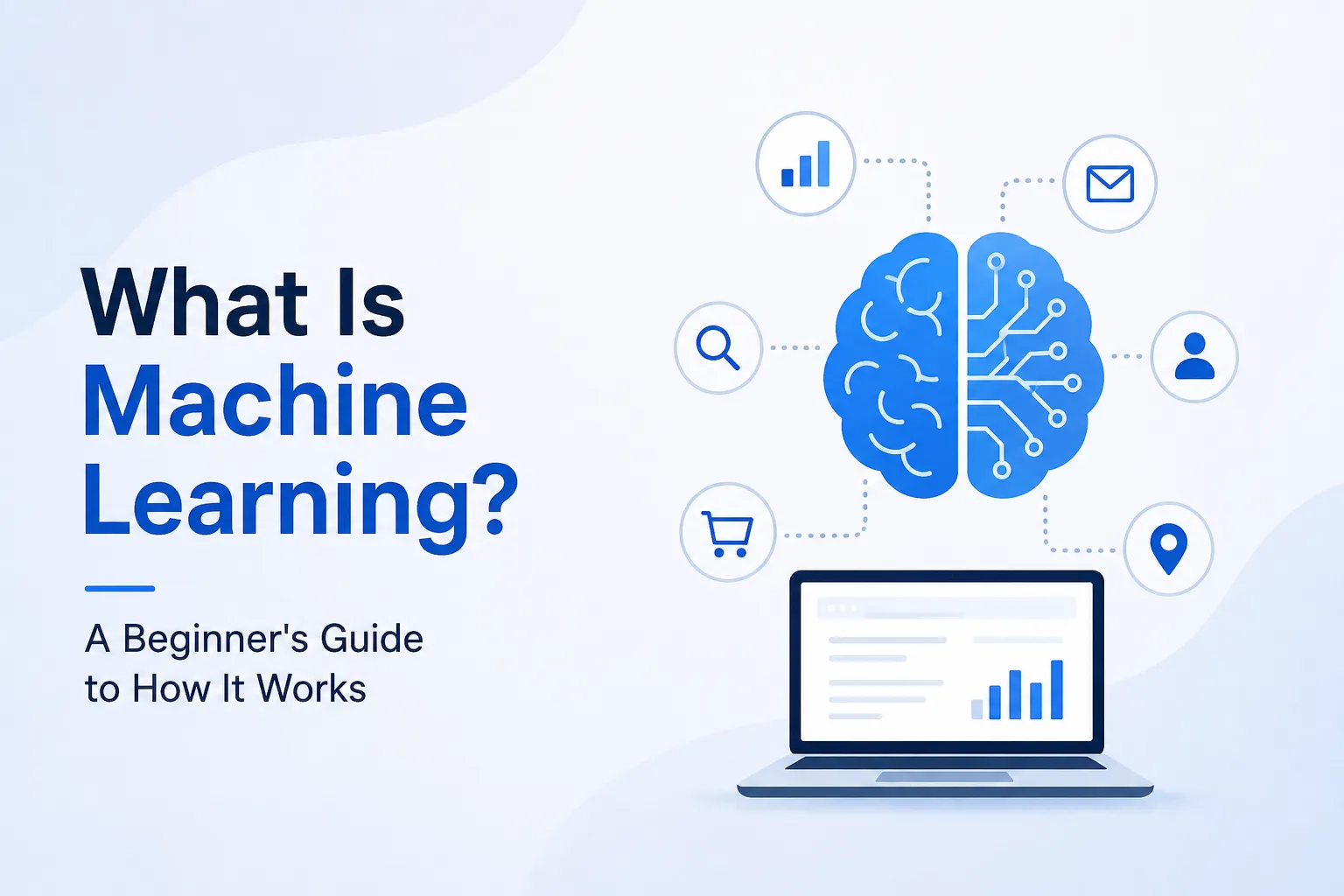
Machine Learning is a subset of Artificial Intelligence that enables computers to learn from data without being explicitly programmed.
Instead of following fixed instructions, machine learning models improve through experience.
Supervised Learning
The model learns from labeled data.
Example
An email system learns which emails are spam and which are not.
Unsupervised Learning
The model identifies patterns in unlabeled data.
Example
An online retailer groups customers based on purchasing behavior.
Reinforcement Learning
The model learns through rewards and penalties.
Example
A robot learns to navigate a room by receiving rewards for correct actions.
Everyday Machine Learning Examples
- Netflix recommendations
- Fraud detection
- Product suggestions
- Search engine rankings
What Is Generative AI?
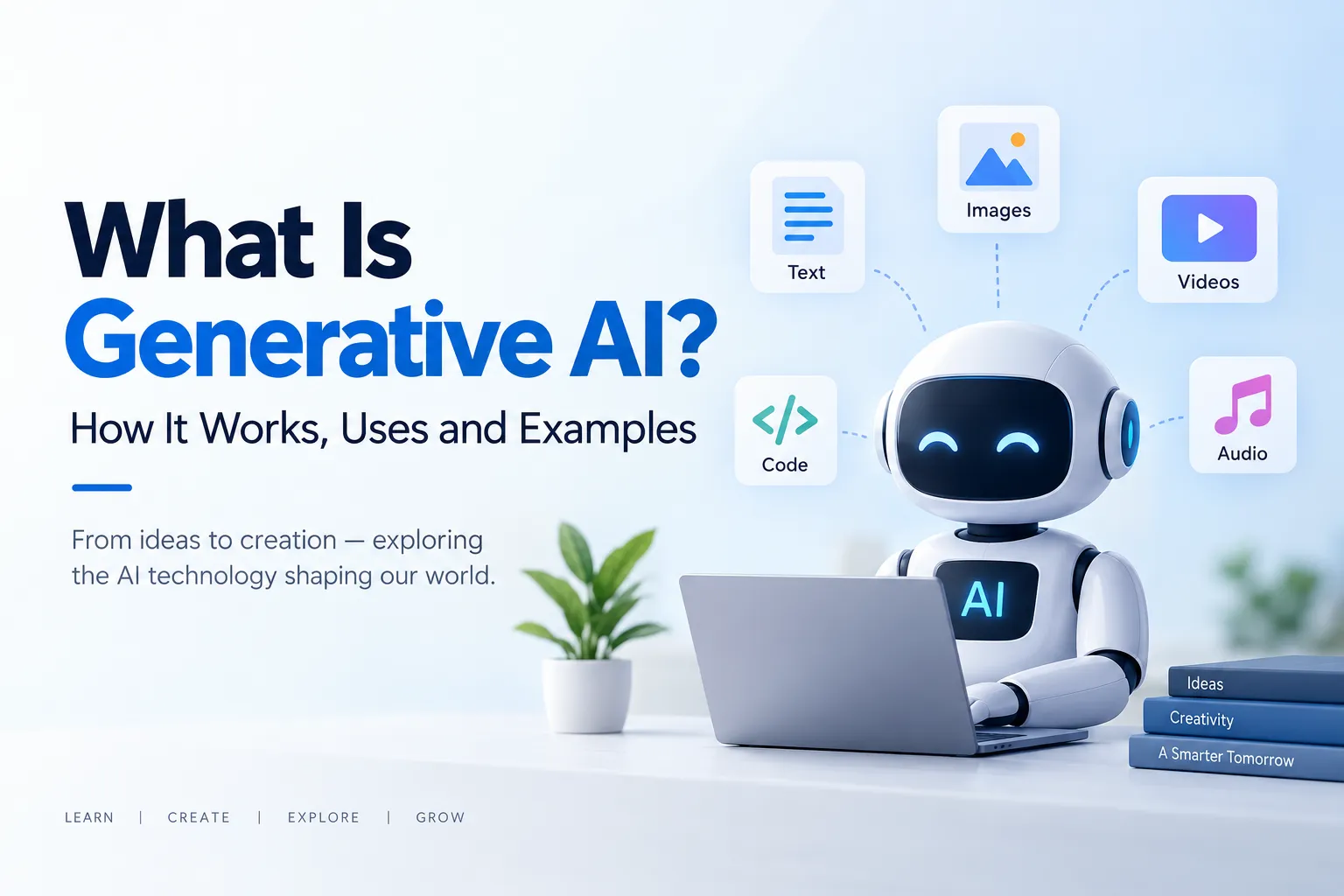
Generative AI is a category of Artificial Intelligence that creates new content such as text, images, videos, audio, and code.
Unlike traditional AI, which focuses on analysis, Generative AI focuses on creation.
Text Generation
AI can generate:
- Articles
- Emails
- Reports
- Marketing content
- Summaries
Example:
ChatGPT helps users create written content and answer questions.
Image Generation
AI can create original images from text descriptions.
Examples include:
- Marketing visuals
- Digital artwork
- Product mockups
Video Generation
Generative AI can create:
- Training videos
- Marketing videos
- Animated content
Practical Generative AI Use Cases
- Content creation
- Graphic design
- Coding assistance
- Customer support
- Education
Real-World Applications of AI
Artificial Intelligence is transforming industries worldwide.
| Industry | AI Use Cases |
| Healthcare | Disease diagnosis, medical imaging, drug discovery |
| Education | Personalized learning, AI tutors, automated grading |
| Finance | Fraud detection, risk analysis, algorithmic trading |
| Marketing | Customer targeting, content creation, analytics |
| Retail | Product recommendations, inventory management |
| Manufacturing | Predictive maintenance, quality control |
| Transportation | Route optimization, autonomous vehicles |
Why AI Applications Matter
AI applications help organizations:
- Improve efficiency
- Reduce costs
- Increase accuracy
- Enhance customer experiences
Benefits of Artificial Intelligence
AI offers numerous advantages across industries.
Automation
AI automates repetitive tasks.
Examples:
- Data entry
- Scheduling
- Customer support
Efficiency
AI processes information faster than humans.
Accuracy
AI can reduce human errors in many situations.
Personalization
AI customizes experiences for individual users.
Examples:
- Product recommendations
- Learning platforms
- Streaming services
Cost Reduction
Automation often lowers operational expenses and improves productivity.
Risks and Challenges of AI
While AI provides significant benefits, it also presents challenges.
Bias
AI can inherit biases from training data.
This may lead to unfair outcomes.
Privacy Concerns
AI systems often require large amounts of user data.
Protecting personal information is critical.
Security Risks
Cybercriminals may misuse AI technologies.
Examples:
- Deepfakes
- Automated attacks
- Fraud schemes
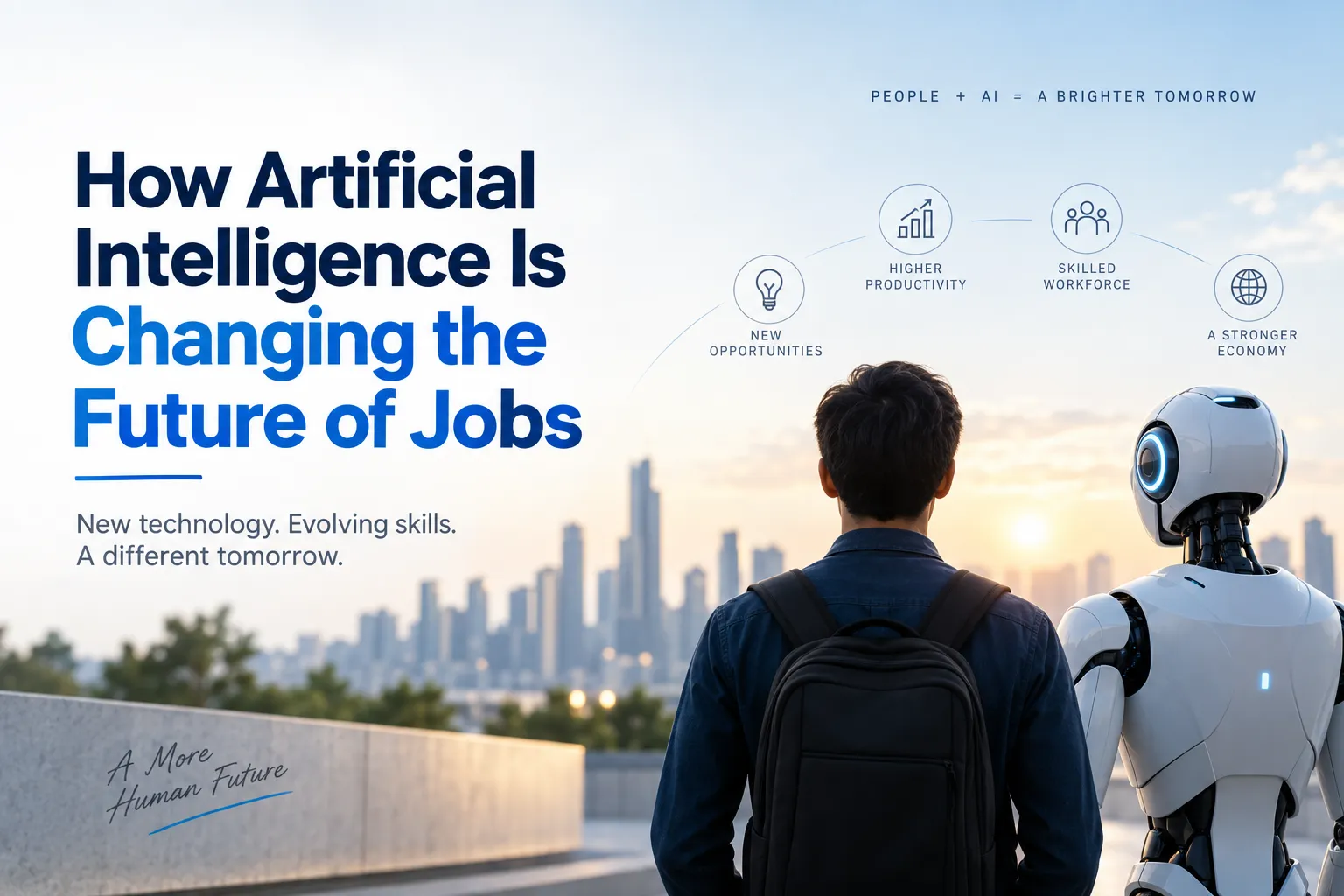
Job Displacement
Automation may replace certain repetitive jobs.
However, it may also create new roles and industries.
Ethical Concerns
Important questions include:
- Who is responsible for AI decisions?
- How should AI be regulated?
- What limits should exist?
AI vs Machine Learning vs Deep Learning
Many people use these terms interchangeably, but they are different.
| Feature | AI | Machine Learning | Deep Learning |
| Definition | Broad field of intelligent systems | Subset of AI that learns from data | Subset of ML using neural networks |
| Data Requirement | Moderate | High | Very High |
| Complexity | Broad | Medium | High |
| Human Intervention | More | Less | Minimal |
| Examples | Chatbots, robotics | Fraud detection | Image recognition, speech recognition |
Simple Relationship
Artificial Intelligence → Machine Learning → Deep Learning
Most Popular AI Tools in 2026
The AI ecosystem continues to grow rapidly.
ChatGPT
Use Cases:
- Writing assistance
- Research
- Learning
- Customer support
- Productivity
AI Image Generators
Use Cases:
- Graphic design
- Marketing materials
- Social media content
- Digital art
AI Coding Assistants
Use Cases:
- Code generation
- Bug fixing
- Documentation
- Programming assistance
AI Productivity Tools
Use Cases:
- Meeting summaries
- Task management
- Workflow automation
- Email drafting
Why These Tools Matter
AI tools help individuals and businesses save time while improving productivity and creativity.
The Future of Artificial Intelligence
The future of Artificial Intelligence is expected to impact nearly every aspect of life.
Workplace Impact
AI will automate routine tasks while increasing demand for advanced skills.
Education
AI-powered tutors and personalized learning systems will improve educational outcomes.
Healthcare
Doctors may use AI for faster diagnoses and treatment planning.
Business
Organizations will increasingly use AI for:
- Decision-making
- Customer service
- Process optimization
Everyday Life
AI may become deeply integrated into:
- Smart homes
- Transportation
- Shopping
- Entertainment
- Personal assistants
The future of Artificial Intelligence will likely focus on responsible innovation, safety, and human-AI collaboration.
Common Myths About AI
| Myth | Fact |
| AI can think exactly like humans | AI processes data but lacks human consciousness |
| AI will replace all jobs | AI changes jobs but also creates new opportunities |
| AI is always accurate | AI can make mistakes |
| AI is only for large companies | Small businesses use AI too |
| AI is science fiction | AI is already used daily |
| AI learns everything automatically | Quality data and training are essential |
Frequently Asked Questions
1. What is Artificial Intelligence?
Artificial Intelligence is technology that enables machines to perform tasks requiring human-like intelligence, such as learning, reasoning, and decision-making.
2. How is AI used today?
AI is used in healthcare, finance, education, marketing, transportation, customer service, and many consumer applications.
3. Is AI dangerous?
AI itself is not inherently dangerous, but misuse, bias, privacy issues, and security risks can create challenges.
4. Will AI replace jobs?
AI may automate certain jobs, especially repetitive tasks, but it is also expected to create new career opportunities.
5. What is the difference between AI and Machine Learning?
AI is the broader field, while Machine Learning is a subset of AI that learns from data.
6. Can beginners learn AI?
Yes. Many beginners start by learning AI fundamentals, basic programming, and Machine Learning concepts.
7. What industries use AI?
Healthcare, education, finance, retail, manufacturing, transportation, marketing, and many others.
8. What is Generative AI?
Generative AI creates new content such as text, images, videos, audio, and code based on patterns learned from data.
Key Takeaways
- Artificial Intelligence enables machines to perform intelligent tasks.
- AI is transforming industries across the world.
- Machine Learning is a subset of AI.
- Generative AI creates text, images, videos, and other content.
- AI improves efficiency, automation, and personalization.
- Risks include bias, privacy concerns, and ethical challenges.
- Understanding AI is becoming essential for modern careers.
- The future of Artificial Intelligence will impact nearly every industry.
Beginner AI Learning Roadmap
If you’re new to AI, follow this simple roadmap:
Step 1: Learn AI Fundamentals
Understand:
- What is AI
- Types of AI
- AI applications
Step 2: Learn Basic Mathematics
Focus on:
- Statistics
- Probability
- Linear algebra
Step 3: Learn Programming
Recommended language:
- Python
Step 4: Study Machine Learning
Learn:
- Supervised learning
- Unsupervised learning
- Reinforcement learning
Step 5: Explore Generative AI
Practice with:
- AI chatbots
- Image generators
- AI productivity tools
Step 6: Build Small Projects
Examples:
- Chatbots
- Recommendation systems
- Image classifiers
Recommended Skills for the AI Era
Technical Skills:
- AI fundamentals
- Data analysis
- Python programming
- Machine Learning
- Prompt engineering
Human Skills:
- Critical thinking
- Creativity
- Communication
- Problem-solving
- Adaptability
Conclusion
Artificial Intelligence is rapidly becoming one of the most important technologies of the 21st century. From healthcare and education to business and everyday life, AI is transforming how people work, learn, and solve problems.
While AI offers enormous opportunities through automation, efficiency, and innovation, it also raises important questions about ethics, privacy, and responsible use.
For beginners, the best way to start is by understanding the fundamentals of Artificial Intelligence, exploring Machine Learning and Generative AI, and practicing with modern AI tools. As AI continues to evolve, individuals who develop AI literacy and related skills will be better prepared for future opportunities.
The journey into AI may seem complex at first, but with consistent learning and hands-on practice, anyone can understand and benefit from the power of Artificial Intelligence.