Compound interest is one of the most useful concepts to understand in personal finance. It explains why money saved or invested for a long period can grow substantially—even when the starting amount is relatively modest.
The basic idea is simple: you earn interest on your original money, and then you can earn interest on the interest that has already accumulated. Over time, this creates a compounding effect.
Whether you are building savings, comparing financial products, or learning about long-term investing, understanding compound interest can help you make sense of how money grows. This guide explains what compound interest is, how it works, how to calculate it, and why factors such as time and compounding frequency matter.
What Is Compound Interest?
So, what is compound interest? Compound interest is interest calculated on both the original amount of money and the interest previously added to that amount.
This is different from simple interest. With simple interest, the calculation is based only on the original principal. With compound interest, accumulated interest becomes part of the balance used for future calculations.
For example, suppose you deposit $1,000 into an account earning 5% annually.
- After one year, you earn $50, giving you $1,050.
- In the second year, the 5% is calculated on $1,050 rather than just $1,000.
- That produces $52.50 in interest, bringing the balance to $1,102.50.
The additional $2.50 came from earning interest on the previous interest.
That may seem small at first, but repeating the process for many years can make the difference much more noticeable.
How Does Compound Interest Work?
Understanding how compound interest works becomes easier when you break it into a simple cycle:
- You start with a principal. This is the initial amount deposited, saved, or invested.
- Interest is earned. The account or financial product generates interest according to its applicable rate.
- The interest is added to the balance.
- Future interest is calculated on the larger balance.
- The cycle repeats.
Imagine you start with $2,000 at a hypothetical annual interest rate of 5%, compounded annually.
After Year 1:
$2,000 × 5% = $100 interest
New balance: $2,100
After Year 2:
$2,100 × 5% = $105 interest
New balance: $2,205
After Year 3:
$2,205 × 5% = $110.25 interest
New balance: $2,315.25
The amount of interest increases because the balance is increasing. This is the central idea behind compounding.
For a broader introduction to managing your money, see these Personal Finance Tips for Beginners.
Compound Interest Formula
The standard compound interest formula is:
A = P(1 + r/n)^(nt)
Here is what each part means:
- A = final amount
- P = principal, or starting amount
- r = annual interest rate expressed as a decimal
- n = number of compounding periods per year
- t = time in years
To find the actual compound interest earned, subtract the original principal from the final amount:
Compound Interest = A − P
Example Calculation
Suppose you deposit $5,000 at a hypothetical 5% annual interest rate, compounded monthly, for 5 years.
The values are:
- P = $5,000
- r = 0.05
- n = 12
- t = 5
So:
A = 5,000(1 + 0.05/12)^(12 × 5)
The resulting balance is approximately $6,416.79.
The compound interest earned is:
$6,416.79 − $5,000 = $1,416.79
This is a simplified hypothetical calculation. Actual savings products and investments can have different rates, fees, taxes, terms, and compounding methods.
Compound Interest Examples
Here are a few simple examples to show how compounding can affect money over time.
Example 1: A Small Starting Amount
Suppose $1,000 earns a hypothetical 4% annual rate, compounded monthly, for 10 years, with no additional contributions.
The balance would grow to approximately $1,490.83.
That means about $490.83 would come from accumulated interest.
Example 2: Growth Over Several Years
Suppose $3,000 earns a hypothetical 6% annual rate, compounded quarterly, for 8 years.
Using the compound interest formula, the balance would be approximately $4,830.97.
The example illustrates an important point: the longer compounding continues, the more opportunity accumulated interest has to generate additional interest.
Example 3: Why Time Matters
Consider two hypothetical savers who receive the same interest rate but keep their money invested for different periods. The person who leaves the money untouched for longer generally gives compounding more time to work.
These examples are purely hypothetical. Actual interest rates and investment returns vary, and investments can lose value as well as gain value.
If you are deciding whether money should be held as savings or allocated toward investments, understanding the Difference Between Saving and Investing can provide useful context.
How Compounding Frequency Affects Your Money
Compounding frequency describes how often interest is added to the balance.
Common schedules include:
- Annual compounding: Interest is added once a year.
- Semi-annual compounding: Interest is added twice a year.
- Quarterly compounding: Interest is added four times a year.
- Monthly compounding: Interest is added 12 times a year.
- Daily compounding: Interest is calculated or credited daily, depending on the product’s terms.
All else being equal, more frequent compounding can result in a somewhat higher final balance because interest is incorporated into the balance sooner.
However, the difference is not always dramatic. The interest rate, starting amount, additional contributions, fees, taxes, and length of time can also have major effects on the outcome.
Compound Interest vs Simple Interest
The easiest way to understand compound interest vs simple interest is to look at what happens to previously earned interest.
| Feature | Compound Interest | Simple Interest |
| Calculation method | Based on principal plus accumulated interest | Based only on the original principal |
| Interest on previous interest | Yes | No |
| Growth over time | Can accelerate as the balance increases | Remains more linear |
| Long-term potential | Generally greater when rates and conditions are otherwise comparable | Generally lower over long periods |
| Common use cases | Some savings products, deposits, and investment calculations | Certain loans and financial arrangements |
For example, $1,000 earning 5% simple interest for 10 years would produce $500 in interest, assuming no changes to the principal.
With monthly compounding at the same hypothetical 5% annual rate, the balance would be about $1,647.01 after 10 years. The difference comes from earning interest on previously accumulated interest.
Why Compound Interest Matters in Personal Finance
Compound interest matters because personal finance is often about what happens to money over time—not just what happens this month.
Several habits can support long-term financial growth:
- Saving regularly: Consistent contributions can give more money the opportunity to compound.
- Starting early: A longer time horizon gives compounding more time to operate.
- Reinvesting returns: When interest, dividends, or other applicable earnings are reinvested, they may become part of the amount that can generate future returns.
- Maintaining consistency: Regular saving or investing can be more practical than relying on occasional large contributions.
- Understanding your financial goals: Knowing whether money is intended for short-term needs or long-term goals can help you choose appropriate financial products.
A realistic monthly budget can also make consistent saving easier. See How to Create a Monthly Budget and Save Money for ideas on organizing income and expenses.
Compound interest can also appear in discussions about income-producing assets and other financial strategies. If you are exploring the broader topic, Best Passive Income Ideas for Beginners is another useful starting point.
How to Make Compound Interest Work for You
There is no guaranteed formula for financial success, but several general habits can help you take advantage of compounding where it applies:
- Start early when possible. Time is an important part of the compounding equation.
- Contribute consistently. Regular additions can increase the amount available to compounds.
- Reinvest earnings where appropriate. Check the terms of the financial product before assuming earnings are automatically reinvested.
- Avoid unnecessary withdrawals. Taking money out reduces the balance available for future compounding.
- Understand fees and taxes. They can reduce the amount that ultimately remains available to grow.
- Compare rates carefully. Look beyond the headline rate and understand how often interest compounds and what conditions apply.
- Think long term. Compounding is a process that generally becomes more noticeable over longer periods rather than overnight.
For investments, remember that compound growth is not the same as guaranteed growth. Market-based investments can fluctuate, and historical performance does not guarantee future results.
Conclusion
Compound interest is essentially the process of earning interest on your original money and on previously accumulated interest. The longer that process continues, the more significant the compounding effect can become.
The compound interest formula provides a straightforward way to estimate how a balance could change based on the principal, interest rate, compounding frequency, and time. Understanding the difference between compound and simple interest also makes it easier to evaluate basic financial calculations.
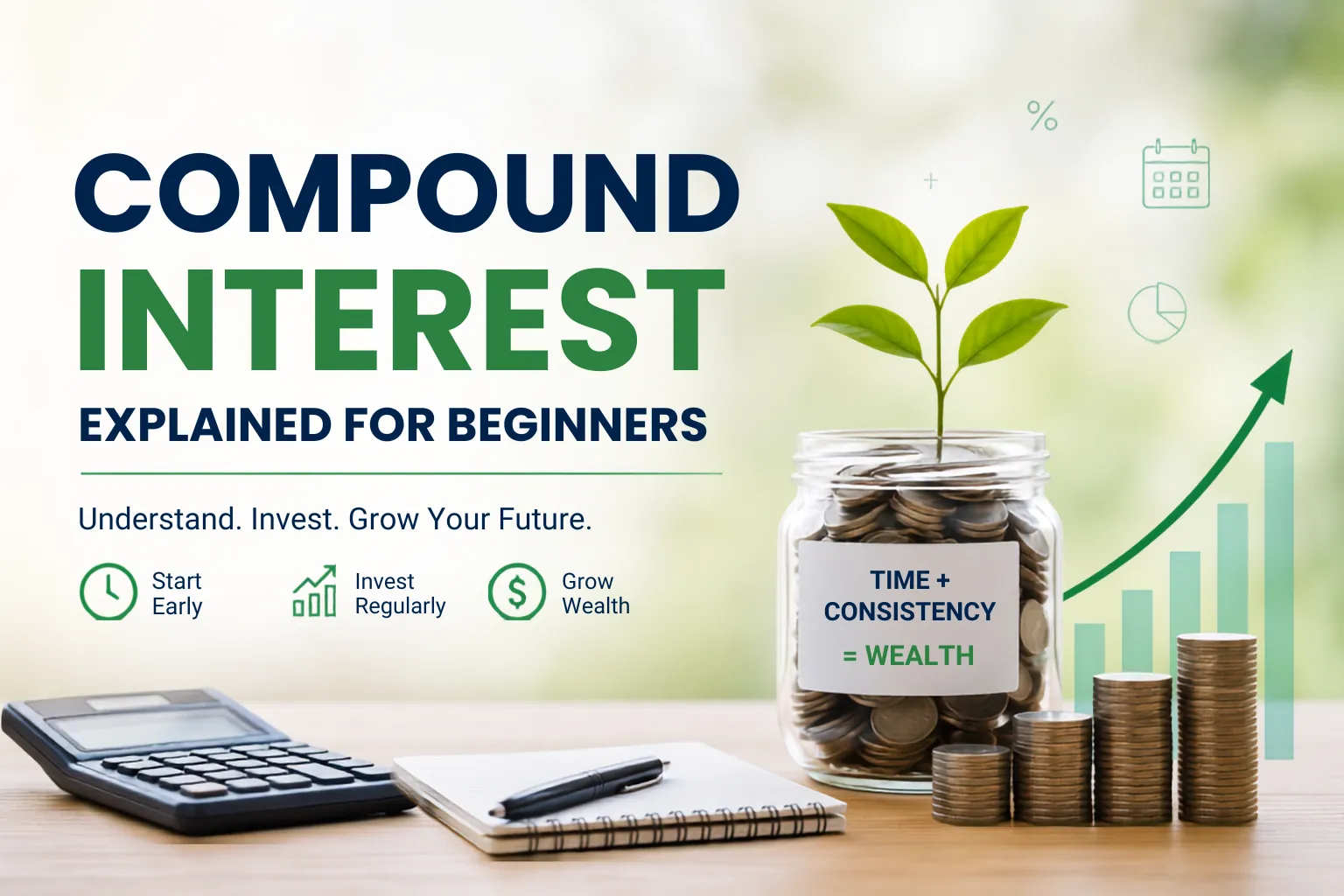
The biggest lesson is simple: time + consistency + compounding can make a significant difference to long-term financial growth. Learning how compound interest works is therefore an important part of building a strong foundation in personal finance.