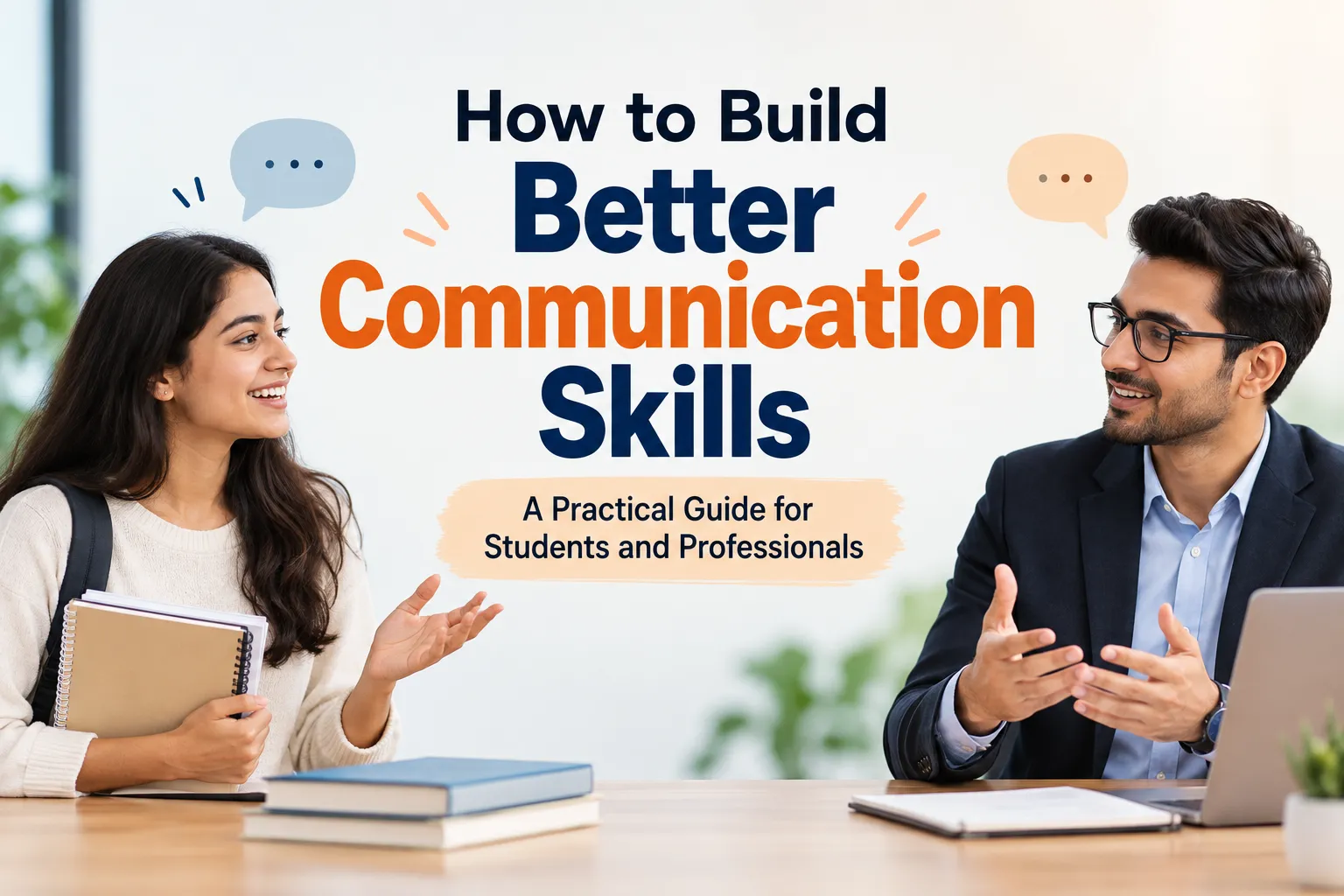
Good communication can make a difference in the classroom, workplace, and everyday relationships. A student may understand a topic perfectly but struggle to explain it during a presentation. A professional may have a valuable idea but find it difficult to communicate it clearly in a meeting.
These situations show that communication is about more than speaking correctly. It involves listening, choosing the right words, understanding body language, writing clearly, asking useful questions, and adapting your message to different people and situations.
The good news is that communication skills are learnable. With regular practice, students and professionals can become clearer, more confident, and more effective communicators.
What Are Communication Skills?
Communication skills are the abilities we use to exchange information, ideas, opinions, and feelings with other people.
The main types include:
- Verbal communication: Using spoken words clearly and appropriately.
- Nonverbal communication: Using facial expressions, posture, gestures, eye contact, and tone.
- Written communication: Communicating through emails, assignments, reports, applications, and messages.
- Listening skills: Paying attention, understanding meaning, and responding thoughtfully.
- Visual communication: Using charts, images, slides, diagrams, and other visual elements to explain information.
Strong communication combines these skills rather than relying on speaking alone.
Why Are Communication Skills Important?
Effective communication skills can help people:
- Perform better in classes and academic presentations
- Build confidence
- Develop stronger personal and professional relationships
- Work more effectively in teams
- Perform better in interviews
- Explain ideas during presentations and meetings
- Reduce misunderstandings
- Handle disagreements more constructively
- Develop leadership abilities
- Create opportunities for career growth
For students, communication can influence classroom participation, group projects, presentations, interviews, and conversations with teachers.
For professionals, communication affects meetings, emails, teamwork, client relationships, leadership, and everyday workplace communication.
How to Build Better Communication Skills
Practice Active Listening
Active listening means giving someone your full attention instead of simply waiting for your turn to speak.
Good active listening involves:
- Avoiding unnecessary interruptions
- Maintaining appropriate eye contact
- Paying attention to the speaker’s main point
- Asking relevant follow-up questions
- Summarizing or confirming what you understood
For example, if a classmate explains a problem with a group assignment, instead of immediately offering your own solution, you might say, “So the main issue is that we haven’t divided the research tasks yet. Is that right?”
That short response shows that you listened before responding.
Speak Clearly and Confidently
Before speaking, take a moment to organize your thoughts. Start with your main point, provide the necessary explanation, and finish with a clear conclusion.
To improve your speaking skills:
- Use simple, familiar language
- Speak at a comfortable pace
- Pause between important ideas
- Avoid excessive filler words such as “um,” “like,” or “you know”
- Match your tone to the situation
- Avoid rushing when you feel nervous
A short pause is usually more effective than filling every silence with unnecessary words.
Improve Your Vocabulary
You do not need to memorize hundreds of complicated words to communicate effectively. In fact, difficult vocabulary can sometimes make a message less clear.
Instead:
- Read regularly.
- Learn a few useful words each week.
- Notice how those words are used in context.
- Write sentences using them.
- Try using appropriate new words in everyday conversations.
Effective communication is about clarity, not complexity.
Improve Nonverbal Communication
Your body language can support your words—or sometimes contradict them.
Pay attention to:
- Facial expressions
- Posture
- Eye contact
- Hand gestures
- Tone of voice
- Personal space
For example, saying “I’m interested” while constantly looking at your phone sends a different message from maintaining attention and responding naturally.
The goal is not to control every movement. Instead, become aware of whether your nonverbal communication supports what you are saying.
Practice Public Speaking
Public speaking becomes easier when you practice gradually.
Try this progression:
- Speak for one minute in front of a mirror.
- Record yourself explaining a familiar topic.
- Participate in a small group discussion.
- Give a short presentation to friends or classmates.
- Volunteer to speak in larger settings.
Before speaking, take a few slow breaths and remind yourself of your main points. You do not need to memorize every sentence.
Improve Written Communication
Written communication matters in assignments, emails, reports, applications, and professional messages.
Before sending or submitting something, check:
- Is the main message obvious?
- Is the information organized logically?
- Are the sentences easy to understand?
- Is the grammar appropriate?
- Is the tone suitable for the reader?
- Have you proofread it?
For professional emails, a clear subject, short paragraphs, specific requests, and a polite closing can make the message easier to understand and act upon.
Ask Better Questions
Asking thoughtful questions is an important interpersonal skill. Good questions demonstrate attention and can prevent misunderstandings.
Instead of asking only yes-or-no questions, try open-ended questions such as:
- “Could you explain that in more detail?”
- “What do you think would be the best approach?”
- “Can you give me an example?”
Good questions can also help conversations become more productive.
Learn to Give and Receive Feedback
Constructive feedback should focus on behavior or the work itself rather than attacking the person.
Instead of saying, “Your presentation was confusing,” you could say, “The main points were useful, but adding headings to the slides could make the presentation easier to follow.”
Receiving feedback also requires practice. Listen carefully, ask for clarification when necessary, and consider what you can apply rather than becoming immediately defensive.
Communication Skills for Students
Students use communication skills every day—in classroom discussions, presentations, group projects, interviews, college applications, networking, and conversations with teachers.
A student who can explain an idea clearly and listen carefully can contribute more effectively to group work and discussions.
A 5-Step Daily Practice Routine for Students
- Read aloud for five minutes to improve pronunciation and speaking flow.
- Listen carefully during one conversation without interrupting.
- Explain one topic for two minutes without reading from notes.
- Write a short paragraph about something you learned.
- Review one communication habit and identify what you can improve tomorrow.
Small exercises are easier to maintain than occasional, intensive practice.
Communication Skills for Professionals
Communication skills for professionals extend beyond formal presentations. They appear in meetings, emails, client conversations, interviews, workplace discussions, and leadership situations.
For example, instead of saying during a meeting, “This project has a lot of problems,” a professional could say, “We have identified three issues that could affect the deadline. I’d like to discuss possible solutions for each.”
The second version is more specific and gives colleagues something actionable to discuss.
Strong workplace communication also means knowing when to speak, when to listen, when to ask questions, and when to put information in writing.
Simple Daily Communication Skills Practice Plan
| Day | Practice Activity | Time |
| Monday | Read aloud | 10 minutes |
| Tuesday | Active listening practice | 10 minutes |
| Wednesday | Record yourself speaking | 10 minutes |
| Thursday | Learn and use new vocabulary | 10 minutes |
| Friday | Practice a short presentation | 15 minutes |
| Saturday | Write a short paragraph/email | 15 minutes |
| Sunday | Review your progress | 10 minutes |
This routine is deliberately simple. Consistency matters more than completing long practice sessions.
How Long Does It Take to Improve Communication Skills?
There is no fixed timeline for improving communication. Progress depends on your starting point, the skills you are practicing, how frequently you practice, and the situations in which you use those skills.
You may notice changes in clarity or confidence as you practice, but lasting improvement generally requires continued use and reflection.
Consistency is more important than perfection.
Frequently Asked Questions
1. How can I improve my communication skills?
Practice active listening, speak clearly, write regularly, and communicate with confidence every day.
2. What are the most important communication skills?
Active listening, clear speaking, nonverbal communication, writing, and asking thoughtful questions are essential.
3. How can students improve communication skills?
Students can improve by participating in discussions, practicing presentations, reading, writing, and listening carefully.
4. Why are communication skills important for career success?
Strong communication helps professionals collaborate effectively, perform better in interviews, build relationships, and advance their careers.
5. Can communication skills be learned?
Yes, communication skills can be developed through consistent practice, feedback, and real-life experience.
Conclusion
Becoming a better communicator does not mean becoming a perfect speaker. It means learning to listen more carefully, express ideas more clearly, write more effectively, understand nonverbal signals, and adapt your communication to different situations.
For students, these skills can support academic performance, presentations, interviews, and relationships. For professionals, they can make everyday workplace communication more organized and productive.
The most effective approach is to start small. Choose one habit today—perhaps listening without interrupting, slowing down when you speak, or practicing a two-minute presentation—and repeat it regularly.
Better communication is built one conversation, presentation, email, and listening moment at a time.