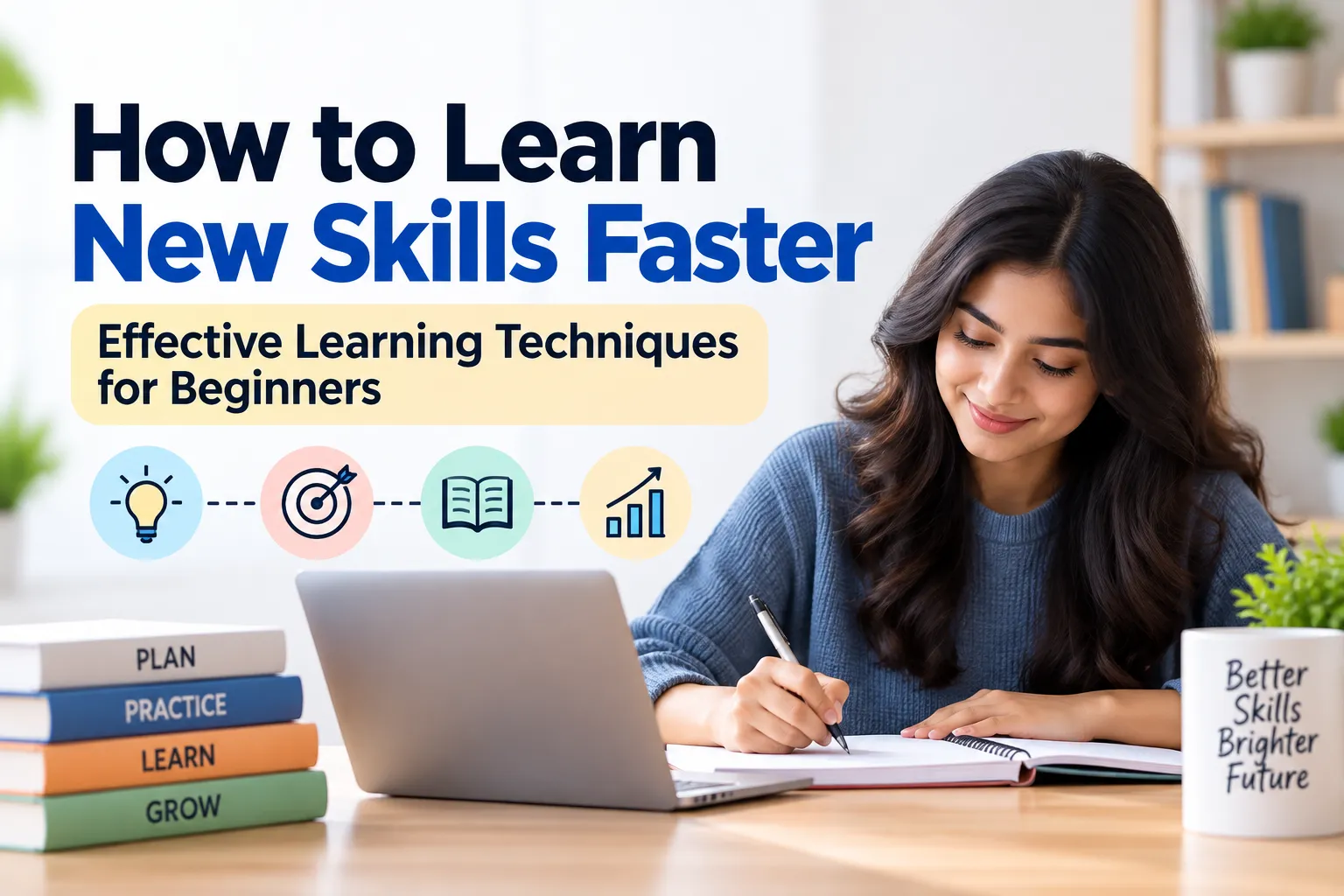
Learning new skills can open doors to better career opportunities, academic success, and personal growth. Whether you want to learn a language, improve your computer skills, master cooking, or explore a new hobby, the right approach can make the process easier and more productive.
However, many beginners struggle to stay focused, remember information, and turn knowledge into practical skills. Spending hours watching tutorials or rereading notes does not always lead to meaningful progress.
The good news is that you can improve your learning process with simple, research-informed strategies. Understanding how to learn new skills faster can help you use your time wisely, remember more information, and build skills through consistent practice.
Why Learning New Skills Efficiently Matters
Effective learning helps you make better use of your time and effort. Instead of repeatedly studying the same material, you can focus on understanding, remembering, and applying what you learn.
Here are some important benefits:
- Save time: Focused practice helps you spend less time on activities that offer little progress.
- Remember information longer: Regular review helps strengthen your memory.
- Build confidence: Small achievements encourage you to continue learning.
- Apply knowledge: Practical exercises help you use what you learn in real situations.
- Support lifelong learning: Effective learning habits help you adapt to changing personal and professional needs.
Learning efficiently does not mean rushing through everything. It means choosing strategies that help you make steady, meaningful progress.
7 Effective Learning Techniques for Beginners
1. Set Clear and Achievable Learning Goals
Before learning a new skill, decide what you want to achieve. Clear goals give your practice sessions direction and help you measure progress.
For example, instead of saying, “I want to improve my English,” set a specific goal: “I will learn 10 new English words every day and use five of them in sentences.”
You can make your goals more manageable by breaking a large objective into smaller tasks.
Try these steps:
- Identify the skill you want to develop.
- Decide what you want to accomplish first.
- Set a realistic deadline.
- Track your progress regularly.
Small, measurable goals make challenging skills feel more manageable and help you stay motivated.
2. Practice Active Learning
Active learning requires you to work with information rather than simply read or watch it.
For example, after watching a programming tutorial, close the video and write a small program yourself. After reading a chapter, explain its main ideas in your own words.
Useful active learning techniques include:
- Answering questions without looking at your notes.
- Solving practice problems.
- Summarizing information from memory.
- Asking questions about unfamiliar concepts.
- Teaching a topic to another person.
One particularly useful method is active recall. It involves retrieving information from memory instead of immediately checking the answer.
This process helps you identify knowledge gaps and gives you an opportunity to strengthen your understanding.
3. Use Spaced Repetition
Spaced repetition involves reviewing information across several sessions rather than studying everything at once.
When you revisit material after increasing intervals, you give yourself opportunities to retrieve and reinforce what you learned.
For example, if you learn new vocabulary on Monday, you might review it on Tuesday, Thursday, the following Monday, and again two weeks later.
A simple revision schedule could look like this:
- Day 1: Learn the material.
- Day 2: Review it from memory.
- Day 4: Test yourself again.
- Day 7: Complete another review.
- Day 14: Check how much you remember.
Adjust this schedule according to how difficult the material feels and how well you remember it.
Spaced repetition works particularly well for vocabulary, definitions, formulas, and factual information. For practical skills, combine it with hands-on practice.
4. Break Complex Skills into Smaller Steps
A difficult skill can feel overwhelming when you try to learn everything at once.
Breaking it into smaller tasks makes it easier to focus on one challenge at a time.
For example, a beginner learning web development could follow this sequence:
- Understand basic HTML.
- Learn common HTML elements.
- Practice CSS fundamentals.
- Build a simple webpage.
- Add basic JavaScript.
- Create a small project using the skills learned.
The same principle applies to writing, cooking, public speaking, and learning a musical instrument.
Focus on one manageable task, practice until you understand it reasonably well, and then move to the next step.
5. Practice Consistently
Regular practice helps you maintain momentum and identify areas that need improvement.
You do not always need long study sessions. A focused 20-minute session can be useful when you have a clear goal and actively practice the skill.
For example, you could spend 20 minutes each day learning a language, solving mathematics problems, or practicing keyboard shortcuts.
Build a routine that fits your schedule. Choose a consistent time, prepare your learning materials in advance, and set a realistic daily target.
Remember that consistency matters, but practice quality matters too. Repeating the same mistake without correcting it will not necessarily improve your performance.
6. Learn by Doing
Reading and watching demonstrations can introduce you to a skill, but practical experience helps you apply it.
If you want to improve your public speaking, practice delivering a short speech instead of only watching presentation videos.
If you want to learn cooking, prepare a simple recipe. And if you want to improve your computer skills, complete a real task using the software.
Hands-on practice allows you to discover problems, test ideas, and develop confidence.
Start with small projects that match your current ability. Increase the difficulty gradually as you become more comfortable.
7. Get Feedback and Learn from Mistakes
Mistakes provide useful information about what you need to improve.
Feedback from teachers, experienced learners, colleagues, or reliable assessment tools can help you identify weaknesses that you might overlook yourself.
For example, an English learner could record a short speech, review pronunciation, and ask a teacher to identify areas for improvement.
Use this simple process:
- Practice the skill.
- Identify what went wrong.
- Ask for specific feedback.
- Correct the problem.
- Repeat the exercise.
Avoid treating mistakes as proof that you cannot learn something. Instead, use them to adjust your approach and guide your next practice session.
Best Learning Techniques at a Glance
| Learning Technique | How It Helps | Beginner-Friendly Example |
| Active recall | Strengthens retrieval and reveals gaps | Answer questions without notes |
| Spaced repetition | Supports long-term retention | Review vocabulary across several days |
| Hands-on practice | Builds practical ability | Create a simple website |
| Breaking tasks into steps | Makes complex skills manageable | Learn coding concepts one at a time |
| Teaching others | Reveals gaps in understanding | Explain a topic to a friend |
You do not need to use every technique in every session. Choose the methods that suit your goal and combine them when useful.
How to Create a Daily Learning Routine
A simple routine can help beginners turn learning into a sustainable habit.
Follow these steps:
- Choose one skill: Focus on a single priority instead of dividing your attention among too many goals.
- Schedule 20–30 minutes: Pick a realistic time that you can maintain consistently.
- Remove distractions: Silence unnecessary notifications and prepare your materials.
- Review previous lessons: Spend a few minutes recalling what you learned earlier.
- Track progress: Record completed tasks, mistakes, and areas that need more practice.
- Take breaks when needed: Rest when your concentration drops, and maintain healthy sleep habits.
Here is an example of a 30-minute learning session:
| Time | Activity |
| 5 minutes | Review previously learned material |
| 15 minutes | Practice a new concept or skill |
| 5 minutes | Test yourself without notes |
| 5 minutes | Review mistakes and plan the next session |
Adjust the schedule to suit your learning goal. A complex practical task may need a longer session, while a vocabulary review may require less time.
Common Learning Mistakes to Avoid
Even motivated learners can slow their progress by using ineffective habits.
- Learning too many skills at once: Choose one main priority and add other goals when your routine becomes manageable.
- Studying without a clear goal: Decide what you want to understand or accomplish before each session.
- Watching tutorials without practicing: Apply each important lesson through an exercise or small project.
- Expecting instant results: Set realistic expectations and measure progress over time.
- Ignoring feedback: Review your mistakes and change your approach when necessary.
- Sacrificing sleep to study longer: Protect your sleep because it supports memory, attention, and learning.
The goal is not to study every available minute. The goal is to make each learning session useful.
Frequently Asked Questions
1. What is the fastest way to learn a new skill?
Set a clear goal, break the skill into manageable steps, practice actively, test yourself, and seek feedback. Combine hands-on practice with regular review to improve your progress.
2. How many minutes should beginners practice daily?
Beginners can start with 20–30 minutes of focused practice each day. Adjust the duration according to your schedule, energy, and the difficulty of the skill.
3. Is active learning better than passive learning?
Active learning often improves retention and understanding because it requires you to retrieve, apply, or explain information. Passive activities, such as reading and watching demonstrations, can still help when you combine them with practice.
4. How can I remember what I learn for longer?
Use active recall and spaced repetition. Test yourself without notes, review difficult material across several days, and apply your knowledge through exercises or real-life tasks.
5. Can I learn a new skill in 30 minutes a day?
Yes, you can make meaningful progress with 30 minutes of focused daily practice. However, the time you need to reach a particular level depends on the skill, its difficulty, your starting point, and the quality of your practice.
Conclusion
Understanding how to learn new skills faster starts with using your time more effectively, not simply spending more hours studying.
Set a clear goal, break it into smaller steps, practice actively, and revisit important information regularly. Combine these habits with hands-on exercises and constructive feedback to improve your understanding and performance.
You do not need to master everything in one day. Choose one skill, begin with a manageable task, and build a routine you can maintain.
Every focused practice session gives you another opportunity to improve. Start small, stay consistent, and let your progress grow over time.