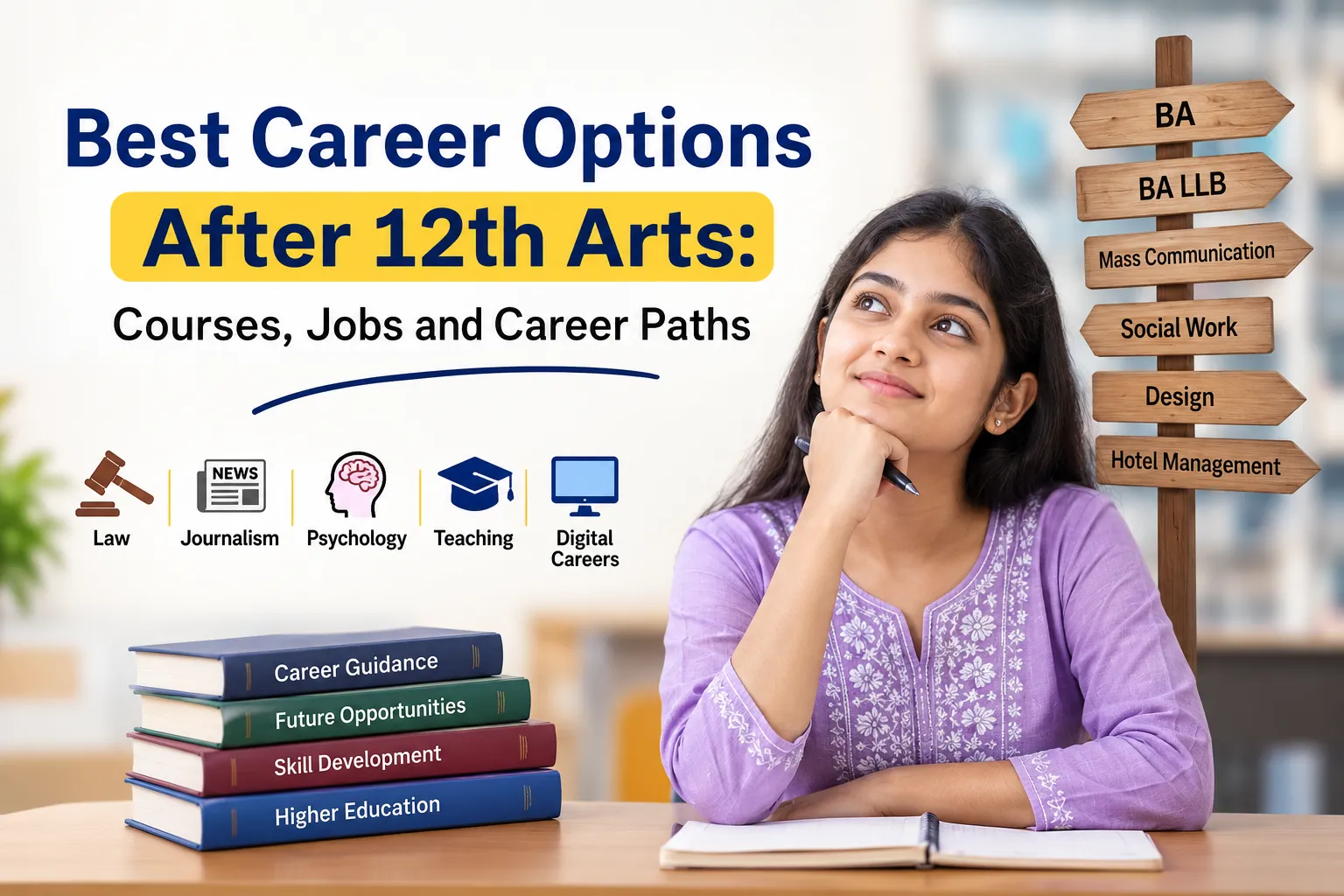
Choosing a career after Class 12 can feel confusing, especially when you have studied Arts or Humanities. With so many courses, entrance exams, colleges and career paths available, it is natural to wonder what to do after 12th Arts.
The good news is that Arts offers much more than a limited set of traditional careers. Students can explore law, psychology, journalism, teaching, design, management, social work, hospitality, digital careers and government examinations, among many other options.
The right choice depends on your interests, strengths, academic goals, financial situation and the kind of work you want to do in the future.
What Can You Do After 12th Arts?
After 12th Arts, students can pursue bachelor’s degrees, professional courses, skill-based programmes and competitive-exam pathways. Popular options include:
- BA in subjects such as English, History, Political Science, Psychology or Economics
- Integrated law courses such as BA LLB
- Journalism and mass communication
- Psychology
- Social work
- Teaching and education
- Design and creative careers
- Hotel management and hospitality
- Digital marketing and other digital careers
- Government and competitive examinations
There is no single “best” option for every Arts student. The ideal career path is one that matches your abilities and long-term goals.
Best Career Options After 12th Arts
Bachelor of Arts (BA)
A BA remains one of the most flexible courses after 12th Arts. Students can choose subjects such as English, Political Science, History, Sociology, Psychology, Economics and Geography, depending on the college and eligibility requirements.
After graduation, career paths may include education, content and communications, research, administration, media, social-sector work and competitive examinations. A BA can also serve as a foundation for postgraduate study or professional qualifications.
Law
Law is a popular career path for Humanities students. Students can explore integrated programmes such as BA LLB after Class 12, subject to the eligibility and admission requirements of the institution or entrance examination.
Career opportunities can include legal practice, corporate legal work, legal research, compliance and related areas. Students should always check the latest admission and professional requirements before applying.
Journalism and Mass Communication
If you enjoy writing, current affairs, storytelling and communication, journalism and mass communication can be worth considering.
Career options include:
- Journalism
- Digital media
- Content creation
- Public relations
- Advertising
- Broadcasting
- Corporate communications
Internships, strong writing skills and familiarity with digital publishing tools can make a significant difference when starting a career in this field.
Psychology
Psychology is another attractive option for students interested in human behaviour, education and mental processes. Undergraduate psychology programmes can lead towards careers in HR, research, education and other people-focused fields.
However, students should understand that certain professional psychology and counselling roles require postgraduate qualifications, supervised training or other requirements. An undergraduate degree alone does not automatically qualify someone for every psychology-related profession.
Social Work
A Bachelor of Social Work (BSW) can suit students who want to work in community development and social services.
Graduates may find opportunities with NGOs, development organisations, community programmes and social-sector projects. Higher studies can further expand opportunities in specialised areas of social work and development.
Teaching and Education
Teaching can be a rewarding career for students who enjoy explaining concepts and working with learners. Students may begin with a relevant bachelor’s degree and then pursue the teacher-training qualifications or examinations applicable to their intended teaching level.
Eligibility requirements can differ by role, institution and state, so check current official rules before choosing a programme.
Design and Creative Careers
Arts students with creative interests can explore:
- Graphic design
- UI/UX design
- Fashion design
- Interior design
- Animation
- Photography
In creative careers, a strong portfolio can be as important as formal qualifications for demonstrating practical ability. Learning industry-standard tools and building real projects can improve employability.
Hotel Management and Hospitality
Hospitality can be a good choice for students who enjoy communication, customer service and fast-paced work environments.
Career areas include hotels, tourism, events, food and beverage services, travel-related businesses and customer experience. Practical training and internships are particularly useful in this sector.
Government Jobs and Competitive Exams
Arts students can explore government and competitive examination pathways where they meet the applicable eligibility criteria. Depending on the examination, opportunities may include SSC-related recruitment, state government examinations, defence-related opportunities and other competitive examinations.
Because eligibility, age limits and examination patterns can change, always refer to the latest official notification before applying.
Best Courses After 12th Arts
| Course | Typical Duration | Suitable For | Career Opportunities |
| BA | 3–4 years, depending on programme | Students interested in humanities and social sciences | Education, research, media, administration, higher studies |
| BA LLB | Typically 5 years | Students interested in law | Legal practice, corporate law, legal research |
| Journalism & Mass Communication | Typically 3–4 years | Students interested in media and communication | Journalism, PR, advertising, digital media |
| Psychology | Typically 3–4 years | Students interested in human behaviour | HR, research, education, further specialised study |
| BSW | Typically 3–4 years | Students interested in social development | NGOs, community development, social services |
| Design | Typically 3–4 years | Creative and visually oriented students | UI/UX, graphic, fashion, interior and related fields |
| Hotel Management | Typically 3–4 years | Students interested in hospitality | Hotels, tourism, events, food and beverage |
| BBA* | Typically 3–4 years | Students interested in business and management | Management, sales, marketing, operations |
*Eligibility varies by institution and programme.
High-Salary Career Options After 12th Arts
Some Arts-related career paths can offer strong earning potential, but salary should not be the only reason for choosing a profession. Income depends on qualifications, skills, experience, specialisation, employer, industry and location.
Potentially strong career paths include:
- Law
- Digital marketing
- UI/UX design
- Media and corporate communications
- Management
- Specialised psychology careers after the required higher education
Rather than searching only for the “highest salary,” consider whether the career has good long-term growth and matches your abilities.
Skills Arts Students Should Develop
A degree is only one part of career preparation. Arts students should also develop practical skills such as:
- Communication
- English proficiency
- Writing
- Research
- Digital literacy
- Critical thinking
- Public speaking
- Basic technology skills
- Problem-solving
- Time management
For students planning their long-term careers, developing practical and future-ready skills is equally important.
Read our guide: Top In-Demand Skills Every Student Should Learn for Future Careers.
How to Choose the Right Career After 12th Arts
Use this simple framework before selecting a course:
- Identify your interests: Think about subjects and activities you genuinely enjoy.
- Understand your strengths: Consider communication, creativity, analysis, leadership or people skills.
- Research courses: Compare the curriculum, duration and admission process.
- Check eligibility: Requirements can vary between colleges and programmes.
- Compare college quality: Look at faculty, curriculum, facilities, internships and overall reputation.
- Consider affordability: Compare tuition, accommodation and other expenses.
- Research career opportunities: Understand what graduates actually do after the course.
- Check higher-study requirements: Some professions require postgraduate education or additional training.
- Seek practical exposure: Internships, projects and portfolios can help you understand a career before committing.
- Take informed guidance: Speak with teachers, career counsellors and professionals where possible.
Arts vs Other Streams: Which Is Better?
There is no universally “best” stream. Science, Commerce and Arts can all lead to successful careers, but they suit different interests and academic strengths.
Arts generally provide strong exposure to humanities, social sciences, languages, communication and society. Science may be more suitable for students interested in scientific, technical or healthcare pathways, while Commerce often aligns with business, finance, accounting and economics-related interests.
If you are also comparing different academic streams, explore our guide to the Best Career Options After 12th Science: Complete Career Guide for a broader comparison.
Students considering Commerce can also explore our Best Career Options After 12th Commerce guide to compare courses and career paths before making a decision.
Common Mistakes Arts Students Should Avoid
Avoid these common mistakes when planning your career:
- Choosing a course because friends chose it
- Selecting a career only because it appears to pay well
- Ignoring eligibility requirements
- Not researching colleges
- Assuming Arts has limited scope
- Ignoring practical and digital skills
- Following career trends blindly
- Overlooking higher-education or professional requirements
A little research before admission can prevent major problems later.
Frequently Asked Questions
1. Which is the best career after 12th Arts?
There is no single best career. Law, psychology, journalism, teaching, design, management, social work, hospitality and government-related pathways can all be suitable depending on a student’s interests, strengths and qualifications.
2. Which course is best after 12th Arts?
BA, BA LLB, journalism and mass communication, psychology, BSW, design, hotel management and BBA where eligible are among the options. The best course depends on your intended career.
3. Can Arts students get government jobs?
Yes. Arts students can pursue government and competitive examinations where they satisfy the eligibility requirements. Always check the latest official notification.
4. Can I do law after 12th Arts?
Yes. Students can explore integrated law programmes such as BA LLB, subject to the relevant institution’s admission and eligibility requirements.
5. Can Arts students get high-paying jobs?
Yes, some Arts-related career paths can offer strong earning potential. However, income depends on qualifications, skills, experience, specialisation and the employer.
6. Is BA a good option after 12th Arts?
Yes. BA is a flexible option that can support careers in areas such as education, media, administration, research and social sciences, as well as further studies.
Quick Career Comparison
| Career Path | Main Qualification | Key Skills | Career Potential |
| Law | Integrated law degree / relevant qualifications | Research, communication, reasoning | Legal and corporate opportunities |
| Psychology | Psychology degree; further study for specialised roles | Empathy, research, analysis | HR, research, education and specialised fields |
| Journalism | Journalism/media qualification | Writing, communication, digital skills | Media, PR, content and communications |
| Design | Design qualification or relevant training | Creativity, software, portfolio building | UI/UX, graphic, fashion and related fields |
| Social Work | BSW / relevant qualifications | Communication, empathy, community skills | NGOs, development and social services |
| Hospitality | Hotel management / hospitality qualification | Customer service, communication | Hotels, tourism and events |
| Management | BBA or relevant degree | Leadership, communication, business skills | Sales, marketing, operations and management |
Key Takeaways
- Arts offers diverse career options beyond traditional humanities careers.
- BA is one of the most flexible courses after 12th Arts.
- Law, psychology, media, design, teaching and hospitality are popular pathways.
- Government examinations can be explored subject to current eligibility.
- Some professional careers require postgraduate study or additional training.
- Practical skills and internships can improve career readiness.
- Do not choose a course solely because of salary or social pressure.
- Research eligibility, college quality, costs and career prospects before enrolling.
Conclusion
Choosing a career after 12th Arts is not about finding one course that is considered “best” by everyone. It is about finding the right match between your interests, strengths, qualifications and long-term goals.
Arts students have multiple academic and professional pathways, from BA and law to psychology, media, design, hospitality, social work and competitive examinations. The strongest career plans combine relevant qualifications with practical skills and real-world exposure.
Take time to research your options, compare courses and understand what each career requires. A thoughtful decision now can give you a much clearer career path after Class 12.