
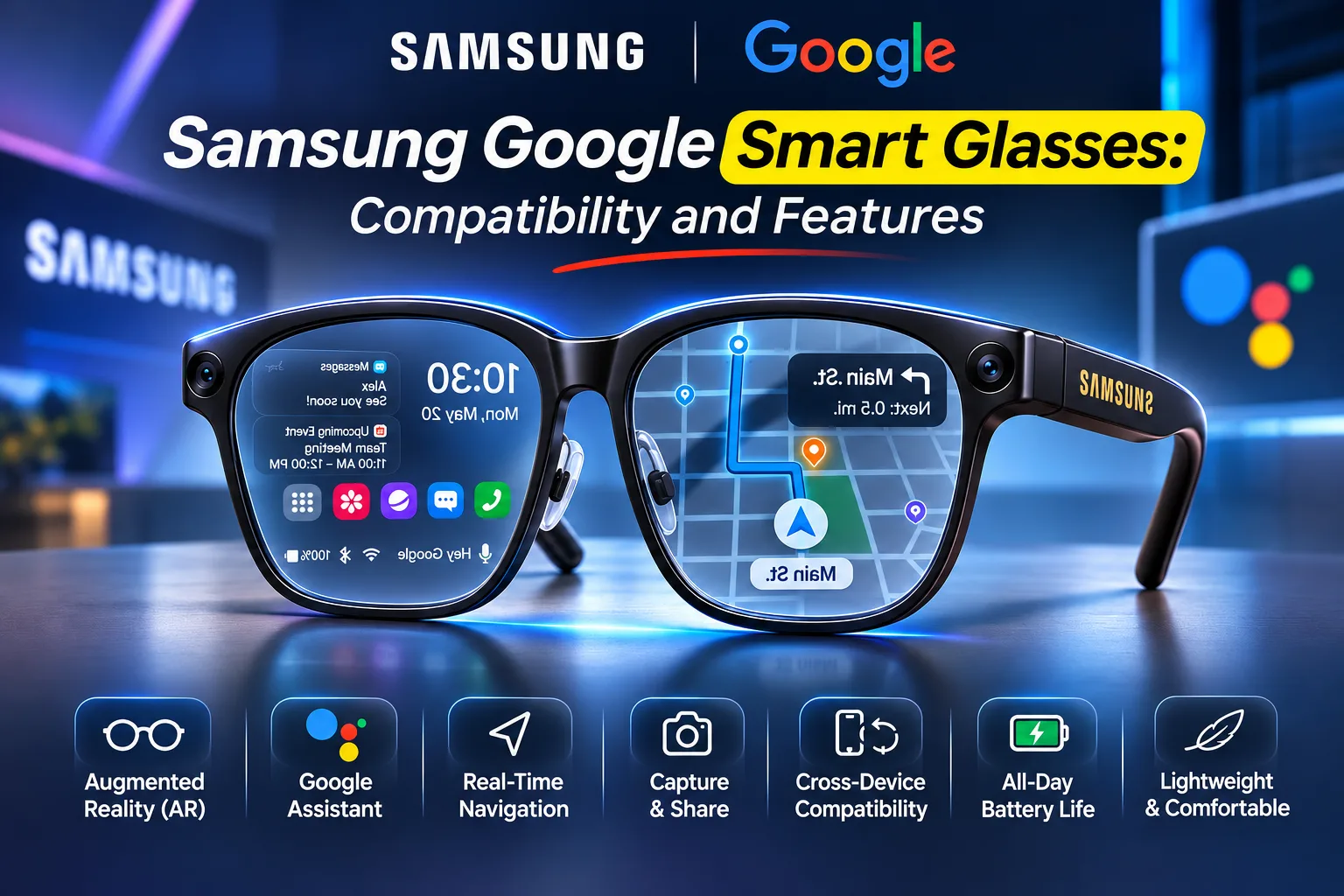
The future of wearable technology is becoming more interesting as Samsung and Google introduce their new AI-powered smart glasses. Designed to combine everyday eyewear with artificial intelligence, the new Intelligent Eyewear collection aims to change how people interact with technology, access information and communicate with the world around them.
Developed through a collaboration between Samsung, Google, Gentle Monster and Warby Parker, the smart glasses bring Google’s Gemini AI assistant directly into wearable eyewear. Instead of taking out a smartphone to search for information, translate conversations or get directions, users can interact with Gemini through voice commands and built-in controls.
However, the announcement has also created an unexpected discussion among Android users. Despite being developed by two of the biggest companies in the Android ecosystem, the new Samsung and Google smart glasses will initially support only selected Samsung Galaxy and Google Pixel smartphones, along with certain iPhone models.
Popular Android brands such as Motorola, OnePlus, Xiaomi, OPPO and HONOR are missing from the initial compatibility list. This means that owning an Android smartphone does not automatically guarantee access to the new intelligent eyewear experience.
The first collection is scheduled to become available on December 10, 2026, in the United States and South Korea. Pre-orders began on November 12, with prices starting at $395.
Let’s explore the new Samsung and Google smart glasses, their features, supported smartphones, pricing, launch details and what their limited compatibility means for Android users.
What Are Samsung and Google Intelligent Eyewear?
Samsung and Google’s Intelligent Eyewear is a new generation of smart glasses designed to bring artificial intelligence into everyday activities.
Unlike traditional glasses, these devices combine cameras, microphones, speakers, wireless connectivity and AI-powered software inside a wearable frame.
The glasses are developed using Google’s Android XR platform and integrate Gemini, Google’s artificial intelligence assistant.
Users can interact with Gemini without constantly checking their smartphones. They can ask questions about objects, understand unfamiliar surroundings, translate conversations, receive navigation instructions and manage selected everyday activities.
For example, imagine travelling to a new city and coming across an unfamiliar building. Instead of searching for its name on your smartphone, you can use the glasses to ask Gemini what you are looking at.
Similarly, if you are visiting a restaurant in another country, you may be able to use the camera and AI capabilities to understand a menu or translate information.
The collection is being developed in collaboration with eyewear brands Gentle Monster and Warby Parker. These companies are responsible for the design and styling of the frames, while Samsung and Google provide the technology and software ecosystem.
The approach combines fashion with technology, making the glasses look more like everyday eyewear rather than traditional electronic gadgets.
Why Are Samsung and Google Smart Glasses Creating So Much Attention?
The launch is important because it represents another step towards making artificial intelligence a part of everyday life.
Until now, most people have interacted with AI through smartphones, computers, websites and dedicated applications.
Smart glasses introduce a different way of accessing these technologies.
Instead of opening an application, typing a question and waiting for an answer, users can communicate with an AI assistant through voice commands while continuing their daily activities.
The integration of Gemini also gives the glasses an understanding of visual surroundings.
This means that the AI assistant can respond to questions based on what the user is seeing through the camera, subject to supported features, permissions and regional availability.
The partnership is also interesting because it brings together four different areas of expertise:
- Samsung contributes hardware engineering and mobile technology.
- Google provides Gemini AI and the Android XR platform.
- Gentle Monster brings contemporary eyewear designs.
- Warby Parker contributes optical eyewear designs and prescription options.
This combination could help smart glasses move beyond the technology enthusiast market and become a more mainstream wearable product.
Samsung and Google Smart Glasses Phone Compatibility: Which Smartphones Are Supported?
One of the biggest talking points surrounding the launch is smartphone compatibility.
The new Intelligent Eyewear collection does not support every Android smartphone. Instead, Google and Samsung have introduced a restricted list of compatible devices for the initial release.
According to the published compatibility information, supported smartphones include selected Samsung Galaxy devices, Google Pixel 7 series and newer models, and compatible Apple iPhones.
Samsung Galaxy Smartphones
Samsung Galaxy smartphones are among the primary devices supported by the new smart glasses.
The supported categories include:
- Samsung Galaxy S23 series and newer supported S-series models.
- Samsung Galaxy S FE series supported by the compatibility requirements.
- Samsung Galaxy Z Fold 5 and newer supported models.
- Samsung Galaxy Z Flip 5 and newer supported models.
- Supported Galaxy Z Fold Ultra models.
Samsung smartphones must run One UI 9.0 or later to meet the announced compatibility requirements.
This software requirement is important because having a compatible Galaxy smartphone does not automatically guarantee access if the device is running an older software version.
Interestingly, Samsung Galaxy A-series smartphones are not included in the initial compatibility list.
This may disappoint users who own popular mid-range Samsung devices and expected the company’s own smart glasses to work across a wider range of its smartphone portfolio.
Google Pixel Smartphones
Google Pixel users also receive support from the beginning.
The announced compatibility list includes the Google Pixel 7 series and newer devices.
However, compatible Pixel smartphones must also meet the specified software requirement, including the September 2026 Android 17 update or later.
This gives Google Pixel users access to the Gemini-powered wearable experience while maintaining a controlled list of supported hardware and software configurations.
Apple iPhone Compatibility
Perhaps the most surprising part of the announcement is that Samsung and Google’s smart glasses will also support Apple iPhones.
According to Samsung’s published specifications, supported iPhones include the iPhone 13 series and newer models, with a minimum of 6GB RAM and iOS 26.6 or later.
However, iPhone users will not receive the complete feature experience available through Android-connected devices.
Certain advanced features, including Guided Vision, Aira visual assistance, Audible integration and some application interactions, are initially restricted to Android-connected glasses.
This means iPhone compatibility provides access to the product without necessarily delivering feature parity.
Which Android Smartphones Are Not Supported?
The limited compatibility list has created confusion among Android smartphone users.
Many people assume that Android applications and connected accessories should work across different Android manufacturers. However, Samsung and Google’s initial smart glasses launch follows a more restricted approach.
Popular smartphone brands missing from the officially announced launch compatibility list include:
- Motorola
- OnePlus
- Xiaomi
- OPPO
- HONOR
- Realme
- Vivo
- Nothing
This does not necessarily mean these brands will never support the glasses.
Google and Samsung have indicated that they plan to share more information about expanding smartphone compatibility in 2027 and beyond.
However, no confirmed expansion schedule or additional manufacturer list has been announced.
For now, users with unsupported Android smartphones should not assume that installing the companion application or updating their operating system will make the glasses fully compatible.
Hardware, software integration, device permissions and manufacturer support may all play a role in determining compatibility.
Samsung and Google Smart Glasses Compatibility List
The following table summarises the announced compatibility requirements.
| Smartphone brand | Supported devices | Requirement |
|---|---|---|
| Samsung | Galaxy S, S FE, Z Fold and Z Flip supported models | One UI 9.0 or later |
| Pixel 7 series and newer | Android 17 September 2026 update or later | |
| Apple | iPhone 13 series and newer | Minimum 6GB RAM and iOS 26.6 or later |
| Motorola | Not officially listed | Support not announced |
| OnePlus | Not officially listed | Support not announced |
| Xiaomi | Not officially listed | Support not announced |
| OPPO | Not officially listed | Support not announced |
| HONOR | Not officially listed | Support not announced |
The compatibility requirements may change as Samsung and Google expand the product to additional markets and devices.
What Can Samsung and Google Smart Glasses Do?
The biggest attraction of the new intelligent eyewear is its integration with Gemini AI.
The glasses are designed to help users access information, communicate and complete everyday tasks without constantly interacting with a smartphone screen.
Here are some of the most important features.
Gemini AI Assistant
Gemini is the central intelligence behind the new smart glasses.
Users can activate the assistant through voice commands or by interacting with the frame.
They can ask questions, request information and have conversations while keeping their smartphones in their pockets.
For example, someone looking at a landmark can ask Gemini about its history, while a shopper can request information about an object they are considering purchasing.
The assistant is designed to understand visual context and provide responses based on the user’s surroundings.
This makes the glasses more than a simple audio accessory.
Camera for Photos and Videos
The glasses include a 12-megapixel HDR camera that allows users to capture photographs and record videos.
The camera can also provide visual information to Gemini, allowing the assistant to understand objects and surroundings.
This could be useful for travellers, content creators and people who want to capture moments without holding a smartphone.
Samsung has also included a recording indicator to inform people nearby when photographs or videos are being captured.
The camera system supports high-resolution photography and video recording, with supported video modes including 3K at 30 frames per second and 2K recording.
Hands-Free Navigation With Google Maps
Navigation is another important feature.
Users can receive turn-by-turn directions through Google Maps, with instructions delivered through the built-in speakers.
This can make walking through unfamiliar locations more convenient.
For example, someone exploring a new city could receive directions while looking at the surrounding streets instead of repeatedly checking a smartphone.
The experience is particularly relevant for travellers who need navigation assistance while carrying luggage, shopping or exploring tourist destinations.
Real-Time Language Translation
The new smart glasses also integrate translation capabilities through Google Translate.
Users can access spoken translation experiences across more than 70 languages, subject to language and regional availability.
This could be helpful when communicating with people who speak different languages.
For international travellers, the ability to receive translation assistance through wearable technology could make everyday communication easier.
It may also benefit business professionals attending international meetings, exhibitions and events.
Music and Audio Experience
The glasses include open-ear speakers that allow users to listen to audio without covering their ears.
They support music playback through services such as YouTube Music, Spotify and Apple Music, depending on the connected device and supported applications.
The open-ear design is intended to help users remain aware of their surroundings while listening to audio.
A four-microphone system also supports voice interactions and calls.
Notifications, Calls and Messages
Users can receive notifications and manage selected communication activities through the glasses.
The system is designed to help users stay connected without repeatedly checking their smartphones.
Depending on application support, users can make calls, respond to messages and receive important updates.
The glasses can also prioritise and summarise notifications based on context, helping reduce the need to interact with multiple applications throughout the day.
Guided Vision and Visual Assistance
One of the more interesting features is Guided Vision.
It is designed to provide spoken descriptions of surroundings and text, particularly helping people who are blind or have low vision.
The glasses also integrate with Aira, a visual assistance service that allows users to connect with trained human visual interpreters.
Through this service, a user can share a camera view with an interpreter who can provide assistance with understanding their surroundings.
However, Guided Vision and Aira-related capabilities are initially among the features restricted to Android-connected glasses.
Samsung and Google Smart Glasses: Hardware and Specifications
Apart from AI features, the new Intelligent Eyewear collection includes several hardware components designed to support everyday use.
| Specification | Details |
|---|---|
| Product | Samsung and Google Intelligent Eyewear |
| Platform | Android XR |
| AI Assistant | Google Gemini |
| Processor | Snapdragon AR1 Gen 1 |
| Camera | 12MP HDR |
| Microphones | Four microphones |
| Speakers | Two open-ear speakers |
| Memory | 2GB |
| Storage | 64GB |
| Battery life | Up to 9 hours |
| Charging case | Up to 72 hours combined usage claim |
| Connectivity | Wi-Fi 6E and Bluetooth 5.4 |
| Water resistance | IPX4 |
| Weight | Approximately 41 grams |
| Controls | Touch and voice |
The specifications show that Samsung and Google are focusing on a lightweight wearable experience rather than packing a large display or bulky computing hardware into the frame.
The glasses use a split-computing approach, allowing some processing tasks to be handled through the connected smartphone.
This can help manage performance, battery consumption and thermal limitations.
Actual battery life will depend on camera usage, Gemini interactions, audio playback, connectivity and other activities.
Samsung and Google Smart Glasses Price: How Much Will They Cost?
The new Intelligent Eyewear collection is being introduced through two eyewear brands: Gentle Monster and Warby Parker.
The pricing differs depending on the brand and frame design.
| Collection | Starting price |
|---|---|
| Warby Parker Intelligent Eyewear | $395 |
| Gentle Monster Intelligent Eyewear | $449 |
| Higher-priced Gentle Monster models | Up to $489 |
Warby Parker’s collection includes three frame designs, while Gentle Monster offers six frame designs with different styles and colour options.
Both collections offer optical and sunglasses configurations, with prescription options available for supported models.
The pricing positions the glasses as premium wearable technology rather than an inexpensive smartphone accessory.
The final purchase cost may also vary depending on prescription lenses, selected configurations, taxes and local availability.
When Will Samsung and Google Smart Glasses Launch?
Samsung and Google began accepting pre-orders for their new Intelligent Eyewear collection on November 12, 2026.
The general release is scheduled for December 10, 2026.
The initial launch markets are limited to the United States and South Korea.
Warby Parker’s collection will be available through its retail and online channels, while Gentle Monster will sell its collection through its official online store.
Selected Samsung retail locations will also provide hands-on demonstrations.
The companies have not announced a confirmed launch date for India or several other international markets.
Therefore, Indian consumers interested in the new glasses will have to wait for an official market availability announcement.
Will Samsung and Google Smart Glasses Launch in India?
At the time of writing, Samsung and Google have not announced an official India launch date for the new Intelligent Eyewear collection.
The initial release is focused on the United States and South Korea.
This means Indian buyers should not assume that the December 10 release date applies to India.
There are also additional considerations beyond physical product availability.
Samsung’s announcement explains that activation requires a Google account and, depending on the connected smartphone, a Samsung account associated with an officially supported sales market.
Accounts associated with unsupported countries may not be eligible for activation.
Some features may also have regional restrictions.
For Indian consumers, an official launch announcement will be important before considering an international purchase.
Samsung and Google Smart Glasses vs Ray-Ban Meta: What Is the Difference?
The new Intelligent Eyewear collection will compete with existing smart glasses products, particularly Ray-Ban Meta.
Both product categories combine traditional eyewear with cameras, microphones, speakers and artificial intelligence.
However, there are differences in their ecosystems and smartphone compatibility.
Ray-Ban Meta smart glasses are designed to work with a broader range of Android and iOS smartphones.
By comparison, Samsung and Google’s initial compatibility list is considerably more restricted.
The new Intelligent Eyewear collection also places significant emphasis on Google’s Gemini ecosystem and Android XR integration.
This gives it access to Google’s AI services, navigation, translation and other connected experiences.
Another important difference is the collaboration with Gentle Monster and Warby Parker, which brings a wider range of fashion-oriented frame designs.
The biggest challenge for Samsung and Google will be convincing consumers that the additional AI capabilities justify the limited smartphone compatibility.
Why Are Motorola, OnePlus and Xiaomi Users Being Left Out?
The absence of major Android smartphone brands is one of the most surprising aspects of this launch.
Android is an open mobile operating system used by manufacturers across different price categories.
Consumers often expect accessories built around Android to offer broad compatibility.
However, the Intelligent Eyewear collection has been introduced with a limited list of officially supported smartphones.
There could be several technical and product-related considerations behind this decision.
Smart glasses require close integration between the phone, wearable hardware, AI services, companion applications and operating system features.
Manufacturers may need to validate performance, connectivity, permissions, security and background application behaviour across different devices.
A restricted launch can help companies manage the initial experience and troubleshoot issues before expanding support.
However, it also creates a disadvantage for consumers who have invested in smartphones from other Android manufacturers.
Google and Samsung have indicated that more information about wider compatibility will be shared in 2027 and beyond.
Until then, Motorola, OnePlus, Xiaomi, OPPO, HONOR and other Android users will have to wait for official confirmation.
How Will AI Smart Glasses Change Everyday Life?
AI-powered smart glasses could become an important category in wearable technology because they offer a more natural way to interact with digital information.
Smartphones require users to look at a screen, open applications and type or tap commands.
Smart glasses can reduce some of these interactions by allowing people to use voice commands and camera-based assistance.
For travellers, they could provide directions and translation assistance.
For students, they could offer quick explanations and access to information.
For professionals, they could help with reminders, communication and selected workplace activities.
For people with visual disabilities, spoken descriptions and visual assistance services could offer additional support.
However, the technology also raises questions about privacy, battery life, comfort and the appropriate use of cameras in public spaces.
The long-term success of smart glasses will depend on whether they can provide useful everyday features without becoming uncomfortable, distracting or unnecessarily expensive.
Privacy and Security: What About the Camera in Smart Glasses?
Privacy is an important concern with any wearable device that includes a camera and microphone.
Unlike a smartphone camera, which is generally visible when someone is holding a device, smart glasses can capture images from a first-person perspective.
This raises questions about how people nearby will know when recording is taking place.
Samsung and Google have included several privacy controls in the new Intelligent Eyewear collection.
The glasses feature an external LED indicator that signals when the camera is capturing photos or videos.
The system also includes safeguards designed to prevent camera capture if the recording indicator is covered or not functioning correctly.
Users can manage application permissions for camera and microphone access.
There is also a physical switch that allows the glasses to be turned off completely and used as regular eyewear.
Google has stated that visual information processed by Gemini is not used for AI model training or advertising targeting. The system is also designed to blur bystanders’ faces before Gemini processes camera visuals.
These features are important because the acceptance of smart glasses will depend not only on technological innovation but also on how responsibly companies handle privacy.
Conclusion
Samsung and Google’s new Intelligent Eyewear collection represents an important development in the wearable technology market.
By combining Gemini AI, camera technology, open-ear audio, navigation and translation capabilities, the companies are attempting to make artificial intelligence more accessible through everyday eyewear.
The collaboration with Gentle Monster and Warby Parker also brings fashion and technology together, giving consumers more design choices.
However, the limited smartphone compatibility remains a major concern.
While selected Samsung Galaxy, Google Pixel and Apple iPhone models are supported, users of Motorola, OnePlus, Xiaomi, OPPO, HONOR and several other Android brands are excluded from the initial launch.
The planned expansion of compatibility in 2027 could make the product more attractive to a wider audience.
For now, the Intelligent Eyewear collection is an interesting step towards AI-powered wearable computing, but its long-term success will depend on pricing, availability, practical features and broader smartphone support.
FAQs
What are Samsung and Google smart glasses?
Samsung and Google’s Intelligent Eyewear is an AI-powered smart glasses collection developed with Gentle Monster and Warby Parker. It combines cameras, microphones, open-ear speakers and Google’s Gemini AI assistant to provide hands-free information, navigation, translation and communication features.
Which phones are compatible with Samsung and Google smart glasses?
The initial compatibility list includes supported Samsung Galaxy S and Z series devices, Google Pixel 7 series and newer smartphones, and compatible iPhone 13 series and newer models. Each device must meet the required software and hardware specifications.
Do Samsung and Google smart glasses support OnePlus and Xiaomi phones?
OnePlus and Xiaomi smartphones are not included in the officially announced launch compatibility list. Google and Samsung have indicated plans to share more information about expanding support in 2027 and beyond.
Are Samsung and Google smart glasses compatible with iPhones?
Yes. Compatible iPhone 13 series and newer models with at least 6GB RAM and iOS 26.6 or later are supported according to Samsung’s published specifications. However, certain advanced features are initially exclusive to Android-connected devices.
What AI assistant do Samsung and Google smart glasses use?
The smart glasses integrate Google Gemini, allowing users to ask questions, understand visual surroundings, receive information, translate conversations and access supported connected services through voice interactions.
How much do Samsung and Google smart glasses cost?
Warby Parker Intelligent Eyewear starts at $395, while Gentle Monster models start at $449 and go up to $489 in the United States.
When will Samsung and Google smart glasses be released?
Pre-orders began on November 12, 2026, and general availability is scheduled for December 10, 2026, in the United States and South Korea.
Will Samsung and Google smart glasses launch in India?
An official India launch date has not been announced. The initial release is limited to the United States and South Korea, with regional account and activation requirements also applying.
How long does the battery last on Samsung and Google smart glasses?
The glasses are rated for up to nine hours of battery life on a single charge. Samsung also claims up to 72 hours of combined usage with a fully charged charging case. Actual performance depends on usage and settings.
Can Samsung and Google smart glasses take photos and record videos?
Yes. The glasses feature a 12-megapixel HDR camera for photography and video recording. An external LED indicator informs people nearby when the camera is active.
Are Samsung and Google smart glasses better than Ray-Ban Meta?
Both offer smart eyewear experiences, but their strengths differ. Samsung and Google’s glasses focus on Gemini AI and Android XR integration, while Ray-Ban Meta offers broader smartphone compatibility. The better option depends on the user’s smartphone, preferred features, budget and ecosystem.
Can Samsung and Google smart glasses work without a smartphone?
Some basic functions, such as volume control and capturing photos or videos, can work independently. However, pairing with a compatible smartphone is required for the complete experience, including conversational and visual AI capabilities powered by Gemini.