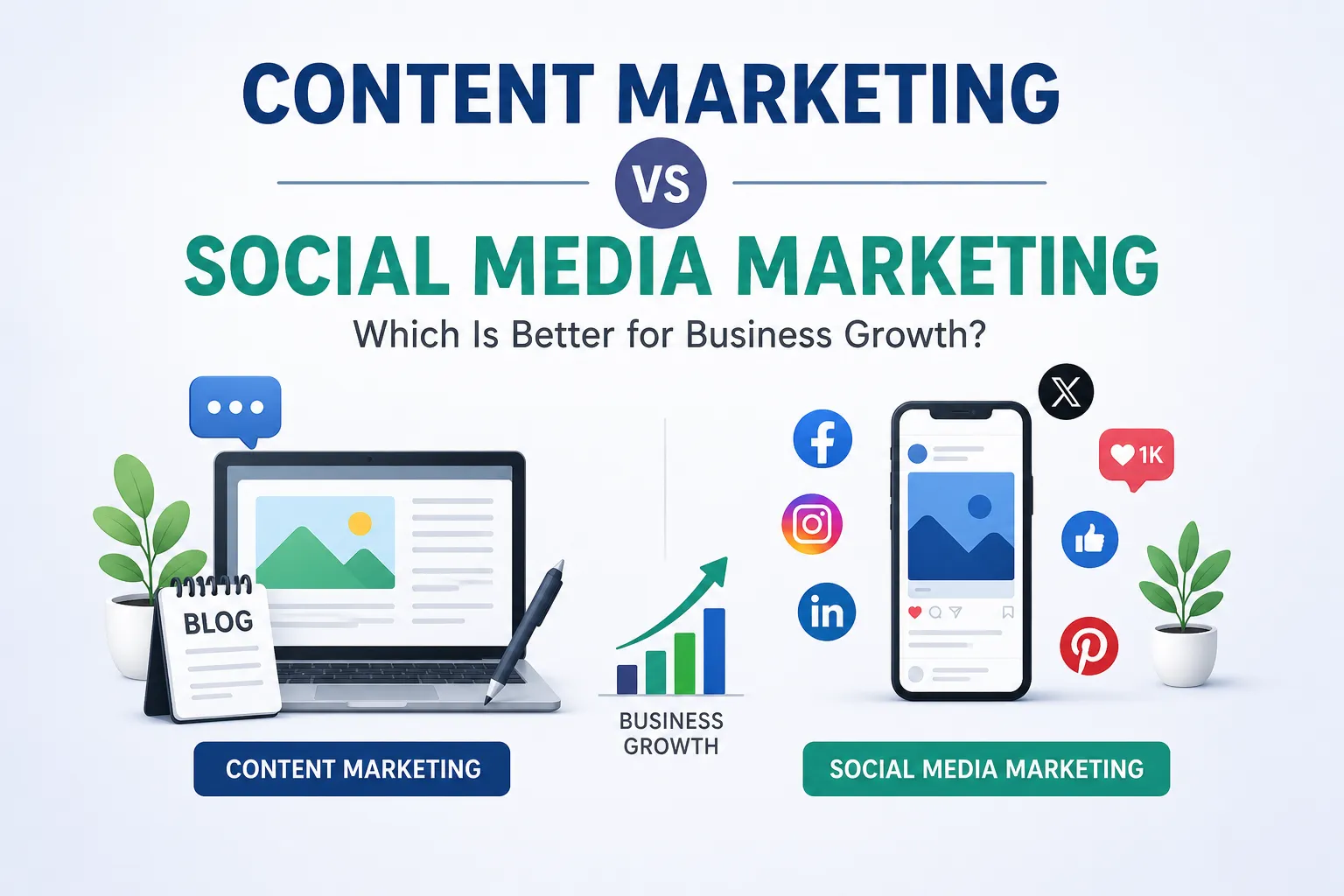
Digital marketing has become one of the most powerful ways for businesses to attract customers, build trust, and increase revenue. Whether you’re running a startup, managing a small business, or growing an online brand, choosing the right digital marketing strategy can significantly impact your success.
Among the many marketing approaches available today, content marketing and social media marketing are two of the most popular. While both help businesses connect with their audience, they serve different purposes and deliver different results.
Many business owners struggle to decide which strategy deserves more time and budget. The truth is that each has unique strengths, and understanding those strengths will help you make smarter marketing decisions.
In this guide, you’ll learn the differences, benefits, and best use cases of Content Marketing vs Social Media Marketing, so you can choose the right approach for sustainable business growth.
What Is Content Marketing?
Content marketing is a long-term marketing strategy focused on creating and sharing valuable, relevant, and informative content that attracts and retains a target audience.
Instead of directly selling products or services, content marketing educates, informs, and solves customer problems. Over time, this builds trust and encourages people to become loyal customers.
Common Types of Content Marketing
- Blog posts
- Ultimate guides
- Videos
- Infographics
- Case studies
- Email newsletters
How It Works
Businesses create helpful content around topics their audience searches for online. When optimized for search engines, this content ranks on Google, attracts organic traffic, and generates qualified leads without relying heavily on paid advertising.
Long-Term SEO Benefits
Content marketing offers lasting value because:
- Improves search engine rankings
- Generates evergreen traffic
- Builds topical authority
- Increases backlinks
- Supports lead generation
- Produces long-term ROI
What Is Social Media Marketing?
Social media marketing involves promoting your business, products, and content through social media platforms to increase visibility, engagement, and customer relationships.
Unlike content marketing, social media focuses on real-time conversations and audience interaction.
Major Social Media Platforms
- X (Twitter)
- TikTok
How It Helps Businesses
Social media marketing can help you:
- Increase brand awareness
- Build an online community
- Engage directly with customers
- Promote products through paid advertising
- Drive website traffic
- Encourage user-generated content
It is especially effective for businesses that need quick exposure or frequent customer interaction.
Content Marketing vs Social Media Marketing
| Feature | Content Marketing | Social Media Marketing |
| Purpose | Educate and build authority | Engage and grow audience |
| Cost | Low to moderate | Organic or paid options |
| SEO Value | Excellent | Limited direct SEO impact |
| Traffic | Long-term organic traffic | Immediate referral traffic |
| Engagement | Moderate | Very high |
| Long-term Results | Strong | Requires continuous activity |
| Lead Generation | High-quality leads | Quick lead generation |
| Brand Awareness | Gradual | Fast |
| ROI | Improves over time | Often immediate but short-lived |
| Best Use Cases | SEO, education, trust building | Promotions, launches, engagement |
Advantages of Content Marketing
Content marketing delivers consistent value over time.
Improves SEO
High-quality articles help your website rank for valuable keywords.
Builds Authority
Helpful content positions your business as an industry expert.
Generates Evergreen Traffic
A well-written blog can attract visitors for months or even years.
Produces Higher-Quality Leads
Educated customers are more likely to convert into paying clients.
Educates Customers
Guides, tutorials, and case studies help customers make informed buying decisions.
Offers Better Long-Term ROI
Although it takes time to produce results, content continues generating traffic long after publication.
Advantages of Social Media Marketing
Social media offers speed, interaction, and visibility.
Faster Audience Reach
Posts can reach thousands of users within hours.
Better Engagement
Likes, comments, shares, and direct messages strengthen customer relationships.
Real-Time Communication
Businesses can answer questions and resolve concerns immediately.
Increased Brand Visibility
Regular posting keeps your brand top of mind.
Supports Paid Advertising
Targeted advertising enables businesses to reach highly specific audiences.
Viral Marketing Opportunities
Creative content can spread rapidly, dramatically increasing exposure.
Which Strategy Is Better for Business Growth?
The best choice depends on your business goals.
For Small Businesses
Prioritize content marketing for long-term visibility while maintaining an active social media presence.
For Startups
Use social media marketing to build awareness quickly, then invest in content marketing to establish authority.
For E-commerce Stores
Combine SEO-focused product guides with social media promotions and video content.
For Bloggers
Content marketing should be the primary strategy, supported by social media to expand reach.
For B2B Companies
Educational blogs, whitepapers, and case studies generate higher-quality leads than social media alone.
For Local Businesses
Use local SEO content alongside Facebook and Instagram to engage nearby customers and promote offers.
Why Combining Both Strategies Works Best
The most successful businesses integrate both approaches.
Simple Marketing Workflow
- Research customer questions.
- Publish an SEO-optimized blog post.
- Create social media graphics.
- Turn key points into reels or short videos.
- Share across multiple platforms.
- Drive traffic back to your website.
- Capture leads with email forms.
- Nurture prospects through email marketing.
Repurposing one piece of content into multiple formats saves time while maximizing reach.
Common Mistakes to Avoid
Avoid these common marketing mistakes:
- Posting without a clear strategy
- Ignoring SEO optimization
- Focusing only on follower counts
- Publishing inconsistently
- Failing to track analytics
- Creating low-quality or duplicate content
Consistency and quality always outperform quantity.
Best Tools for Content & Social Media Marketing
| Tool | Purpose |
| Google Analytics | Track website traffic and conversions |
| Google Search Console | Monitor SEO performance |
| Canva | Create graphics and social posts |
| Buffer | Schedule social media content |
| Hootsuite | Manage multiple social platforms |
| Semrush | SEO research and competitor analysis |
| Ahrefs | Keyword and backlink research |
| Grammarly | Improve writing quality |
Frequently Asked Questions
1. Is content marketing better than social media marketing?
Neither is universally better. Content marketing supports long-term growth, while social media marketing delivers faster visibility and engagement.
2. Can I use both strategies together?
Yes. Combining both creates stronger brand awareness, higher traffic, and better lead generation.
3. Which is more affordable for small businesses?
Content marketing often provides better long-term value, while organic social media can be very cost-effective.
4. Which delivers faster results?
Social media marketing usually produces faster engagement and traffic.
5. Which strategy is better for SEO?
Content marketing has a much greater impact on search engine rankings and organic traffic.
6. How often should businesses publish content?
Aim for one to four high-quality blog posts each month and maintain a consistent social media posting schedule.
7. Does social media improve website traffic?
Yes. Sharing valuable content on social media encourages users to visit your website and explore your offerings.
8. What is the best digital marketing strategy for long-term business growth?
A balanced strategy that combines SEO-driven content marketing with consistent social media engagement delivers the most sustainable results.
10-Point Digital Marketing Success Checklist
- Define clear marketing goals.
- Know your target audience.
- Research relevant keywords.
- Publish high-quality content consistently.
- Optimize every page for SEO.
- Share content across social platforms.
- Repurpose content into videos and graphics.
- Build an email list.
- Monitor analytics regularly.
- Continuously test and improve your strategy.
Expert Tips
Expert Insight
Focus on creating one exceptional piece of content each week. Then repurpose it into multiple formats—blog articles, short videos, carousels, infographics, email newsletters, and social media posts. This approach increases reach while saving time and marketing resources.
Conclusion
When comparing Content Marketing vs Social Media Marketing, there is no one-size-fits-all winner. Each strategy plays a distinct role in a successful online marketing plan.
Content marketing builds long-term authority, strengthens SEO, and delivers consistent organic traffic that compounds over time. Social media marketing, on the other hand, boosts brand awareness, encourages customer engagement, and generates faster visibility.
For sustainable business growth, the smartest approach is not choosing one over the other—it is integrating both. Publish valuable, SEO-optimized content on your website, promote it through social media, repurpose it into engaging formats, and use analytics to refine your efforts. By combining these strengths, businesses can expand their reach, build trust, generate qualified leads, and increase conversions over the long term.