

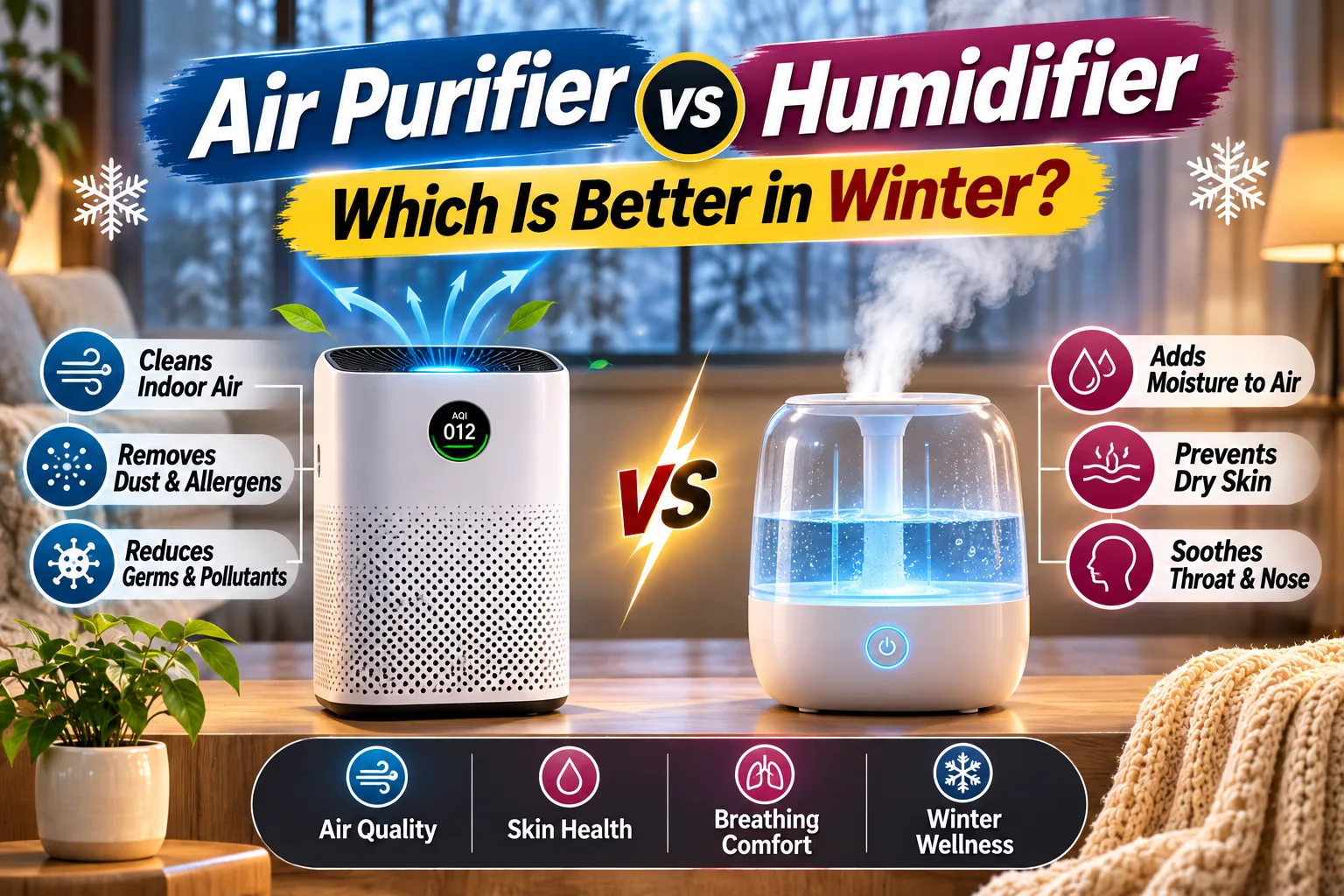
As winter approaches across India, maintaining healthy indoor air has become an important consideration for households dealing with pollution, dry weather, respiratory discomfort and seasonal allergies. Two appliances that frequently attract attention during this period are air purifiers and humidifiers. Although both are designed to improve indoor comfort, they perform completely different functions.
An air purifier removes airborne pollutants such as dust, pollen, smoke and fine particulate matter, while a humidifier adds moisture to dry indoor air by increasing humidity levels. Choosing between them depends on the conditions inside your home, your health concerns and the quality of outdoor air.
For people living in highly polluted cities such as Delhi, an air purifier with a suitable HEPA filter can help reduce indoor exposure to PM2.5 and other airborne particles. On the other hand, people experiencing dry skin, cracked lips, dry nasal passages and throat irritation because of low indoor humidity may benefit from a humidifier.
The difference becomes particularly important during winter 2026, when northern and western parts of India experience changing weather conditions. Delhi-NCR faces seasonal air pollution, while several regions experience dry atmospheric conditions that can increase moisture loss from the skin and respiratory passages.
However, purchasing the wrong appliance may not solve the actual problem. A humidifier cannot remove PM2.5 pollution, and an air purifier cannot increase moisture levels in a dry room. Some households may benefit from using both devices, provided indoor humidity is monitored and the appliances are maintained correctly.
Understanding the differences between an air purifier and a humidifier can help consumers make a practical decision before investing in either appliance.
Air Purifier vs Humidifier: What Is the Main Difference?
An air purifier and a humidifier are both indoor air-quality appliances, but their working mechanisms and purposes are different.
An air purifier circulates indoor air through filters that capture airborne particles and, depending on its filtration system, certain gases and odours.
A humidifier releases water vapour or fine moisture into the surrounding air to increase indoor humidity.
The main difference is that an air purifier focuses on cleanliness, whereas a humidifier focuses on moisture levels.
HEPA Air Purifiers for Dust-Mite Allergies | Breathe Clearly – iDustMite
Air Purifier
Removes pollutants
Filters airborne dust, pollen, smoke and fine particles.
Best Bedroom Humidifier – sosticated
Humidifier
Adds moisture
Increases humidity in dry indoor environments.
| Feature | Air Purifier | Humidifier |
|---|---|---|
| Main purpose | Clean indoor air | Increase humidity |
| Removes PM2.5 | Yes, with suitable filtration | No |
| Removes dust | Yes, with suitable filtration | No |
| Helps with dry air | Not directly | Yes |
| Helps with pollen | Yes, with suitable filtration | No |
| Adds moisture | No | Yes |
| Requires water | Usually no | Yes |
| Main maintenance | Filter replacement | Water and tank cleaning |
Neither appliance is a universal solution for every indoor air-quality problem. The right choice depends on whether the primary concern is airborne pollution or insufficient moisture.
What Is an Air Purifier and How Does It Work?
An air purifier is an electrical appliance designed to reduce airborne pollutants inside an enclosed space.
It draws indoor air through an intake, passes it through one or more filtration stages and releases filtered air back into the room.
Modern air purifiers commonly use HEPA filters, pre-filters and activated carbon filters to address different types of indoor pollutants.
How Does an Air Purifier Work?
Most conventional air purifiers follow a simple filtration process.
Step 1: Air Intake
The appliance draws surrounding air through its intake vents using an internal fan.
Step 2: Pre-Filtration
A pre-filter captures larger particles, including visible dust, hair, lint and some pet dander.
Step 3: HEPA Filtration
The air passes through a high-efficiency particulate air filter that captures fine airborne particles.
A properly functioning HEPA filtration system can help reduce airborne PM2.5, pollen, mould spores and other particulate contaminants.
Step 4: Activated Carbon Filtration
Some air purifiers contain an activated carbon filter that can help reduce certain gases, odours and volatile organic compounds (VOCs).
Its effectiveness depends on the type and quantity of carbon used and the specific pollutant.
Step 5: Cleaned Air Release
The filtered air is released back into the room, and the process continues while the appliance operates.
What Pollutants Can an Air Purifier Remove?
An air purifier equipped with appropriate filtration can help reduce several common indoor airborne pollutants.
- PM2.5: Fine particles originating from combustion, outdoor pollution and other sources.
- PM10: Larger airborne particles, including some dust and construction-related particles.
- Pollen: Airborne particles released by plants that can trigger seasonal allergies.
- Pet dander: Small particles associated with pets.
- Dust: Airborne household dust and other suspended particles.
- Smoke particles: Fine particles produced by smoking, cooking and combustion.
- Mould spores: Some airborne particles released by mould growth.
- Certain odours and gases: Only when the appliance includes an appropriate gas-phase filter, such as activated carbon.
An important limitation is that ordinary particle filters do not remove every gaseous pollutant. An air purifier also cannot solve the underlying source of indoor mould, excessive moisture or chemical emissions.
Why Is an Air Purifier Useful During Winter?
Winter can increase indoor exposure to pollution because people may keep doors and windows closed for longer periods.
Outdoor pollution can enter homes through doors, windows and ventilation openings. Indoor activities such as cooking, cleaning, smoking and burning fuels can also contribute to poor air quality.
In cities experiencing high PM2.5 concentrations, an appropriately sized HEPA air purifier can help reduce airborne particle exposure inside a room.
It can be particularly useful for:
- Families living near busy roads.
- People living in areas affected by industrial emissions.
- Households exposed to seasonal smoke and dust.
- People sensitive to airborne allergens.
- Homes with pets.
- Individuals who want to reduce indoor particulate exposure.
However, air purifiers should complement source control and appropriate ventilation rather than replace them.
What Is a Humidifier and How Does It Work?
A humidifier is an electrical appliance that increases the moisture content of indoor air.
During winter, low humidity can contribute to dry skin, chapped lips, throat discomfort and irritation in the nasal passages. A humidifier can help make indoor conditions more comfortable by adding moisture to the air.
It is important to understand that a humidifier does not clean polluted air. It does not remove PM2.5, vehicle emissions, smoke or airborne dust.
How Does a Humidifier Work?
Humidifiers use different technologies to release moisture into indoor environments.
The three commonly available types are:
1. Ultrasonic Humidifier
Ultrasonic humidifiers use high-frequency vibrations to create a fine water mist.
The mist is released into the surrounding air, increasing indoor humidity.
Advantages:
- Generally operates quietly.
- Available in compact designs.
- Usually consumes relatively little electricity.
- Suitable for bedrooms and smaller rooms, depending on capacity.
Limitations:
- Requires regular cleaning.
- Can disperse minerals from untreated water into the air.
- Poor maintenance can encourage microbial growth.
2. Evaporative Humidifier
Evaporative humidifiers use a fan to draw air through a moisture-saturated wick or filter.
As air passes through the wet material, some water evaporates and increases indoor humidity.
Advantages:
- Uses natural evaporation.
- Generally does not release mineral dust in the same way as ultrasonic mist devices.
- Evaporation tends to slow as humidity increases.
Limitations:
- Can produce fan noise.
- Requires regular cleaning and wick or filter maintenance.
- Replacement components add to operating costs.
3. Warm Mist Humidifier
Warm mist humidifiers heat water to produce steam, which cools before mixing with the surrounding air.
Advantages:
- Produces warm moisture.
- Does not typically disperse minerals in the same manner as ultrasonic devices.
- Can provide comfortable humidity during cold weather.
Limitations:
- Uses more electricity for heating.
- Hot water and steam can cause burns.
- Requires careful placement, particularly in homes with children and pets.
What Are the Benefits of Using a Humidifier in Winter?
A humidifier can be useful when indoor humidity becomes too low.
Some potential benefits include:
1. Helps Reduce Dry Skin
Low humidity can increase moisture loss from the skin. Maintaining comfortable indoor humidity may help reduce environmental dryness.
However, a humidifier is not a replacement for moisturiser, especially for people with eczema or naturally dry skin.
2. Helps With Dry Lips
Low indoor humidity can contribute to dry lips and discomfort. Maintaining suitable moisture levels may help reduce this environmental factor.
Regular lip balm application is still important.
3. May Improve Dry Nasal and Throat Discomfort
Dry indoor air can irritate the nasal passages and throat.
A properly maintained humidifier may improve comfort when low humidity is contributing to these symptoms.
4. May Improve Bedroom Comfort
People who experience discomfort in dry indoor environments may find a humidifier useful during sleep.
However, it should be operated at a controlled humidity level rather than continuously producing moisture.
5. Helps Maintain Suitable Indoor Humidity
Indoor humidity is an important part of maintaining a comfortable home environment.
The US Environmental Protection Agency recommends keeping indoor relative humidity between 30% and 50%. This range helps balance comfort with the risk of excessive moisture and biological growth.
Air Purifier vs Humidifier: Which One Is Better for Different Health Problems?
The right appliance depends on the problem you are trying to address.
For example, someone living in Delhi during a high-pollution episode has different indoor air-quality requirements from someone living in a dry environment with no major pollution concerns.
The following comparison explains which appliance may be more appropriate for different situations.
| Problem or Concern | Air Purifier | Humidifier |
|---|---|---|
| PM2.5 pollution | Recommended | Not effective |
| Dust and pollen | Recommended | Not effective |
| Smoke particles | Recommended | Not effective |
| Dry indoor air | Not effective | Recommended |
| Dry skin | Indirect benefit only | May improve comfort |
| Cracked lips | No direct benefit | May improve comfort |
| Dry nasal passages | No direct benefit | May improve comfort |
| Pet dander | Recommended | Not effective |
| Certain airborne odours | With suitable carbon filtration | Not effective |
| Low indoor humidity | Not effective | Recommended |
It is important to distinguish between comfort and medical treatment. Neither appliance cures asthma, allergies, respiratory infections or chronic skin conditions.
Air Purifier vs Humidifier: Which One Should You Buy During Winter 2026?
There is no single answer for every household. The purchasing decision should be based on indoor pollution levels, relative humidity, location and personal requirements.
Choose an Air Purifier If You Live in a Highly Polluted City
An air purifier should be your priority if your main concern is outdoor pollution entering your home.
Residents of Delhi-NCR, industrial areas and locations near major highways may benefit from an appropriately sized HEPA air purifier.
Look for a product with:
- A genuine HEPA filtration system.
- A suitable Clean Air Delivery Rate (CADR).
- Room-size compatibility.
- An activated carbon filter if odour and certain gaseous pollutants are concerns.
- Easily available replacement filters.
- Reasonable noise levels.
- No intentional ozone-generating technology.
An air purifier is particularly useful when outdoor pollution is high and keeping windows open would increase indoor particle exposure.
Choose a Humidifier If Your Indoor Air Is Too Dry
A humidifier may be a better investment if your home has consistently low indoor humidity.
You may consider one if you frequently experience:
- Dry and tight skin.
- Chapped lips.
- Dry nasal passages.
- Throat discomfort associated with dry air.
- General discomfort in heated indoor environments.
However, first measure your indoor humidity using a hygrometer.
If humidity is already within a comfortable range, adding more moisture may be unnecessary.
Should You Buy Both an Air Purifier and a Humidifier?
Some households may benefit from both appliances.
For example, a family living in an area with significant outdoor air pollution may need an air purifier to reduce indoor particulate matter. If the same home also has low indoor humidity, a humidifier may address the separate moisture problem.
The two appliances can serve different purposes in the same room.
However, using both does not automatically improve indoor air quality. Excessive humidification can encourage mould and dust mites, while poor maintenance of either device can create additional problems.
A practical approach is to measure indoor humidity, identify the major pollutant sources and purchase appliances according to actual requirements.
How to Choose the Best Air Purifier for Your Home
Buying an air purifier based only on brand name, design or advertised room coverage can lead to disappointing results.
The most important factors are filtration quality, CADR, room size and maintenance costs.
1. Check the HEPA Filter
HEPA filtration is one of the most important considerations when selecting an air purifier for particulate pollution.
A true HEPA filter is designed to capture at least 99.97% of particles measuring 0.3 micrometres under the relevant standard test conditions.
This does not mean that every air purifier advertised as having a HEPA-type filter offers the same performance.
Check the manufacturer’s specifications and independent performance information before purchasing.
2. Understand CADR
CADR stands for Clean Air Delivery Rate.
It indicates how quickly an air purifier delivers filtered air and is useful when comparing models.
A higher CADR generally means the appliance can clean a larger volume of air within a given period.
For example, a small bedroom does not necessarily require the same CADR as a large living room.
Choose an appliance according to the actual room dimensions and recommended air changes per hour.
3. Check Room Coverage
Manufacturers generally specify the recommended room size for their products.
However, advertised maximum coverage should be evaluated carefully.
A purifier may perform differently depending on ceiling height, room layout, doors, windows and operating speed.
For better results, choose a unit with sufficient capacity for the room where it will operate.
4. Consider Filter Replacement Costs
Air purifier filters require periodic replacement.
The replacement frequency depends on the product, operating hours, pollution levels and manufacturer’s recommendations.
Before purchasing, check:
- Replacement filter prices.
- Filter availability in India.
- Recommended replacement intervals.
- Warranty conditions.
- Electricity consumption.
A cheaper appliance may become expensive if its replacement filters are difficult to find or costly.
5. Avoid Ozone-Generating Air Purifiers
Some electronic air-cleaning technologies can produce ozone, which is a respiratory irritant.
The EPA advises consumers to avoid ozone generators and air-cleaning devices that intentionally produce ozone in occupied spaces.
A mechanical filtration system using suitable filters is a practical choice for most households.
How to Choose the Best Humidifier for Your Home
Selecting a humidifier requires a different approach because its primary purpose is to control indoor moisture.
1. Check the Room Size
Choose a humidifier with sufficient output capacity for the room where it will be used.
A compact bedroom humidifier may not be suitable for a large living room.
Check the manufacturer’s recommended coverage rather than relying only on water-tank capacity.
2. Look for a Humidistat
A built-in humidistat measures indoor humidity and allows the appliance to regulate its output.
This feature can help prevent excessive humidification.
If the device does not have a built-in humidity sensor, use a separate hygrometer to monitor the room.
3. Check Water Tank Capacity
A larger water tank generally allows longer operation between refills, depending on the humidifier’s output setting.
However, a large tank does not necessarily mean better performance.
Choose a capacity that matches your daily usage and cleaning routine.
4. Consider Noise Levels
Noise is an important factor if you plan to operate the humidifier in a bedroom.
Ultrasonic models are often quieter than fan-based evaporative models, although actual performance varies between products.
5. Check Cleaning Requirements
Humidifiers contain water, which can become a suitable environment for microorganisms if the appliance is not maintained properly.
Choose a model with an accessible tank and components that are easy to clean.
Regular maintenance is essential for safe operation.
Can You Use an Air Purifier and Humidifier Together?
Yes. An air purifier and a humidifier can be used together because they perform different functions.
An air purifier filters airborne particles, while a humidifier increases moisture levels.
However, using both appliances requires some care.
Important precautions:
- Keep the appliances at a reasonable distance from each other.
- Avoid directing humidifier mist towards the air purifier’s air intake.
- Maintain indoor relative humidity between 30% and 50%.
- Clean the humidifier tank regularly.
- Replace air purifier filters according to manufacturer instructions.
- Avoid placing either appliance where airflow is blocked.
- Monitor windows and walls for condensation, which can indicate excessive humidity.
The most important consideration is to prevent excess moisture from reaching the air purifier’s filters and electrical components.
For households dealing with both outdoor pollution and dry indoor air, using the appliances together can be a practical solution when operated correctly.
Air Purifier vs Humidifier: Which Is Better for Delhi, Mumbai, Ahmedabad and Other Indian Cities?
India experiences different winter weather conditions across its regions. Therefore, the usefulness of an air purifier or humidifier can vary depending on where you live.
Delhi-NCR
Priority: Air Purifier
Delhi-NCR experiences significant winter air pollution, including elevated PM2.5 concentrations.
A HEPA air purifier with an appropriate CADR can help reduce indoor particulate exposure.
A humidifier should only be considered if indoor humidity measurements indicate that the air is excessively dry.
Ahmedabad and Gujarat
Priority: Depends on indoor conditions
Ahmedabad and several other parts of Gujarat experience comparatively dry winter weather.
People living in dusty areas or near busy roads may benefit from an air purifier, while households experiencing consistently low indoor humidity may consider a humidifier.
Measuring indoor humidity before purchasing either appliance is recommended.
Mumbai
Priority: Usually air quality and ventilation assessment
Mumbai generally experiences a more humid climate than northern and western inland cities.
A humidifier is often unnecessary when indoor humidity is already high.
Air purification may be useful in homes affected by traffic pollution, dust, smoke and other airborne particles.
Bengaluru
Priority: Depends on pollution and humidity
Bengaluru experiences comparatively moderate temperatures during much of the year, but local traffic, construction dust and indoor pollution can still affect air quality.
An air purifier may be useful where particulate pollution is a concern. A humidifier is appropriate only when indoor humidity is consistently low.
Jaipur and Rajasthan
Priority: Depends on dust and dryness
Parts of Rajasthan experience dry weather and airborne dust, particularly during certain seasonal conditions.
An air purifier can help reduce airborne particles indoors, while a humidifier may improve comfort in rooms with low humidity.
Shimla, Manali and Other Hill Stations
Cold temperatures and dry winds can contribute to skin and respiratory discomfort in some mountain environments.
A humidifier may be useful when indoor humidity is low. However, air purification can also be relevant in rooms affected by smoke, dust or indoor combustion sources.
Neither appliance should be selected simply because the location is cold.
How Much Electricity Do Air Purifiers and Humidifiers Consume?
Electricity consumption depends on appliance capacity, operating speed, technology and daily usage.
Air purifiers generally use electricity to operate an internal fan and filtration system. Humidifier consumption varies according to the technology used.
Ultrasonic humidifiers typically use less electricity than warm mist models because they do not need to heat water.
| Appliance Type | Main Electricity Usage |
|---|---|
| HEPA Air Purifier | Fan and filtration operation |
| Ultrasonic Humidifier | Ultrasonic vibration and fan |
| Evaporative Humidifier | Fan operation |
| Warm Mist Humidifier | Water heating and operation |
Consumers should check the rated wattage on the appliance before purchasing.
The approximate monthly electricity cost can be calculated using:
\[ \text{Monthly Cost} = \frac{\text{Wattage} \times \text{Hours} \times \text{Days}}{1000} \times \text{Electricity Rate} \]
For example, consider a 40-watt air purifier operating for eight hours daily for 30 days.
Its monthly electricity consumption would be:
\[ \frac{40 \times 8 \times 30}{1000} = 9.6 \text{ kWh} \]
At an assumed electricity rate of ₹8 per unit, the monthly operating cost would be approximately ₹76.80.
This is an illustrative calculation, not a fixed electricity cost. Actual consumption and tariffs vary.
Important Safety Tips for Using Air Purifiers and Humidifiers
Both appliances require appropriate operation and regular maintenance.
Air Purifier Safety Tips
- Clean the pre-filter according to manufacturer instructions.
- Replace HEPA and activated carbon filters when required.
- Keep air intake and outlet areas unobstructed.
- Do not operate the appliance with damaged electrical components.
- Avoid ozone-generating air-cleaning devices.
- Place the purifier in a room where people spend considerable time.
- Follow the manufacturer’s instructions for filter cleaning and replacement.
Humidifier Safety Tips
- Use clean water as recommended by the manufacturer.
- Empty and refill the tank regularly.
- Clean the water tank and internal components frequently.
- Avoid allowing water to remain stagnant.
- Keep indoor humidity below 50% as a general target.
- Stop or reduce operation if condensation develops on windows or walls.
- Keep warm mist humidifiers away from children because of burn risks.
The US Environmental Protection Agency recommends regular humidifier maintenance because contaminated water and poorly cleaned equipment can disperse microorganisms and minerals into indoor air.
Common Myths About Air Purifiers and Humidifiers
Several misconceptions can lead consumers to purchase unsuitable appliances or use them incorrectly.
Myth 1: A Humidifier Can Remove Air Pollution
Fact: A humidifier adds moisture to the air. It does not filter PM2.5, smoke, pollen or other airborne pollutants.
Myth 2: An Air Purifier Can Prevent Dry Skin
Fact: An air purifier removes airborne particles but does not directly increase indoor humidity. A humidifier may help when low humidity contributes to skin dryness.
Myth 3: Every Home Needs a Humidifier During Winter
Fact: Not necessarily. Some Indian homes already have comfortable or high indoor humidity. Additional moisture may increase the risk of mould and dust mites.
Myth 4: More Humidity Is Always Better
Fact: Excessive humidity can encourage mould and biological growth. The EPA recommends keeping indoor relative humidity between 30% and 50%.
Myth 5: An Air Purifier Removes Every Type of Pollutant
Fact: Different filters target different pollutants. HEPA filters capture particles, while activated carbon filters can address certain gases and odours. No single filter removes everything.
Myth 6: Both Appliances Can Replace Ventilation
Fact: Neither appliance replaces appropriate ventilation, source control or regular maintenance. Ventilation should be used when outdoor air quality and weather conditions allow.
Conclusion: Air Purifier or Humidifier – Which One Should You Choose in Winter 2026?
The choice between an air purifier and a humidifier depends on your home’s actual indoor conditions.
An air purifier is the better option when your primary concern is dust, smoke, PM2.5, pollen and other airborne pollutants. A humidifier is more suitable when indoor humidity is consistently low and you experience discomfort associated with dry air.
For people living in highly polluted cities such as Delhi, a properly sized HEPA air purifier can be a valuable addition to the home. Meanwhile, households experiencing dry indoor conditions in parts of Gujarat, Rajasthan and northern India may benefit from a humidifier.
Some households may need both appliances, but using them together should involve regular cleaning, proper placement and humidity monitoring.
Before spending money on either device, identify the problem first. Check your local air quality, measure indoor humidity and select an appliance that addresses your actual requirements.
A healthier indoor environment is not necessarily created by purchasing more electronic appliances. It comes from controlling pollution sources, maintaining appropriate humidity, ensuring suitable ventilation and using the right equipment correctly.
FAQs
1. Which is better in winter: an air purifier or a humidifier?
An air purifier is better for removing airborne pollutants such as PM2.5, dust and smoke. A humidifier is better for increasing moisture in dry indoor air. The right choice depends on your home’s air quality and humidity levels.
2. Can an air purifier and humidifier be used together?
Yes. Both appliances can be used together because they perform different functions. Maintain proper humidity, keep the appliances appropriately separated and prevent humidifier mist from entering the air purifier.
3. Does a humidifier remove PM2.5 pollution?
No. A humidifier does not filter PM2.5 or other airborne pollutants. A properly sized air purifier with HEPA filtration is a more suitable option for reducing airborne particulate matter.
4. Is an air purifier useful during winter in Delhi?
Yes. Delhi experiences seasonal air pollution, particularly during winter. A suitable HEPA air purifier can help reduce indoor exposure to fine particles, including PM2.5, when operated and maintained correctly.
5. What is the ideal indoor humidity level during winter?
The US Environmental Protection Agency recommends maintaining indoor relative humidity between 30% and 50%. This range helps maintain comfortable moisture levels while reducing the risk of excessive dampness and mould growth.
6. Does a humidifier help with dry skin and cracked lips?
A humidifier may improve comfort when low indoor humidity contributes to skin and lip dryness. However, regular moisturiser and lip balm application remain important for protecting the skin barrier.
7. Which air purifier filter is best for PM2.5?
A properly designed HEPA air purifier with sufficient CADR for the room is a suitable choice for reducing airborne PM2.5. Check the manufacturer’s filtration specifications and avoid devices that intentionally generate ozone.
8. Is a humidifier necessary in Ahmedabad during winter?
Not necessarily. Ahmedabad can experience dry winter conditions, but indoor humidity varies between homes. Measure humidity using a hygrometer before purchasing a humidifier. If humidity is already comfortable, additional moisture may not be needed.