
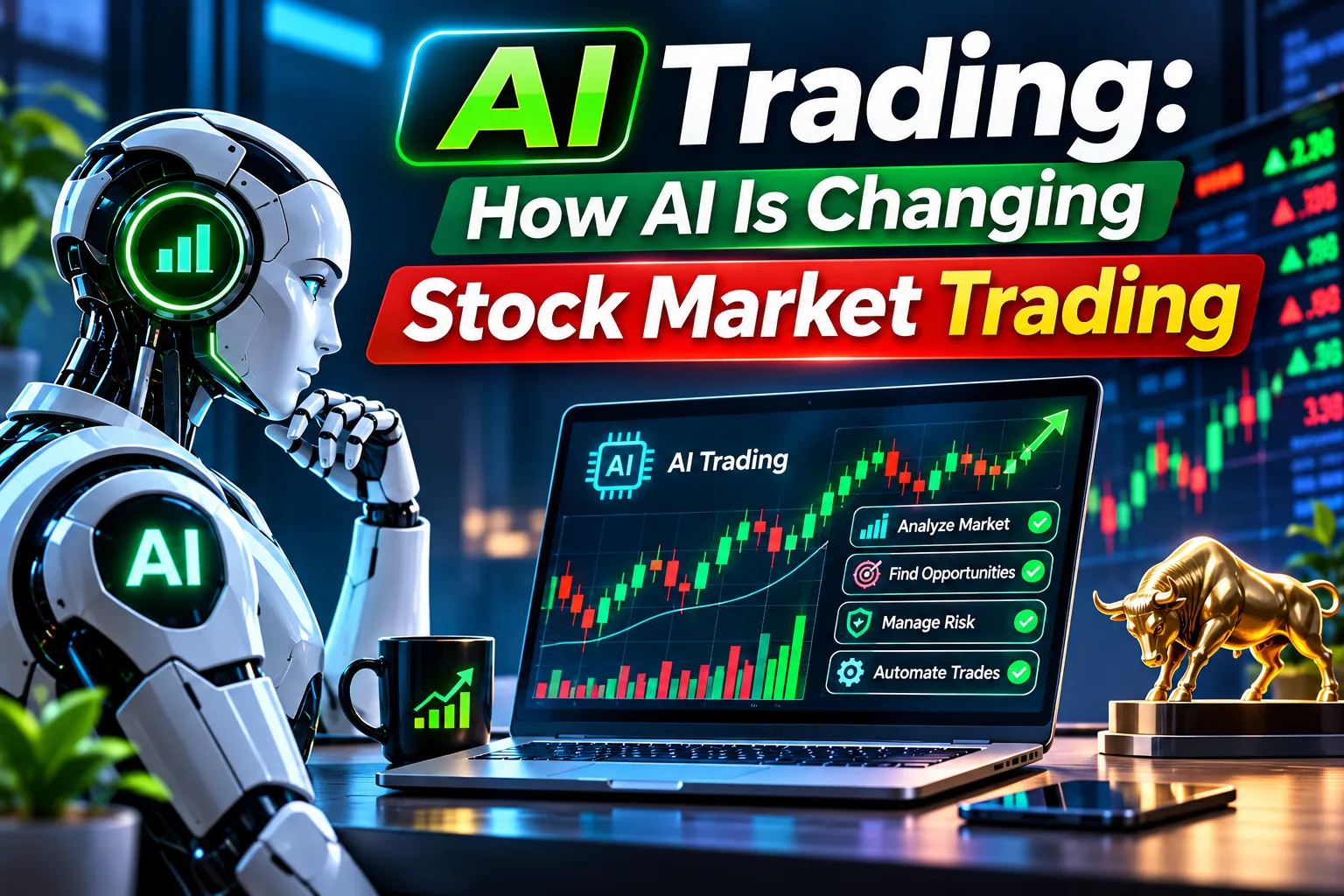
Artificial intelligence is transforming the financial markets by changing how investors analyse stocks, identify trading opportunities and manage investment risks. From institutional investment firms using advanced machine learning models to retail traders exploring AI-powered stock market tools, artificial intelligence is becoming an important part of modern trading.
The growing interest in AI trading has also created a major question among investors: Can artificial intelligence actually help people make better trading decisions?
AI trading systems can analyse large volumes of financial data, identify patterns, process market news and generate trading signals within seconds. These capabilities can help traders improve their research process and respond to changing market conditions more efficiently.
However, artificial intelligence is not a guaranteed method of generating profits. Stock prices are influenced by economic developments, company performance, investor sentiment, geopolitical events and unexpected market movements. Even sophisticated AI models can make incorrect predictions.
For Indian investors, the growing adoption of AI trading also raises important questions about SEBI regulations, automated trading platforms, trading bots, investment risks and the future of financial technology.
This detailed guide explains what AI trading is, how it works, how artificial intelligence is changing stock market trading, which strategies are commonly used, and what investors should understand before using AI-powered trading tools.
What Is AI Trading?
AI trading, also known as artificial intelligence trading, refers to the use of artificial intelligence technologies to analyse financial markets, identify trading opportunities and support investment decisions.
AI trading systems use technologies such as machine learning, deep learning, natural language processing and predictive analytics to process financial information.
Traditional trading often involves analysing stock charts, company financial statements, market news and economic indicators manually. AI-powered trading systems can process these sources of information simultaneously and identify patterns that may be difficult for human traders to recognise.
For example, an AI model may analyse a company’s historical stock prices, quarterly earnings, trading volume and market sentiment to estimate the probability of a future price movement.
Based on its analysis, the system may generate a trading signal suggesting that a stock deserves further attention.
Some AI trading systems simply provide recommendations or analytical insights. Others are connected to brokerage platforms and can automatically execute orders when specific conditions are satisfied.
The important distinction is that AI trading uses artificial intelligence to improve some part of the trading process. It does not necessarily mean that a computer independently controls every investment decision.
How Is AI Changing Stock Market Trading?
Artificial intelligence is changing stock market trading by improving the speed, scale and complexity of financial analysis.
Earlier, traders often relied on technical indicators, financial statements and manually interpreted news reports. Although these methods remain useful, AI can analyse a much wider range of information and identify relationships between different market variables.
For example, an AI model may simultaneously examine:
- Historical stock prices and trading volumes.
- Company earnings announcements.
- Economic growth and inflation data.
- Interest rate changes.
- Financial news and corporate announcements.
- Market sentiment and investor behaviour.
- Relationships between different stocks and sectors.
The system can use this information to identify potential trading opportunities or changes in market conditions.
AI is also changing how financial institutions manage portfolios, execute large orders and monitor market risks.
The technology is increasingly being used as a research assistant, an analytical engine and, in some cases, an automated decision-making system.
However, the effectiveness of these applications depends on the quality of the underlying data, the design of the model and the conditions in which it operates. Built In+1
How Does AI Trading Work?
AI trading generally follows a series of steps, starting with financial data collection and ending with a trading decision or order execution.
Understanding these steps helps investors understand what happens behind an AI trading platform.
Financial Data Collection
The first stage involves collecting financial information from relevant sources.
AI trading systems may use historical market data, live price feeds, trading volumes, financial statements, economic indicators and publicly available news.
The information is collected according to the trading strategy.
For example, a long-term investment model may focus heavily on company financial statements, earnings growth and economic indicators.
A short-term trading model may place greater importance on price movements, trading volume, volatility and order-book information.
The quality and reliability of this information are essential because inaccurate data can lead to misleading trading signals.
Data Processing and Pattern Recognition
Once the data is collected, the AI system processes it to identify relevant patterns.
Machine learning models are trained using historical information to recognise relationships between market conditions and potential outcomes.
For example, a model may identify that certain price and volume patterns have historically appeared before a stock experienced a strong movement.
The model can then monitor live market conditions for similar patterns.
However, historical patterns do not guarantee future results. Financial markets change over time, and a model that performs well under one set of conditions may become less effective under another.
AI-Based Market Analysis
The AI model analyses the available information and estimates potential market outcomes.
Depending on its design, the system may identify a possible upward trend, estimate volatility, evaluate market sentiment or compare the relative strength of different securities.
Some systems use machine learning models trained specifically for financial forecasting.
Others combine AI with traditional technical indicators and quantitative trading strategies.
The objective is not necessarily to predict the exact future price of a stock. In many cases, the system attempts to estimate probabilities or identify conditions that may provide a potential trading advantage.
Trading Signal Generation
After analysing the market, the system may generate a trading signal.
For example, an AI trading model may identify a stock that is experiencing increasing trading volume, improving momentum and positive market sentiment.
The model may classify the situation as a potential buying opportunity.
A different system may identify deteriorating market conditions and recommend reducing exposure.
Trading signals can be used by human traders or passed to an automated execution system.
Order Execution and Risk Management
In automated trading, the signal may be sent to a connected brokerage platform.
Before placing an order, a properly designed system should evaluate factors such as position size, liquidity, transaction costs, permitted exposure and predefined risk limits.
For example, a trading system may reject a signal if the potential position would exceed the permitted exposure for a particular stock.
Once the required conditions are satisfied, the system can submit the order.
Actual execution depends on market conditions, broker infrastructure, available liquidity and the applicable trading rules.
AI Trading vs Algorithmic Trading: What Is the Difference?
AI trading and algorithmic trading are related, but they are not identical.
Algorithmic trading involves using computer programs to execute trades according to predefined instructions.
AI trading uses artificial intelligence techniques to analyse information, identify patterns and potentially adapt decisions based on data.
For example, a trading system may automatically buy a stock whenever its 20-day moving average crosses above its 50-day moving average.
This is algorithmic trading because the system follows predefined rules.
An AI trading system may analyse price movements, market volatility, trading volume, financial news and historical patterns to estimate the probability of a future movement.
The difference becomes clearer through the following comparison.
| Feature | Algorithmic Trading | AI Trading |
|---|---|---|
| Main technology | Predefined rules and instructions | Machine learning and AI models |
| Decision-making | Rule-based | Data-driven and potentially adaptive |
| Pattern recognition | Depends on programmed conditions | Can identify complex patterns |
| Learning capability | Not necessarily | May learn during model training |
| Automation | Can be fully automated | Can be manual, assisted or automated |
| Complexity | Can range from simple to advanced | Often requires advanced models and data |
| Risk | Depends on strategy and execution | Depends on model quality and execution |
AI trading can be a specialised form of algorithmic trading when AI-generated decisions are converted into automated orders.
However, not every algorithmic trading system uses artificial intelligence, and not every AI trading system executes trades automatically.
Major AI Trading Strategies Used in the Stock Market
AI trading systems can use different strategies depending on the investment objective, trading timeframe and type of financial data available.
Some strategies focus on short-term price movements, while others aim to identify longer-term investment opportunities.
AI-Powered Trend Following
Trend-following strategies attempt to identify whether a stock is moving in an upward or downward direction.
AI models can analyse price movements, technical indicators, trading volume and volatility to identify potential trends.
For example, a model may identify a stock that is consistently trading above important moving averages while experiencing increasing trading volume.
The system may classify these conditions as a potential upward trend.
However, trend-following strategies can produce losses when markets move sideways or experience sudden reversals.
AI-Based Sentiment Analysis
Sentiment analysis uses natural language processing to evaluate the tone and meaning of financial information.
AI systems can analyse news articles, company announcements, earnings calls and other publicly available information to estimate market sentiment.
For example, an AI model may identify increasing negative sentiment surrounding a company following a weak quarterly earnings announcement.
The system may then evaluate whether the information is likely to influence the stock price.
Sentiment analysis can be useful because financial markets often respond to expectations, news and investor reactions.
However, sentiment does not always translate into a predictable price movement.
AI Momentum Trading
Momentum trading focuses on stocks that are experiencing strong price movements.
AI models can analyse price acceleration, trading volume, volatility and other indicators to identify potential momentum opportunities.
For instance, a model may identify a stock that is gaining momentum after a major business announcement.
The system may estimate whether the movement has the potential to continue.
Momentum strategies can be attractive during strong market trends, but they can also experience sharp losses when momentum reverses.
AI-Based Mean Reversion
Mean reversion strategies assume that certain prices or indicators may move back towards their historical average after experiencing an unusually large deviation.
AI systems can analyse historical price behaviour, volatility and relationships between securities to identify possible mean-reversion opportunities.
For example, a stock that has experienced a sharp short-term decline may be identified as a potential recovery candidate.
However, a price that appears unusually low can continue falling if the company’s fundamentals or market conditions deteriorate.
Mean reversion should therefore not be treated as a guarantee of recovery.
AI-Powered Portfolio Optimisation
AI can also support long-term investment decisions.
Portfolio optimisation systems analyse asset returns, volatility, correlations and investment objectives to help determine portfolio allocations.
For example, an AI model may evaluate whether a portfolio is excessively concentrated in a particular sector.
It may then suggest changes intended to improve diversification or reduce exposure to certain risks.
These tools can support portfolio management, but the suitability of an investment allocation depends on the investor’s financial goals, risk tolerance and investment horizon.
How AI Is Used in Different Areas of the Stock Market
Artificial intelligence is not limited to identifying buying and selling opportunities. It is also being used across several areas of financial markets.
AI in Stock Market Research
Stock market research involves evaluating a company’s financial performance, business model, industry position and future growth opportunities.
AI tools can help investors process financial statements, compare company performance and summarise earnings announcements.
For example, an investor researching an Indian banking company may use AI to examine:
- Revenue and net profit growth.
- Net interest margin.
- Non-performing assets.
- Capital adequacy.
- Management commentary.
- Changes in industry conditions.
AI can organise this information and highlight areas that require further investigation.
However, investors should verify important financial information against company filings and official disclosures. AI-generated summaries can contain inaccuracies or misunderstand financial terminology.
AI in High-Frequency Trading
High-frequency trading (HFT) involves executing a large number of trades at extremely high speeds.
It generally relies on sophisticated algorithms, powerful computing infrastructure and low-latency connections to financial exchanges.
AI can support certain aspects of high-frequency trading, including market pattern analysis, execution decisions and risk monitoring.
However, high-frequency trading is not simply a matter of using an AI chatbot to buy and sell stocks.
It requires specialised infrastructure, reliable market data and sophisticated execution systems.
The technology is primarily associated with professional trading firms and institutional market participants.
AI in Risk Management
Risk management is one of the most important applications of artificial intelligence in financial markets.
AI systems can analyse market volatility, portfolio exposure, correlations between securities and potential changes in market conditions.
For example, a portfolio management system may identify that a portfolio has become heavily concentrated in banking stocks.
The system may flag this concentration and help the investor understand how a sudden change in interest rates could affect the portfolio.
AI can also support stress testing by evaluating how a portfolio might respond to different economic scenarios.
However, risk models are not always capable of anticipating unexpected market events.
AI in Financial News Analysis
Financial markets react to company announcements, economic data, government policies and global developments.
AI-powered news analysis systems can process large volumes of information and identify developments that may be relevant to particular stocks or sectors.
For example, an AI model may analyse a government announcement concerning electric vehicle incentives and identify automobile companies that could be affected.
The system can help traders organise information more efficiently.
However, identifying relevant news does not automatically mean that the system can predict the market’s reaction accurately.
Best AI Trading Tools and Platforms
The AI trading industry includes several types of tools, ranging from research assistants to automated trading platforms.
Investors should select tools based on their actual requirements rather than choosing a platform simply because it advertises artificial intelligence.
AI Tools for Stock Market Research
Research-focused AI tools help investors analyse financial information and understand market developments.
These tools may be useful for:
- Summarising earnings announcements.
- Comparing company financial performance.
- Explaining financial terminology.
- Identifying important industry developments.
- Organising investment research.
AI research assistants are generally more suitable for investors who want to improve their understanding of the market without automatically executing trades.
However, they should not be treated as a replacement for independent financial research.
AI Tools for Trading Strategy Development
Some platforms provide tools for building, testing and evaluating trading strategies.
These environments may include historical market data, technical indicators, programming capabilities and automated testing.
Quantitative traders often use these tools to evaluate how a strategy might have performed under historical market conditions.
A strategy that performs well in a historical simulation may not necessarily perform well in live trading.
AI Tools for Automated Trading
Automated trading platforms connect trading strategies with brokerage infrastructure.
When a strategy generates a valid signal, the system can submit an order through the connected broker.
Depending on the platform, the strategy may use predefined rules, machine learning models or a combination of both.
Investors should verify the platform’s regulatory compliance, security standards, brokerage integration and risk-management features before using it.
AI Trading Bots
AI trading bots are software applications designed to analyse markets and execute trades automatically or provide trading signals.
Some bots are marketed as beginner-friendly tools, while others require programming knowledge and advanced configuration.
A major concern is that some trading bots advertise guaranteed profits, unusually high returns or extremely low risk.
These claims should be treated with caution.
A trading bot is only as reliable as its strategy, data, execution infrastructure and risk controls.
How to Evaluate an AI Trading System Before Using It
Choosing an AI trading platform requires more than checking its advertised returns.
Investors should evaluate how the system operates, what information it uses and how it handles losses.
Understand Whether the System Actually Uses AI
Not every automated trading platform uses artificial intelligence.
Some systems rely entirely on predefined rules, such as buying a stock when a particular technical indicator reaches a specific level.
These systems can still be useful, but they should not be confused with machine learning-based trading models.
Investors should understand what role AI plays in the platform’s decision-making process.
Check Historical Performance
Historical performance can provide useful information about a trading strategy.
However, investors should examine more than the total return.
Important metrics include:
| Metric | What It Explains |
|---|---|
| Total return | Overall gain or loss during a period |
| Maximum drawdown | Largest decline from a previous portfolio peak |
| Win rate | Percentage of trades that generated profits |
| Risk-adjusted return | Return relative to the level of risk taken |
| Transaction costs | Brokerage, taxes and other trading expenses |
| Slippage | Difference between expected and actual execution price |
A strategy with a high win rate may still lose money if its losing trades are significantly larger than its profitable trades.
Similarly, a strategy that appears profitable before transaction costs may become unprofitable after brokerage charges, taxes and slippage.
Understand the Backtesting Process
Backtesting evaluates a trading strategy using historical market data.
It can help identify weaknesses, estimate performance and understand how the strategy behaves under different market conditions.
However, a poorly designed backtest can create misleading results.
Common problems include:
- Overfitting the strategy to historical data.
- Ignoring transaction costs.
- Using information that was unavailable at the time of a trade.
- Testing only during favourable market conditions.
- Assuming that every order executes at the expected price.
A more reliable evaluation includes out-of-sample testing, realistic execution assumptions and paper trading before live deployment.
Check the Security of the Platform
AI trading systems may require access to brokerage accounts through application programming interfaces (APIs).
Investors should understand exactly what permissions they are granting.
Where supported, API access should be restricted to the minimum permissions required for the intended activity.
Investors should avoid sharing brokerage passwords, OTPs or other sensitive credentials with unverified service providers.
Can Beginners Use AI Trading?
Yes, beginners can use AI-powered tools to support their stock market research and trading education.
However, using an AI tool does not automatically make trading easier or safer.
Beginners should first understand basic financial concepts, including stock prices, market orders, limit orders, volatility, risk management and diversification.
AI tools can then be used to explore financial information, analyse historical price movements and understand different trading strategies.
For beginners, a sensible approach is to use AI as a research assistant rather than allowing an unfamiliar system to make unrestricted trading decisions.
A Practical Approach for Beginners
A beginner interested in AI trading can follow a structured learning process.
Understand the basics: Learn how the stock market operates and how trading orders are executed.
Explore AI tools: Use research tools to analyse company information and market trends.
Test strategies: Evaluate trading strategies using historical data or paper trading.
Set risk limits: Define the maximum amount of money that can be exposed to a single trade or strategy.
Start cautiously: Avoid committing significant capital to a strategy that has not been properly evaluated.
Monitor performance: Review trading results regularly and investigate unexpected losses or system behaviour.
The objective should be to understand the technology and its limitations before using real money.
Is AI Trading Legal in India?
AI trading is not automatically illegal in India. However, the legal and regulatory requirements depend on the nature of the activity, the trading platform and whether automated orders are being executed.
The Securities and Exchange Board of India (SEBI) regulates India’s securities markets.
SEBI has introduced a framework to facilitate safer participation of retail investors in algorithmic trading.
On February 4, 2025, SEBI issued a circular titled Safer Participation of Retail Investors in Algorithmic Trading.
The framework addresses retail participation in algorithmic trading through brokers and includes requirements intended to improve investor protection and control risks associated with automated trading.
The National Stock Exchange (NSE) also provides information about its algorithmic trading framework, implementation standards and empanelled algorithm providers. Securities and Exchange Board of India+2
What Should Indian Retail Investors Know?
Retail investors interested in AI trading should pay attention to the following points:
- Use a SEBI-registered stockbroker.
- Understand whether the trading system uses automated order execution.
- Check the broker’s requirements for API-based trading.
- Verify whether the algorithm or provider is permitted under the applicable framework.
- Understand the risk controls associated with the trading system.
- Avoid unregulated platforms that promise guaranteed returns.
SEBI has also clarified that regulated entities using AI and machine learning tools remain responsible for protecting investor data and ensuring the accuracy of AI-generated outputs. Securities and Exchange Board of India
Investors should not assume that a platform is legitimate simply because it uses artificial intelligence or displays impressive historical returns.
AI Trading and SEBI’s Growing Use of Artificial Intelligence
Artificial intelligence is not only being used by traders and investment firms.
Market regulators are also exploring AI technologies to improve surveillance and identify potential market misconduct.
The increasing use of AI in market supervision reflects the growing importance of financial technology in India’s securities market.
This development also highlights the need for responsible AI adoption, investor protection and effective regulatory oversight.
Benefits of AI Trading
Artificial intelligence offers several potential advantages in financial markets.
However, these advantages depend on the quality of the system and how it is used.
Faster Data Analysis
Financial markets generate enormous amounts of information.
AI systems can process large datasets much faster than manual analysis, helping traders identify potentially relevant patterns and information.
Reduced Emotional Decision-Making
Human traders may make impulsive decisions because of fear, greed or overconfidence.
A properly designed AI trading system can follow predefined risk-management rules without experiencing human emotions.
However, AI systems can still make poor decisions when their models are inaccurate or their assumptions no longer reflect market conditions.
Improved Market Monitoring
AI systems can monitor multiple stocks, indicators and market conditions simultaneously.
This can help traders identify opportunities that may otherwise be difficult to track manually.
Better Research Efficiency
AI-powered tools can summarise financial information, compare company performance and help investors understand complex market developments.
This can reduce the time required for preliminary research.
Automated Execution
Automated systems can execute trades when predefined conditions are satisfied.
This may reduce delays associated with manual order placement.
However, execution quality still depends on market liquidity, broker infrastructure and the availability of suitable prices.
Risks and Disadvantages of AI Trading
AI trading also involves important risks.
Investors should understand these limitations before relying on artificial intelligence for financial decisions.
AI Cannot Predict Every Market Movement
Financial markets are influenced by unexpected developments, including geopolitical events, economic announcements, corporate scandals and sudden changes in investor sentiment.
An AI model trained on historical information may not accurately predict how markets will respond to an entirely new situation.
Overfitting in Trading Models
Overfitting occurs when a trading model performs extremely well on historical data but fails to perform effectively in real market conditions.
For example, a model may identify patterns that were specific to a particular period.
When market conditions change, those patterns may disappear.
A strategy should therefore be tested using data that was not used during model development.
Poor Data Quality
AI models depend on reliable information.
Incorrect prices, missing data, inaccurate financial statements or delayed information can produce misleading trading signals.
Data quality is particularly important for strategies that depend on short-term market movements.
Technical Failures
Automated trading systems may experience technical problems involving software, APIs, connectivity or order execution.
A system that continues operating during a technical failure may generate unintended trades or unexpected losses.
Cybersecurity Risks
Trading platforms and connected financial accounts may be exposed to cybersecurity threats.
Investors should use strong authentication, secure API permissions and reliable software providers.
Unexpected Market Volatility
AI systems can struggle during sudden market movements.
A strategy that performs well during normal trading conditions may experience significant losses during periods of extreme volatility.
Risk management should therefore remain an essential part of every AI trading strategy.
AI Trading vs Traditional Trading: Which Is Better?
There is no universally superior approach.
Traditional trading allows investors to use experience, judgement and personal understanding of a company’s business.
AI trading can provide faster analysis, systematic decision-making and automated execution.
The most suitable approach depends on the investor’s objectives, knowledge, resources and risk tolerance.
| Factor | Traditional Trading | AI Trading |
|---|---|---|
| Decision-making | Human judgement | AI-assisted or automated |
| Data analysis | Manual or software-assisted | Automated data processing |
| Emotional influence | Can be significant | Can be reduced, but not eliminated |
| Technical requirements | Relatively simple | May require advanced infrastructure |
| Strategy flexibility | Human-adjusted | Model-dependent |
| Monitoring | Usually manual | Can be automated |
| Risk | Depends on the investor | Depends on the model and controls |
For many investors, combining human judgement with AI-powered research may be more practical than relying entirely on automated trading.
The Future of AI Trading in India
The future of AI trading in India is likely to involve greater integration of artificial intelligence into investment research, portfolio management, trading infrastructure and market surveillance.
As financial technology develops, investors may gain access to more advanced tools for analysing financial information and evaluating trading strategies.
Several developments could influence the future of AI trading.
Greater Access to AI-Powered Research
Retail investors may increasingly use AI tools to analyse company announcements, understand financial statements and compare investment opportunities.
This could make certain forms of financial research more accessible to individuals.
Improved Risk Management
AI systems may become more useful in identifying portfolio concentration, changing market conditions and potential risk exposures.
However, risk-management models will still require monitoring and independent evaluation.
More Sophisticated Trading Models
Advances in machine learning and data processing may enable the development of more sophisticated trading strategies.
These models may analyse a wider range of information, including financial news, economic data and market behaviour.
Stronger Regulatory Oversight
As AI adoption increases, regulators are likely to focus on investor protection, data security, transparency and the reliability of automated trading systems.
For Indian investors, the development of AI trading should therefore be viewed alongside the evolution of SEBI’s regulatory framework.
Conclusion: Is AI Trading the Future of the Stock Market?
AI trading is becoming an important part of modern financial markets.
Artificial intelligence can help traders analyse information, identify potential opportunities, evaluate strategies and automate certain trading activities.
For investors in India, AI-powered financial tools may provide new ways to understand the stock market and improve research efficiency.
However, AI trading is not a shortcut to guaranteed profits.
The effectiveness of an AI trading system depends on its data, model quality, strategy, execution infrastructure and risk-management framework.
Investors should be cautious about platforms that promise fixed returns or claim that artificial intelligence can eliminate market risk.
The most practical approach is to understand AI trading as a technology that can support financial decision-making rather than replace the need for knowledge, discipline and careful risk management.
As artificial intelligence continues to develop, its role in India’s financial markets is likely to expand. Investors who understand both its opportunities and limitations will be better positioned to use these technologies responsibly.
FAQs
What is AI trading in the stock market?
AI trading is the use of artificial intelligence technologies to analyse financial markets, identify trading opportunities and support or automate trading decisions.
Can AI trading make money?
AI trading can generate profits when a strategy performs effectively, but profits are not guaranteed. Trading outcomes depend on market conditions, strategy quality, execution and risk management.
Is AI trading legal in India?
AI trading is not automatically illegal in India. However, automated trading systems and related services must comply with applicable SEBI regulations, exchange requirements and broker policies.
Which AI is best for stock market trading?
There is no single best AI trading tool. The suitable platform depends on whether an investor needs market research, strategy development, technical analysis, portfolio management or automated execution.
Can beginners use AI trading?
Yes. Beginners can use AI tools for research and learning. However, they should understand basic stock market concepts and test strategies before using real money.
Is AI trading better than manual trading?
AI trading can offer faster analysis and systematic execution, while manual trading allows human judgement and flexibility. The better approach depends on the investor’s objectives, experience and risk tolerance.
What is the difference between AI trading and algorithmic trading?
Algorithmic trading follows programmed instructions to execute trades. AI trading uses artificial intelligence to analyse data, identify patterns and potentially adapt its decisions. AI trading can be a type of algorithmic trading, but not all algorithmic trading uses AI.
Are AI trading bots safe?
AI trading bots are not automatically safe. Their reliability depends on the software, strategy, data quality, security and risk controls. Investors should avoid unverified platforms and guaranteed-profit claims.
Can AI predict stock market prices accurately?
AI can estimate potential price movements using historical and current data, but it cannot predict stock prices with complete accuracy. Unexpected events and changing market conditions can make predictions unreliable.
What is the biggest risk of AI trading?
One of the biggest risks is relying on a model that performs well in historical testing but fails under live market conditions. Poor data, overfitting, technical failures and unexpected volatility can also cause losses.