Your first salary credit can feel exciting, but the amount you receive may be lower than the salary mentioned in your offer letter. The difference usually comes from salary components, employer benefits, and payroll deductions.
Learning how to read a salary slip helps you understand where your money comes from and where it goes. It also helps you plan your monthly budget, review tax deductions, prepare loan applications, and identify payroll errors.
In this guide, we explain the main salary slip components, the difference between gross and net salary, and how to calculate your take-home salary using a simple Indian payroll example.
What Is a Salary Slip?
A salary slip, also called a payslip, is a document that shows how an employer calculates an employee’s salary for a particular pay period.
Employers commonly provide salary slips every month in digital or printed form. The document usually includes employee details, earnings, deductions, and the final amount payable.
A typical salary slip contains:
- Employee name, ID, and salary period
- Basic salary and allowances
- Gross salary
- Provident Fund and other applicable deductions
- Tax Deducted at Source (TDS)
- Net salary or take-home pay
Understanding these details helps you verify your earnings and keep accurate financial records.
Important Components of a Salary Slip
Salary slip components can differ between employers, industries, and employment contracts. However, most payslips include the following items.
Basic Salary
Basic salary forms the core of your salary structure. Employers may use it to calculate certain benefits and contributions, depending on applicable rules and company policies.
For example, if your monthly basic salary is ₹20,000, your employer may calculate certain Provident Fund contributions using this amount and other applicable wage rules.
Your basic salary is not necessarily the amount you receive in your bank account.
House Rent Allowance (HRA)
House Rent Allowance helps employees meet housing expenses. Employers may include HRA as a separate component in the salary structure.
HRA tax exemption depends on the applicable tax regime, eligibility conditions, rent paid, salary details, and other relevant rules. You should not assume that the entire HRA amount is automatically tax-free.
Other Allowances
Employers may include additional components, such as:
- Special allowance: An additional salary component defined by the employer.
- Conveyance-related benefits: Payments or reimbursements connected with commuting, depending on the employer’s policy.
- Medical-related benefits: Certain reimbursements or benefits, depending on the compensation structure.
- Other allowances: Additional payments based on the employee’s role or company policy.
The tax treatment of these components varies. Always check the applicable tax rules rather than assuming that every allowance qualifies for an exemption.
Gross Salary
Gross salary is the total salary earnings for a pay period before employee-side deductions.
It generally includes basic salary, HRA, and other salary components included in the employee’s earnings for that period.
Salary Deductions
Salary deductions reduce the amount payable to you. Common examples include:
- Employee Provident Fund (EPF): An eligible employee’s contribution toward retirement savings.
- Professional tax: A state-level tax that applies to eligible employees where the state imposes it.
- Tax Deducted at Source (TDS): Income tax that an employer deducts from salary as required under applicable tax rules.
- Employee State Insurance (ESI): A contribution that applies to eligible employees and establishments under the relevant rules.
- Other authorized deductions: Items such as applicable recoveries or employee-authorized deductions.
Not every employee will see all these deductions on their payslip.
Net Salary or Take-Home Salary
Net salary is the amount payable after the employer subtracts applicable employee-side deductions from the relevant salary earnings.
This amount usually represents the salary credited to your bank account, although adjustments, advances, or other payroll entries can affect the final payment.
Gross Salary vs Net Salary vs CTC
Understanding these three terms is essential when comparing job offers.
| Salary Term | Meaning | Illustrative Example |
| Gross salary | Earnings before employee deductions | ₹40,000 per month |
| Net salary | Amount payable after deductions | ₹35,000 per month |
| CTC | Employer’s total annual cost for the employee | ₹6,00,000 per year |
These figures are illustrative and do not represent one employee’s actual salary structure.
Cost to Company (CTC) may include your salary, employer contributions, insurance, bonuses, and other employment-related benefits or costs. Some components may not reach your bank account as monthly cash.
For this reason, always compare the salary structure and expected take-home pay instead of relying only on the CTC figure in an offer letter.
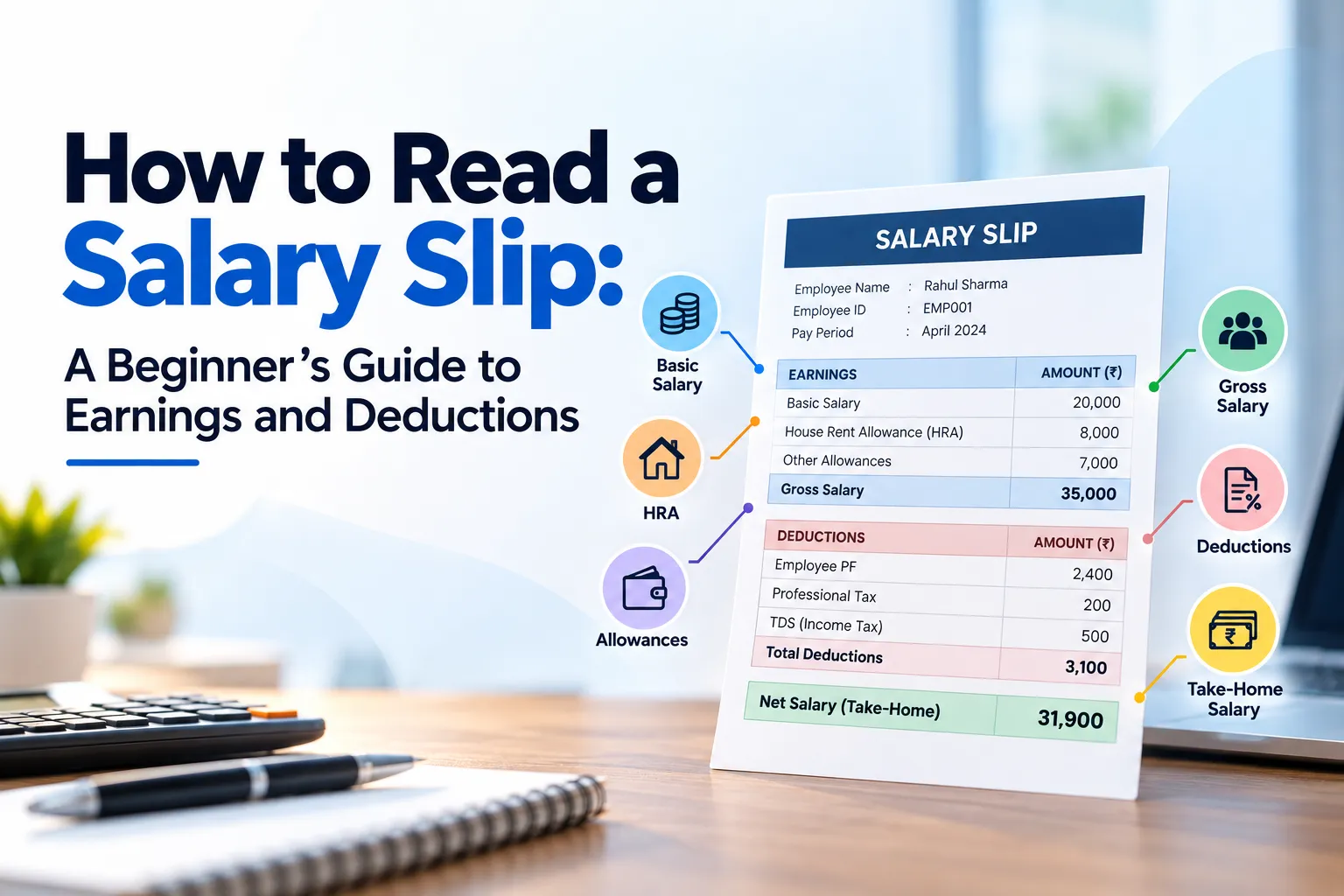
Example of a Salary Slip With Calculations
Let’s understand a sample monthly payslip for an Indian employee.
Monthly Earnings
| Earnings Component | Amount |
| Basic salary | ₹20,000 |
| HRA | ₹8,000 |
| Other allowances | ₹7,000 |
| Gross salary | ₹35,000 |
Monthly Deductions
| Deduction | Amount |
| Employee PF | ₹2,400 |
| Professional tax | ₹200 |
| TDS | ₹500 |
| Total deductions | ₹3,100 |
Calculate Take-Home Salary
The calculation is straightforward:
Net Salary = Gross Salary − Total Deductions
₹35,000 − ₹3,100 = ₹31,900
In this example, the employee’s monthly take-home salary is ₹31,900.
These amounts are illustrative only. Actual PF contributions, professional tax, TDS, and other deductions depend on the employer’s payroll structure, applicable laws, state rules, tax regime, eligibility, and individual circumstances. The example does not establish universal deduction rates.
How to Read Your Salary Slip Step by Step
Follow these six steps whenever you receive your payslip.
- Check your employee details. Confirm your name, employee ID, and salary period.
- Review your earnings. Check basic salary, HRA, bonuses, and other allowances.
- Verify gross salary. Make sure the total earnings match the individual components.
- Check each deduction. Review PF, professional tax, TDS, ESI, and any other listed amounts.
- Compare your net salary. Check whether the amount payable matches the salary credited to your bank account, allowing for any explained adjustments.
- Contact HR or payroll if something looks wrong. Ask for clarification about unexpected deductions, missing allowances, or incorrect employee details.
Keeping your monthly payslips makes it easier to track salary changes and maintain financial records.
Common Salary Slip Mistakes to Avoid
Avoid these common mistakes when reviewing your payslip:
- Confusing CTC with take-home salary: CTC includes costs and benefits that may not form part of monthly cash earnings.
- Ignoring deductions: Small monthly deductions can affect your budget over time.
- Assuming every allowance is tax-free: Tax treatment depends on the component and applicable rules.
- Overlooking incorrect details: Errors in employee information or salary components can create administrative problems.
- Ignoring unexpected changes: Compare each month’s payslip to identify unexplained differences in earnings or deductions.
Frequently Asked Questions
1. What is the difference between gross salary and net salary?
Gross salary represents earnings before employee-side deductions. Net salary is the amount payable after applicable deductions.
2. Why is my in-hand salary lower than my CTC?
CTC may include employer contributions, insurance, bonuses, and other benefits that do not reach your bank account as monthly salary. Employee-side deductions can also reduce your take-home pay.
3. What is PF in a salary slip?
PF usually refers to Provident Fund contributions. Eligible employees contribute toward retirement savings under the applicable rules, and employers may also make contributions.
4. Is HRA always tax-free?
No. HRA tax exemption depends on eligibility, rent paid, salary details, the applicable tax regime, and relevant tax rules.
5. Why is TDS deducted from my salary?
Employers deduct TDS from salary according to applicable income tax requirements. The amount can depend on estimated taxable income, the tax regime, eligible deductions or exemptions, and tax declarations.
Conclusion
Learning how to read a salary slip gives you a clearer picture of your income and financial responsibilities. When you understand basic salary, allowances, gross earnings, deductions, and net pay, you can budget more confidently and compare job offers more accurately.
Make it a habit to review your payslip every month, check unexpected changes, and ask your payroll team about anything you do not understand. A few minutes of careful review can help you manage your salary more effectively.
Financial information disclaimer: This article provides general educational information, not personalized tax or financial advice. Indian payroll and income tax rules may change, so verify the rules applicable to your circumstances and the relevant financial year.