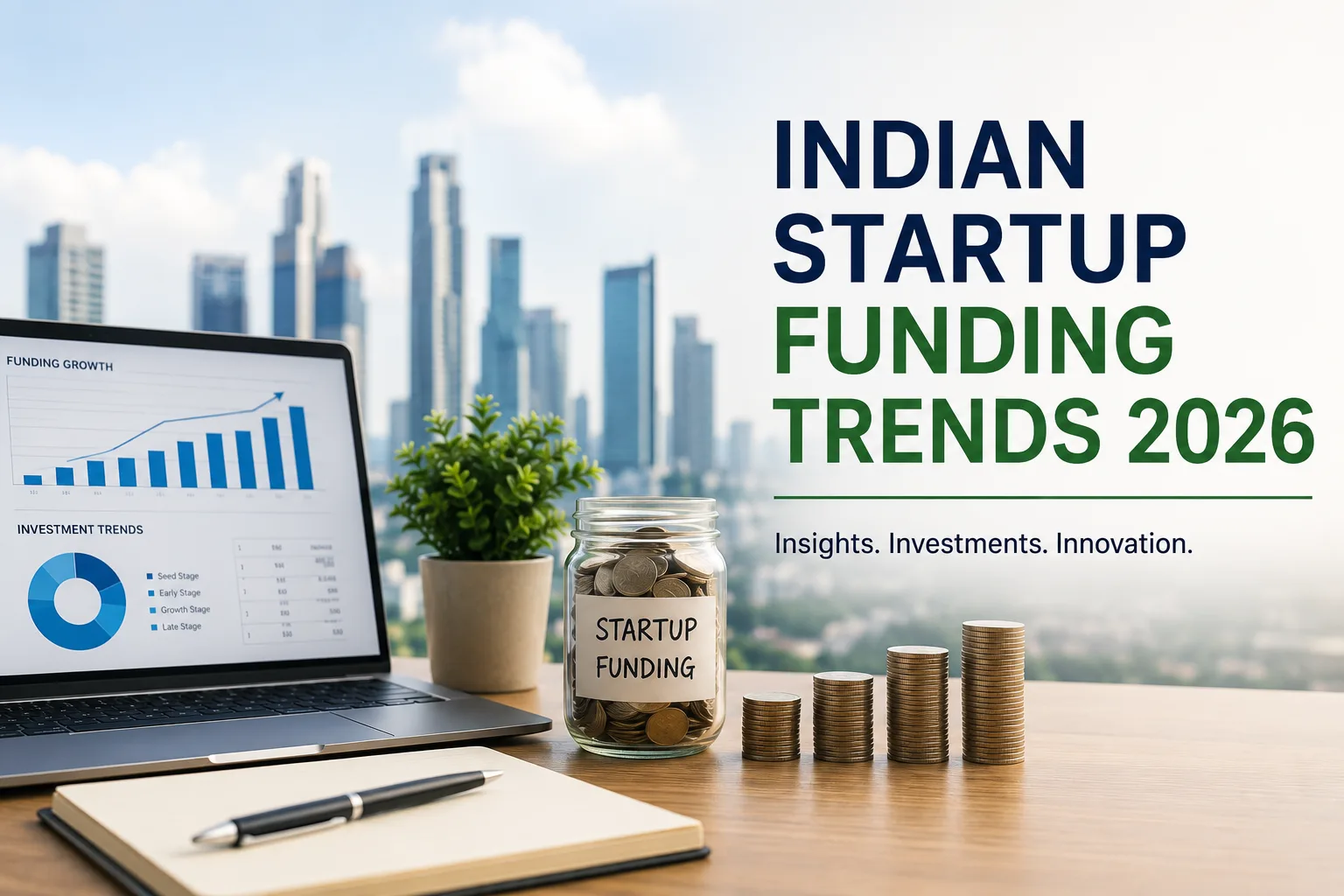
The Indian startup ecosystem has entered a new phase of maturity in 2026. After navigating global economic uncertainty, higher interest rates, funding slowdowns, and changing investor expectations over the past few years, startups across India are now witnessing renewed confidence from venture capital firms, private equity investors, family offices, sovereign wealth funds, and strategic corporate investors. However, the funding landscape has evolved significantly. Investors are no longer chasing growth at any cost. Instead, they are focusing on businesses with strong fundamentals, sustainable revenue models, clear profitability paths, scalable technology, and long-term market potential.
One of the biggest trends shaping the startup ecosystem in 2026 is the rise of larger funding rounds despite a reduction in the overall number of deals. Investors are writing bigger cheques for startups that demonstrate resilience, innovation, and market leadership. This shift is creating a more competitive environment where quality matters more than quantity. As a result, startups operating in sectors such as artificial intelligence, fintech, SaaS, climate technology, healthcare technology, deep tech, and enterprise solutions are attracting significant attention from investors looking for the next generation of industry leaders.
India remains one of the world’s largest startup ecosystems, home to thousands of innovative companies and a growing number of unicorns. With a young population, increasing digital adoption, supportive government policies, and expanding internet penetration, the country continues to offer attractive opportunities for entrepreneurs and investors alike. Understanding the funding trends shaping 2026 is essential for founders, investors, professionals, and businesses seeking to capitalize on the next wave of innovation.
The Current State of Startup Funding in India
The Indian startup ecosystem has shown remarkable resilience despite global economic challenges. While the funding frenzy seen during the pandemic years has moderated, the overall health of the ecosystem has improved. Investors are now making more calculated decisions, focusing on long-term value creation rather than short-term hype.
Funding activity during 2026 indicates that capital remains available for startups capable of demonstrating strong execution, customer demand, and scalable business models. Rather than investing in a large number of early-stage ventures, many investors are concentrating resources on companies that have already achieved product-market fit and proven their ability to generate revenue.
This trend has resulted in fewer funding rounds overall but larger average investment sizes. Investors are increasingly willing to support businesses with clear competitive advantages and sustainable growth strategies. The shift reflects a broader evolution of the startup ecosystem from experimentation toward maturity.
India’s startup landscape now includes a diverse range of sectors, from artificial intelligence and fintech to logistics, healthtech, agritech, climate technology, and manufacturing innovation. This diversification has strengthened the ecosystem and reduced dependence on a small number of industries.
Why Investors Are Writing Bigger Cheques in 2026
One of the defining characteristics of startup funding in 2026 is the growing preference for larger investments in fewer companies. Investors have become more selective and disciplined in their approach. Rather than spreading capital across numerous startups, they are concentrating investments on businesses that demonstrate strong fundamentals and long-term potential.
Several factors are driving this trend. First, investors are prioritizing profitability and sustainable growth. Startups that can demonstrate healthy unit economics, efficient customer acquisition, and predictable revenue streams are receiving greater attention. Second, market uncertainty has encouraged investors to focus on businesses capable of surviving economic fluctuations while continuing to grow.
Another important factor is the increasing complexity of technology-driven businesses. Startups operating in artificial intelligence, deep technology, semiconductor innovation, and advanced software often require significant capital to scale. Investors recognize that meaningful market leadership in these sectors requires substantial funding and long-term commitment.
As competition intensifies globally, venture capital firms are also seeking opportunities to secure larger ownership stakes in promising companies. Writing bigger cheques allows investors to deepen their involvement while supporting ambitious growth strategies.
Artificial Intelligence Has Become the Biggest Investment Magnet
Artificial intelligence has emerged as the most attractive sector for startup funding in 2026. The rapid adoption of generative AI, machine learning, automation, predictive analytics, and intelligent software solutions has created enormous opportunities for innovative startups.
Businesses across industries are integrating AI into their operations to improve efficiency, reduce costs, enhance customer experiences, and gain competitive advantages. This widespread demand has encouraged investors to increase funding for AI-focused startups that offer scalable solutions.
Indian entrepreneurs are developing AI applications across healthcare, education, finance, retail, logistics, manufacturing, agriculture, cybersecurity, and customer support. These innovations are attracting both domestic and international investors eager to participate in one of the fastest-growing technology segments.
The AI boom is also driving increased interest in supporting technologies such as cloud infrastructure, data management platforms, cybersecurity solutions, and enterprise software. As AI adoption expands, startups enabling this transformation are likely to remain attractive investment targets for years to come.
Industry experts predict that artificial intelligence will continue to dominate funding discussions throughout the remainder of the decade, making it one of the most important drivers of startup growth and innovation.
The Rise of Enterprise SaaS and B2B Startups
Software-as-a-Service and business-to-business technology companies continue to attract significant investor interest in 2026. Unlike consumer-focused businesses that often face intense competition and high customer acquisition costs, enterprise software companies typically benefit from recurring revenue models and long-term customer relationships.
Indian SaaS startups have earned global recognition for their ability to build world-class products at competitive costs. Many companies now serve international clients while operating from India, creating scalable and profitable business models that appeal strongly to investors.
The growing digital transformation of businesses worldwide has increased demand for cloud software, workflow automation, cybersecurity tools, customer relationship management platforms, data analytics solutions, and productivity applications. Startups providing these services are positioned to benefit from long-term market growth.
Investors appreciate SaaS businesses because of their predictable revenue streams, strong retention rates, and ability to scale efficiently. As a result, enterprise technology remains one of the strongest sectors for startup funding in India.
Fintech Continues to Evolve Beyond Payments
Fintech remains one of India’s most dynamic startup sectors, although investor focus has shifted beyond basic digital payments. While payment technologies remain important, funding is increasingly flowing toward financial infrastructure, lending technology, wealth management platforms, insurance innovation, and embedded finance solutions.
India’s expanding digital economy creates opportunities for startups to address gaps in financial inclusion, credit access, investment services, and business banking. Millions of consumers and small businesses continue to adopt digital financial services, supporting long-term sector growth.
Investors are particularly interested in startups that combine technology with strong regulatory compliance and sustainable business models. As the financial services industry becomes more digital, fintech companies capable of delivering secure, scalable, and user-friendly solutions are likely to remain attractive funding candidates.
The evolution of fintech demonstrates how the startup ecosystem is moving toward deeper innovation rather than relying solely on rapid customer acquisition and growth metrics.
Climate Tech and Sustainability Investments Are Rising
Climate technology has emerged as one of the fastest-growing investment categories in 2026. Governments, corporations, and consumers are increasingly focused on sustainability, creating opportunities for startups developing innovative environmental solutions.
Indian startups are addressing challenges related to renewable energy, carbon management, electric mobility, waste reduction, water conservation, sustainable agriculture, and green manufacturing. These solutions align with global sustainability goals while addressing critical domestic needs.
Investors recognize that climate challenges will require significant innovation and infrastructure investment over the coming decades. As a result, climate-focused startups are attracting increasing amounts of venture capital and strategic investment.
The combination of environmental impact and commercial potential makes climate technology one of the most promising sectors for long-term startup growth.
Why Profitability Matters More Than Ever
The startup ecosystem of 2026 differs significantly from previous funding cycles because profitability has become a central consideration for investors. During earlier periods, many startups focused primarily on growth and market share. Today, investors expect companies to demonstrate efficient operations and a credible path to sustainable profitability.
This shift reflects lessons learned from previous market corrections and changing economic conditions. Investors are increasingly evaluating metrics such as gross margins, customer retention, revenue growth quality, cash flow management, and operational efficiency.
Founders who can balance growth with financial discipline are often rewarded with stronger investor interest and higher valuations. This trend is encouraging startups to build healthier businesses that can withstand market fluctuations and competitive pressures.
The emphasis on profitability is contributing to a more mature and sustainable startup ecosystem, benefiting both entrepreneurs and investors.
Global Investors Continue to See India as a Growth Market
Despite economic uncertainty in various regions, global investors remain optimistic about India’s long-term growth prospects. The country’s large population, expanding middle class, increasing digital adoption, and entrepreneurial culture make it one of the most attractive startup markets in the world.
International venture capital firms, sovereign wealth funds, private equity investors, and multinational corporations continue to allocate capital to Indian startups. Many view India as a strategic market capable of producing globally competitive businesses across multiple sectors.
The combination of talent availability, market scale, technological innovation, and supportive policy initiatives creates a compelling investment environment. As a result, India is expected to remain a major destination for startup capital throughout the coming years.
This international confidence further strengthens the ecosystem and provides founders with access to diverse funding sources and global networks.
Challenges Facing Startups in 2026
While funding conditions have improved, startups still face several challenges. Competition remains intense, customer expectations continue to rise, and regulatory requirements are becoming more sophisticated. Founders must also navigate talent acquisition, technology development, cybersecurity risks, and market expansion challenges.
Access to capital has become more selective, meaning startups must demonstrate stronger fundamentals before attracting investment. Businesses relying solely on rapid growth without sustainable economics may struggle to secure funding.
At the same time, these challenges are encouraging entrepreneurs to build stronger, more resilient organizations. Companies capable of adapting to changing conditions and maintaining operational excellence are likely to emerge as long-term winners.
The evolving funding environment rewards innovation, discipline, and strategic execution rather than short-term momentum alone.
Conclusion
Indian startup funding trends in 2026 reveal an ecosystem that is becoming more mature, focused, and sustainable. Investors continue to deploy significant capital, but they are doing so with greater discipline and strategic intent. Larger funding rounds, increased focus on artificial intelligence, growing interest in enterprise technology, expanding climate-tech investments, and a renewed emphasis on profitability are reshaping the startup landscape.
For entrepreneurs, the message is clear: building strong fundamentals matters more than ever. Startups that solve meaningful problems, demonstrate scalable business models, embrace innovation, and maintain financial discipline are attracting investor attention and positioning themselves for long-term success.
As India’s startup ecosystem continues to evolve, 2026 may be remembered as the year when investors shifted from chasing hype to backing quality. This transformation is creating a healthier environment for innovation, entrepreneurship, and sustainable economic growth, ensuring that India remains one of the world’s most exciting startup destinations.
FAQs
Why are startup funding rounds becoming larger in 2026?
Investors are focusing on fewer but higher-quality startups, leading to larger investments in companies with strong fundamentals, scalable business models, and proven market demand.
Which sectors are attracting the most startup funding in India?
Artificial intelligence, SaaS, fintech, climate technology, healthcare technology, enterprise software, and deep-tech startups are among the leading sectors attracting investment.
Is startup funding increasing in India during 2026?
While the number of deals may be lower compared to previous years, overall funding remains strong, with larger investment amounts flowing into mature and high-potential startups.
Why is profitability becoming important for investors?
Investors want startups to demonstrate sustainable growth, efficient operations, strong unit economics, and a clear path toward long-term financial success.
How does India’s startup ecosystem compare globally?
India remains one of the world’s largest and fastest-growing startup ecosystems, attracting significant domestic and international investment across multiple industries.