
Samsung has played a major role in bringing foldable smartphones into the mainstream. Its Galaxy Z Fold and Galaxy Z Flip series have demonstrated that smartphone displays do not always need to remain fixed in one shape. However, the next major development in smartphone design could move beyond folding screens. Instead of opening a phone like a book, users may soon be able to expand its display by sliding or rolling it outward.
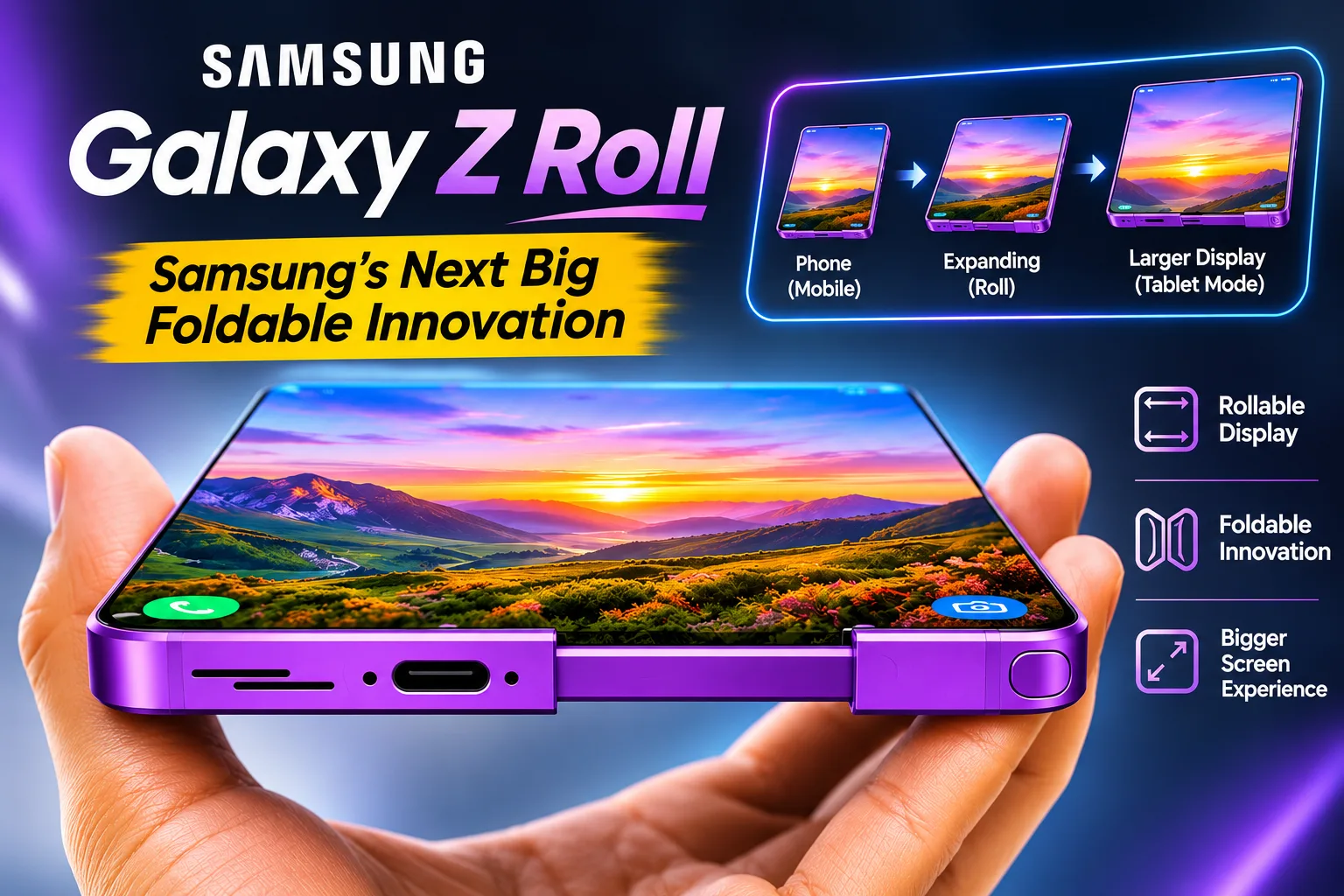
The rumoured Samsung Galaxy Z Roll represents this possible next step in mobile technology. The device is expected to use a flexible display that can expand when additional screen space is needed and return to a more compact form when it is not in use. Recent reports suggest Samsung is exploring a vertically expandable design that could change the screen’s aspect ratio depending on how it is used.
The concept could offer a different experience from traditional foldable smartphones. Users might get a compact device for everyday activities and a larger display for watching videos, reading, browsing and multitasking. However, there are still several questions about its final design, durability, battery capacity, price and release date.
As of November 2026, Samsung has not officially announced a retail smartphone called the Galaxy Z Roll. Most available information comes from technology demonstrations, patents and industry reports. Here is everything currently known about Samsung’s possible rollable smartphone and what it could mean for the future of mobile devices.
What Is the Samsung Galaxy Z Roll?
The Samsung Galaxy Z Roll is a rumoured smartphone that could feature a rollable or expandable display instead of a conventional folding screen. Unlike the Galaxy Z Fold, which opens through a central hinge, a rollable phone would use a flexible display that moves through a sliding mechanism.
The main idea is to increase the screen size without making the entire smartphone significantly wider or thicker. When the extra display area is not required, part of the screen would remain hidden inside the phone’s body. When users need more space, the display could extend through a mechanical system.
Samsung has spent years researching flexible OLED technology, and its display division has demonstrated several expandable-screen concepts. These experiments indicate that the technology is developing, although a demonstration model is not the same as a finished smartphone ready for commercial sale.
The Galaxy Z Roll name has appeared in discussions surrounding Samsung’s rollable-phone plans. However, the company has not confirmed whether this will be the final name of a future product.
How Will the Rollable Display Work?
The biggest attraction of the Samsung Galaxy Z Roll would be its expandable display. A traditional smartphone has a fixed screen size, while a foldable phone uses a hinge to open an additional display area. A rollable smartphone could take a different approach by storing part of its flexible screen inside the device.
A sliding mechanism would move the display outward or upward, increasing the available viewing area. Depending on the final design, this movement could be powered by a small motor or another mechanical arrangement. The phone would need carefully designed internal rails and support structures to keep the flexible screen stable during movement.
Recent reports have discussed a possible Samsung design that changes between 16:9 and 21:9 aspect ratios. This could allow the phone to remain relatively compact in one configuration and offer a taller display when extended. These figures are leak-based claims, not confirmed Samsung specifications.
For users, the benefit could be simple: more screen space without carrying a separate tablet or a large foldable phone. The technology could also allow applications to adjust their layouts automatically as the display expands.
Samsung Galaxy Z Roll: Expected Features and Specifications
Samsung has not released an official specification sheet for the Galaxy Z Roll. Therefore, details such as its display size, processor, camera system, battery capacity, charging speed and storage options remain unknown.
The following table separates the reported design direction from features that have not been confirmed.
| Feature | Current information |
|---|---|
| Device name | Samsung Galaxy Z Roll is a rumoured name |
| Display | Flexible, expandable OLED display is expected |
| Screen mechanism | Rumoured sliding or rollable mechanism |
| Aspect ratio | 16:9 to 21:9 has been reported |
| Processor | Not announced |
| RAM | Not announced |
| Storage | Not announced |
| Rear cameras | Not announced |
| Front camera | Not announced |
| Battery | Not announced |
| Charging | Not announced |
| Operating system | Not announced |
| Launch timeline | First half of 2028 has been reported |
| Price | Not announced |
It is important to avoid treating online concept specifications as confirmed product details. Some websites and social media posts may display specific camera resolutions, battery capacities, screen sizes and prices, but Samsung has not verified those claims.
1. Expandable OLED Display
The display will likely be the most important part of the Galaxy Z Roll if Samsung brings the concept to market. Flexible OLED technology makes it possible to create screens that can bend or move without using the traditional rigid glass structure found in conventional smartphones.
A rollable design could offer a larger viewing area while maintaining a relatively compact body. It may also reduce the need for a large external display, as the main screen itself could change size depending on the user’s requirements.
2. Sliding Display Mechanism
The internal mechanism will determine how smoothly the screen expands and retracts. A well-designed system would need to move the display without creating visible damage, uneven tension or alignment problems.
Samsung will also need to make sure that dust and small particles do not interfere with the moving components. Since the display would move regularly, the mechanism must be tested for long-term reliability.
3. Software Optimisation
Hardware alone will not make a rollable smartphone successful. Samsung would also need to optimise its software to support multiple screen configurations.
For example, an application could display a compact interface when the phone is closed and automatically rearrange its content when the display expands. Video applications, web browsers, productivity tools and games could benefit from this flexibility.
Samsung’s One UI software could play an important role in making the transition between screen sizes feel natural. However, the company has not announced any Galaxy Z Roll-specific software features.
4. Cameras and Performance
A premium Samsung smartphone would be expected to offer strong processing performance and a capable camera system. However, there is currently no reliable confirmed information about the processor, camera sensors or memory configurations of the rumoured device.
The internal space required for the rolling mechanism could also influence the hardware arrangement. Samsung would need to balance performance, camera quality, battery capacity and the physical requirements of the expandable display.
Samsung’s Rollable Display Technology: What Has the Company Demonstrated?
Samsung’s interest in expandable displays did not begin with the Galaxy Z Roll rumours. Samsung Display has showcased several flexible-screen concepts over the years, demonstrating different ways to increase screen space without relying entirely on traditional folding mechanisms.
One notable development is the company’s Rollable Flex technology, which demonstrated how a flexible OLED display could expand from a compact form into a much larger screen. Samsung has also presented concepts involving sliding and hybrid display designs.
At Mobile World Congress 2026, Samsung Display reportedly demonstrated a Mobile Slidable concept that expanded vertically from approximately 5.1 inches to 6.7 inches. This showed how a smartphone-sized display could become taller when required.
These demonstrations are important because they show the direction of Samsung’s display research. However, Samsung Display develops and demonstrates display technologies, while Samsung Electronics’ mobile division is responsible for commercial Galaxy smartphones. A working display prototype does not automatically mean that a finished Galaxy Z Roll is ready for launch.
The distinction matters because technology companies regularly demonstrate experimental products that may never reach retail stores.
Samsung Galaxy Z Roll vs Galaxy Z Fold: What Is the Difference?
The Galaxy Z Fold series has already established a market for smartphones that transform into larger-screen devices. A rollable smartphone could offer a different solution to the same problem.
| Feature | Galaxy Z Fold Series | Rumoured Galaxy Z Roll |
|---|---|---|
| Display design | Foldable display | Expandable or rollable display |
| Main mechanism | Central hinge | Sliding or rolling mechanism |
| Screen expansion | Opens like a book | Screen extends outward |
| Compact mode | External cover display | Smaller retracted display |
| Large-screen use | Unfolded inner display | Extended flexible display |
| Moving components | Folding hinge | Sliding mechanism and internal support |
| Commercial availability | Established product range | Not officially announced |
The Galaxy Z Fold is designed to provide a phone and tablet experience in one device. Its larger inner display is useful for multitasking, reading documents, editing content and running multiple applications.
The Galaxy Z Roll could focus more on changing the screen size without requiring users to unfold the device. This may make the transition between compact and expanded modes more convenient, depending on how Samsung implements the mechanism.
However, rollable technology also introduces new engineering challenges. Samsung would need to prove that the screen can expand and retract reliably over thousands of uses.
Samsung Galaxy Z Roll Launch Date: When Could It Arrive?
The launch date is one of the biggest questions surrounding the rumoured Samsung Galaxy Z Roll.
Recent industry reports have suggested that Samsung could target the first half of 2028 for its first commercial rollable smartphone. Other reports have discussed a sliding-display phone that may be under development, although it is not clear whether every reported design refers to the same device.
Samsung has not officially confirmed a launch date, announcement event or commercial production schedule. Therefore, the first-half 2028 timeline should be treated as a reported possibility rather than a guaranteed release window.
The company may also change its plans depending on manufacturing costs, display durability, consumer demand and the readiness of the internal mechanism.
If Samsung successfully develops a commercial product, it could become one of the most interesting additions to the Galaxy smartphone lineup. Until an official announcement arrives, however, buyers should not consider the rumoured launch timeline final.
Samsung Galaxy Z Roll Expected Price
Samsung has not announced the price of the Galaxy Z Roll. There is also no confirmed information about its storage variants, regional pricing or availability.
A rollable smartphone could be expensive to manufacture because it would require a specialised flexible display, precision mechanical components and additional engineering. These requirements could place it in the premium smartphone category if it reaches the market.
However, estimating an exact price at this stage would be misleading. The final cost would depend on the production technology, component availability, manufacturing scale and Samsung’s positioning strategy.
If the Galaxy Z Roll launches, its price will be an important factor in determining whether consumers see it as a practical alternative to existing foldable phones or simply an experimental luxury device.
What Could Make the Samsung Galaxy Z Roll Special?
The Galaxy Z Roll could introduce several advantages if Samsung manages to solve the engineering challenges associated with expandable displays.
More screen space without a traditional hinge: A rollable display could expand without requiring the user to open the device like a book. This would create a different experience from the Galaxy Z Fold series.
A compact everyday design: When the display is retracted, the phone could remain smaller than a device with a permanently large screen. This may make it easier to carry and use with one hand.
Better media consumption: An expanded screen could provide additional space for watching videos, viewing photographs and browsing content. The actual benefit would depend on the final screen dimensions and aspect ratio.
Improved productivity: A larger display could make reading documents, editing files and multitasking more convenient. Software optimisation would be essential to deliver these benefits.
A new smartphone category: If Samsung launches a reliable rollable phone, it could encourage other manufacturers to explore similar designs and create a new category alongside conventional and foldable smartphones.
Major Challenges Samsung Must Solve
Although the concept sounds exciting, a rollable smartphone will need to overcome several practical challenges before it can become a successful consumer product.
Durability of the Flexible Display
The screen would need to withstand repeated expansion and retraction without developing damage. Traditional smartphone displays are not designed to move in this way, so Samsung would need specialised materials and protective structures.
Dust and Water Resistance
A sliding mechanism may create openings through which dust and small particles could enter the phone. Protecting the internal components while allowing the screen to move smoothly could be difficult.
Water resistance could also require additional engineering. Samsung would need to make sure the moving structure does not compromise the protection expected from a premium smartphone.
Battery Capacity
Motors, rails and other mechanical components could occupy space that would otherwise be available for the battery. An expandable screen could also require additional power depending on its size and brightness.
Samsung would need to balance battery capacity with the internal space required for the display mechanism and other components.
Repair and Replacement Costs
A rollable display may be more complicated to repair than a conventional smartphone screen. If the rolling mechanism or flexible panel becomes damaged, replacement costs could be high.
The availability of repair services, replacement components and warranty coverage would therefore influence consumer confidence.
Price and Consumer Demand
New display technology often costs more to manufacture, particularly during its early stages. Samsung would need to decide whether the Galaxy Z Roll should be positioned as a premium flagship or introduced as a specialised experimental device.
Consumers will also want a clear reason to choose it over an existing Galaxy Z Fold or a conventional flagship smartphone.
Samsung Galaxy Z Roll vs Other Rollable Smartphone Concepts
Samsung is not the only company interested in expandable smartphone displays. Other manufacturers have explored rollable technology through prototypes and concept devices.
Motorola has demonstrated rollable smartphone concepts, including designs in which the screen expands vertically. OPPO has also presented its X 2021 rollable concept, showing how a display could extend sideways to provide more viewing space.
These developments demonstrate that expandable screens are not limited to one manufacturer. However, prototypes should not be confused with commercially available smartphones. The industry still needs to solve questions involving durability, manufacturing costs, software support and long-term reliability.
Samsung’s advantage could come from its experience in flexible OLED manufacturing and its established Galaxy ecosystem. If the company can turn its display research into a dependable consumer device, it may have an opportunity to influence the next generation of smartphone design.
Could Rollable Phones Replace Foldable Smartphones?
It is too early to say whether rollable smartphones will replace foldable devices. Both technologies have different strengths, and consumers may prefer one over the other depending on their needs.
Foldable smartphones already offer a practical way to combine a compact phone with a larger screen. Manufacturers have also had several generations to improve hinge designs, display quality and software experiences.
Rollable smartphones could offer a more flexible approach to screen expansion, but they introduce new mechanical challenges. Their long-term success will depend on whether manufacturers can make them durable, affordable and easy to repair.
It is possible that both categories will exist together. Foldables may continue to serve users who want a phone that opens into a tablet-like device, while rollables could appeal to people who prefer a screen that expands without a traditional folding action.
Is the Samsung Galaxy Z Roll Worth Waiting For?
For consumers interested in the future of smartphone technology, the Galaxy Z Roll is certainly worth watching. An expandable screen could offer a fresh experience and give users more flexibility than a fixed-size display.
However, there is no confirmed retail product, official specification sheet, price or launch date at present. The reported 2028 timeline is not a guarantee, and the final device could look different from the designs currently circulating online.
Anyone planning to buy a new Samsung smartphone should make a decision based on products that are officially available rather than waiting indefinitely for a rumoured device. The Galaxy Z Fold and Galaxy Z Flip ranges already provide established foldable experiences.
The Galaxy Z Roll will become a more serious buying option only when Samsung confirms the product, demonstrates its final design and provides details about durability, pricing and availability.
FAQs
1. Has Samsung officially announced the Galaxy Z Roll?
No. Samsung has not officially announced a commercial smartphone called the Galaxy Z Roll. The name and device are currently associated with reports, display research and rumours about a possible rollable smartphone.
2. What is the Samsung Galaxy Z Roll?
The Samsung Galaxy Z Roll is a rumoured smartphone that could feature an expandable display. Instead of folding the screen through a central hinge, the device may use a sliding mechanism to increase its display area when required.
3. When will the Samsung Galaxy Z Roll launch?
Recent reports have suggested a possible launch in the first half of 2028. However, Samsung has not confirmed this timeline, and the launch date could change.
4. What will be the price of the Samsung Galaxy Z Roll?
There is no official price information. The device could be positioned in the premium smartphone category because of its specialised display and mechanical design, but any exact price estimate would be speculative.
5. What is the difference between the Galaxy Z Roll and Galaxy Z Fold?
The Galaxy Z Fold uses a hinge to open a larger inner display, while the rumoured Galaxy Z Roll could use a sliding mechanism to expand its screen. The two designs aim to provide more display space through different technologies.
6. Will the Samsung Galaxy Z Roll have a 21:9 display?
A recent leak has discussed a display that could change from a 16:9 to a 21:9 aspect ratio. This has not been confirmed by Samsung and should not be treated as an official specification.
7. Is the Samsung Galaxy Z Roll available in India?
No official India launch or availability information has been announced. Consumers should wait for Samsung’s official product announcement before expecting a confirmed Indian release.
Conclusion
The Samsung Galaxy Z Roll could represent an important development in the evolution of smartphones. By moving beyond traditional folding displays, Samsung may be exploring a design that allows users to expand their screens whenever additional space is required.
The technology has potential benefits for entertainment, productivity and everyday smartphone use. However, durability, battery capacity, dust protection, repair costs and pricing remain major challenges that Samsung would need to address.
For now, the Galaxy Z Roll remains a rumoured product rather than an officially announced smartphone. The reported 2028 launch window makes it an interesting device to watch, but its actual future will depend on Samsung’s ability to turn its flexible-display research into a reliable product that consumers can buy and use every day.