
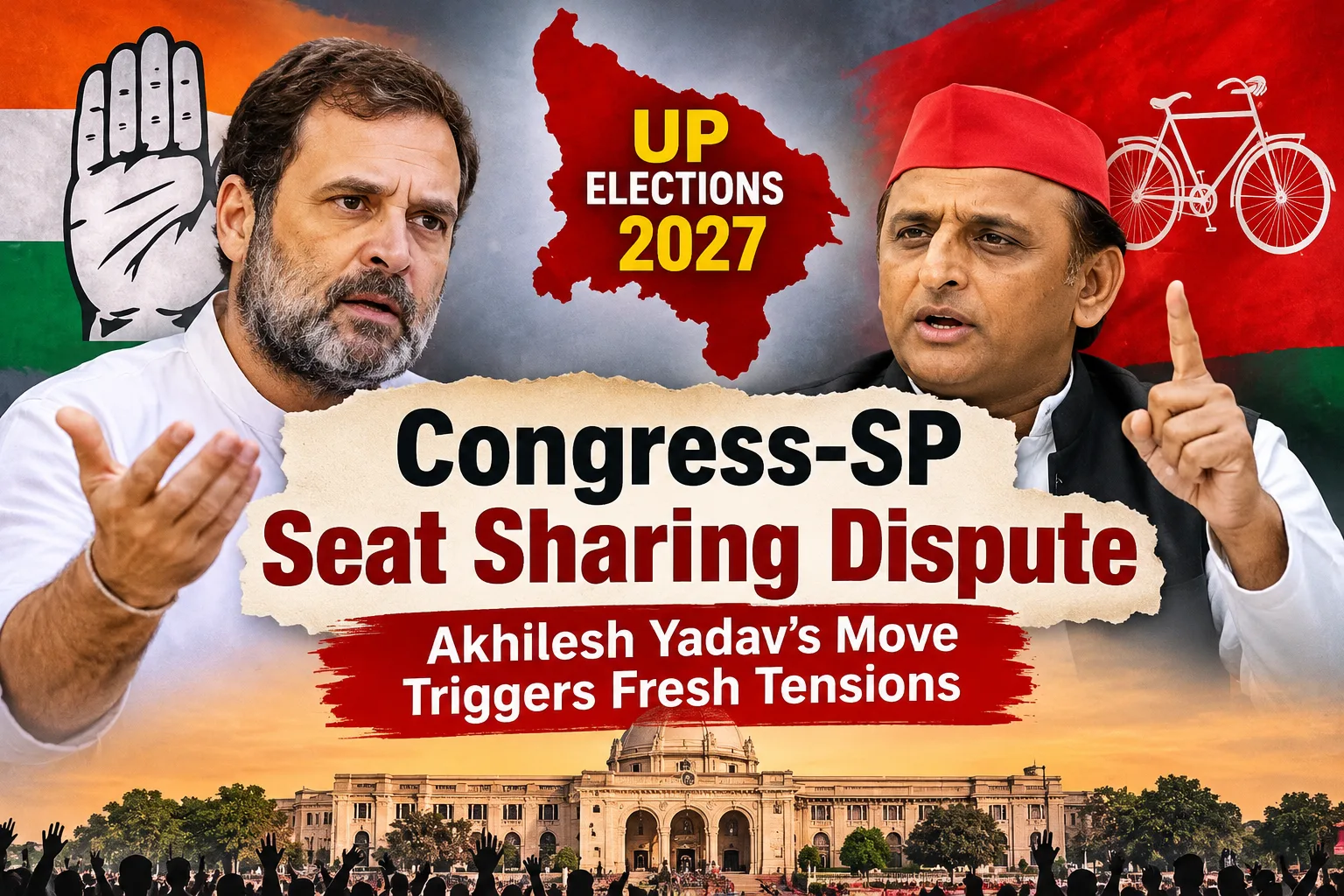
The seat-sharing negotiations between the Congress and the Samajwadi Party (SP) for the 2027 Uttar Pradesh Assembly elections have run into fresh difficulties. The disagreement has intensified after the SP announced five candidates while discussions over the alliance’s seat-sharing arrangement were still underway. The move has reportedly upset Congress leaders, particularly because some of the announced constituencies were also part of the Congress’s preferred list.
The dispute comes at a crucial stage for both parties as they explore a joint strategy for the 403-member Uttar Pradesh Legislative Assembly. While the SP is emphasising candidates’ winnability and electoral calculations, Congress is seeking a larger share of seats to strengthen its political presence in the state. The gap between the two sides has now become a public political issue, with the BJP using the disagreement to question the coordination between its potential opponents. NDTV+1
What Happened Between the Congress and Samajwadi Party?
The latest disagreement centres on two issues: the number of seats Congress wants to contest and the SP’s decision to announce candidates before completing the alliance negotiations.
According to reports, Congress initially sought 181 seats in the 403-member Uttar Pradesh Assembly. Its demand was subsequently reduced to around 131 seats and then brought down further to 110 during the latest discussions. The Samajwadi Party, meanwhile, proposed offering Congress 26 seats, although SP leaders indicated that discussions on individual constituencies were still continuing. NDTV+1
The gap between the two proposals has become a major obstacle. Congress wants a share that reflects its political presence and recent electoral performance, while the SP is emphasising constituency-level calculations, local strength and the chances of individual candidates winning.
SP leaders have argued that the alliance should focus on winning constituencies rather than simply dividing seats according to a fixed numerical formula. Akhilesh Yadav has repeatedly highlighted the importance of selecting candidates based on electoral prospects.
However, for Congress, the proposed 26 seats are considerably below its stated expectations. The difference has made it difficult for both parties to reach a mutually acceptable arrangement.
Why Did Akhilesh Yadav’s Announcement of Five Candidates Upset Congress?
The immediate trigger for the latest controversy was the Samajwadi Party’s announcement of five candidates while seat-sharing negotiations were still underway.
The announcement reportedly caught Congress leaders by surprise because some of the constituencies were also being considered by Congress as potential seats for its candidates.
The five candidates announced by the Samajwadi Party were:
| Constituency | SP candidate |
|---|---|
| Behat | Umar Ali |
| Saharanpur | Aashu Malik |
| Kairana | Nahid Haidar |
| Amroha | Mahbub Ali |
| Lalitpur | Jyoti Lodi |
Four of these constituencies are located in western Uttar Pradesh, while Lalitpur is in the Bundelkhand region. The announcement of candidates in western UP attracted particular attention because Congress was reportedly interested in contesting some of these seats.
Saharanpur became especially sensitive because Congress leader Imran Masood represents the constituency in the Lok Sabha and is also the party’s Uttar Pradesh working president.
Congress leaders reportedly felt that announcing candidates in constituencies under discussion could weaken the ongoing negotiations and create uncertainty about the seriousness of the proposed alliance. NDTV+1
Imran Masood Questions the SP’s Approach
Congress leader Imran Masood expressed dissatisfaction over the Samajwadi Party’s decision to announce candidates before the negotiations had been concluded.
Questioning the timing of the announcement, Masood asked how the SP could release candidate names while seat-sharing discussions were still taking place. He also indicated that Congress was not dependent on the Samajwadi Party for political space and could consider contesting candidates from the same constituencies.
His remarks reflected the frustration among sections of the Uttar Pradesh Congress leadership.
For Congress, the disagreement is not only about the number of constituencies it may receive. It is also about how both parties communicate and coordinate their decisions during alliance negotiations.
The party reportedly plans to raise the issue with its central leadership. However, Congress has not formally announced a final decision to withdraw from the proposed alliance or contest independently against the SP in the affected constituencies. NDTV+1
Akhilesh Yadav’s Message: Focus on Winning, Not Just Seat Numbers
Amid the disagreement, Akhilesh Yadav has attempted to present the negotiations as a discussion about electoral strategy rather than a simple division of constituencies.
In a public message, the SP chief called for serious discussions between the two parties, taking public expectations and political realities into consideration. He argued that the alliance should prioritise constituencies where its candidates have a stronger possibility of winning.
His position is based on the idea that seat allocation should consider local political equations, previous election results and the strength of candidates from both parties.
The SP has also indicated that it wants Congress to share its preferred constituencies and potential candidate details. This would allow both parties to assess individual seats and decide which alliance partner should contest each constituency.
However, Congress is reportedly uncomfortable with some of these demands, particularly when it believes that its organisational interests and political influence are not being adequately considered.
The difference in approach has become one of the central challenges in the negotiations. While the SP wants flexibility based on constituency-level calculations, Congress is seeking a more substantial and clearly defined arrangement before committing fully to the alliance. Rediff.com India News+1
BJP Targets the Congress-SP Disagreement
The disagreement has also provided an opportunity for the Bharatiya Janata Party (BJP) to criticise the opposition parties.
BJP MLA Rajeshwar Singh took aim at the Samajwadi Party’s candidate announcement, questioning the difference between Akhilesh Yadav’s public appeal for cooperation and the party’s decision to release five names without a completed seat-sharing agreement.
Singh argued that the announcement contradicted the message of mutual coordination being presented by the opposition parties. He also raised questions about the candidate distribution and the representation of different communities.
The BJP’s criticism is part of its broader political response to the proposed Congress-SP alliance ahead of the 2027 Uttar Pradesh Assembly elections.
Uttar Pradesh Deputy Chief Minister Keshav Prasad Maurya and other BJP leaders have also criticised the opposition’s efforts to form a joint electoral arrangement.
For the BJP, disagreements between the two parties offer an opportunity to question whether the opposition can maintain coordination across the state’s 403 constituencies. However, the final impact of the dispute will depend on whether the alliance partners resolve their differences and announce a mutually accepted arrangement. NDTV+1
Why Is Uttar Pradesh So Important for the Congress-SP Alliance?
Uttar Pradesh is one of India’s most politically significant states, with 403 Assembly constituencies and 80 Lok Sabha seats. Its electoral results have a major influence on national political discussions.
For the Samajwadi Party, the state remains its primary political battleground. The party is seeking to strengthen its position and challenge the BJP-led government in the 2027 Assembly elections.
Congress, meanwhile, is attempting to rebuild its organisational presence in Uttar Pradesh. A seat-sharing arrangement with the SP could give it an opportunity to contest selected constituencies where it believes it has local support and a competitive candidate.
The two parties have previously contested elections together. Their 2017 Uttar Pradesh Assembly alliance did not produce the result they had hoped for, with the SP winning 47 seats and Congress securing seven.
Their more recent partnership in the 2024 Lok Sabha elections produced a different outcome. The SP won 37 of the 62 parliamentary constituencies it contested, while Congress won six of the 17 seats it contested. Together, they secured 43 of Uttar Pradesh’s 80 Lok Sabha constituencies. The New Indian Express+1
That performance has become an important reference point for both parties as they prepare for the next Assembly election.
However, the Lok Sabha and Assembly elections involve different constituency-level calculations. The strength of a party in a parliamentary election does not automatically translate into the same position across Assembly constituencies.
This is one reason why seat-sharing negotiations require detailed discussions rather than relying only on the overall results of the previous election.
Congress and SP: The Political Importance of Seat-Sharing
The current disagreement highlights a common challenge faced by political alliances: deciding how much space each partner should receive.
For Congress, contesting a meaningful number of seats is important for maintaining its organisational presence, giving local leaders opportunities and building its political position in the state.
For the SP, the priority is to protect its established constituencies while deciding where Congress candidates could strengthen the combined alliance.
Both parties therefore have different considerations.
A larger seat allocation for Congress could help the party contest more constituencies, but the SP may question whether every proposed seat has a strong Congress candidate. Similarly, a smaller allocation could make negotiations easier from the SP’s perspective but may create dissatisfaction within Congress.
The issue becomes more complicated when both parties want to contest the same constituency.
The announcement of five SP candidates has brought this challenge into the open. Even if both parties agree on the broader objective of contesting together, disagreements over individual constituencies can affect the trust needed to sustain an alliance.
What Happens Next in the Congress-SP Seat-Sharing Talks?
The immediate focus will be on how the senior leadership of both parties responds to the latest developments.
Congress leaders are expected to take their concerns to the party high command, while the SP leadership will have to address the objections raised by its potential alliance partner.
The negotiations will need to resolve several important questions:
- How many seats will Congress finally receive?
- Will the SP reconsider any of the five announced candidates?
- How will both parties decide on constituencies claimed by both sides?
- Will candidate selection be based on previous election results, local organisational strength or other winnability assessments?
- Can the central leadership of both parties reach an agreement acceptable to their state-level leaders?
The final seat-sharing arrangement will require more than an agreement on numbers. Both parties will also need a mechanism for coordinating candidate announcements, campaign activities and constituency-level decisions.
The SP and Congress had initially expressed confidence that their alliance could be finalised within a few days of the first round of negotiations. However, the latest developments indicate that important differences remain unresolved. Rediff.com India News+1
2027 UP Assembly Elections: A Crucial Test for Opposition Coordination
The Congress-SP seat-sharing disagreement has emerged months before the expected 2027 Uttar Pradesh Assembly elections, but it has already placed the proposed alliance under public scrutiny.
The SP wants to prioritise constituency-level winnability, while Congress is seeking a larger and more clearly defined role in the alliance. The announcement of five candidates has added another layer to the negotiations, particularly because some of the constituencies reportedly overlap with Congress’s interests.
The BJP has used the disagreement to question the opposition’s ability to work together. Meanwhile, neither Congress nor the SP has formally announced the collapse of their proposed alliance.
The coming negotiations will be important in determining whether both parties can settle their differences and move towards a common electoral strategy. Until an official seat-sharing agreement is announced, the final number of constituencies allocated to Congress and the SP remains undecided.
For now, the Congress-SP dispute is an important development in the political preparations for the 2027 Uttar Pradesh Assembly elections.
Frequently Asked Questions (FAQs)
Why are Congress and the Samajwadi Party fighting over seat-sharing in Uttar Pradesh?
Congress and the Samajwadi Party are facing disagreements over the number of seats each party should contest in the 2027 Uttar Pradesh Assembly elections. Congress reportedly reduced its demand to 110 seats, while the SP proposed 26 seats. The announcement of five SP candidates during negotiations further increased tensions.
How many seats did the Samajwadi Party offer Congress?
According to reports, the Samajwadi Party initially proposed offering Congress 26 seats. However, discussions were continuing, and the final seat-sharing arrangement had not been officially announced as of November 25, 2026.
Which five candidates did Akhilesh Yadav’s Samajwadi Party announce?
The five announced candidates are Umar Ali from Behat, Aashu Malik from Saharanpur, Nahid Haidar from Kairana, Mahbub Ali from Amroha and Jyoti Lodi from Lalitpur.
Why is Imran Masood upset with the Samajwadi Party?
Congress leader Imran Masood reportedly questioned the SP’s decision to announce candidates before completing seat-sharing negotiations. The announcement of Aashu Malik from Saharanpur was particularly sensitive because Congress was reportedly interested in the constituency.
What did Akhilesh Yadav say about the Congress-SP alliance?
Akhilesh Yadav emphasised that the alliance should focus on winning equations rather than only the number of seats. He argued that candidate selection and constituency allocation should consider electoral prospects and local political realities.
Will Congress and the Samajwadi Party contest the 2027 UP elections together?
Both parties have been negotiating a possible alliance, but a final seat-sharing agreement had not been announced as of November 25, 2026. The latest disagreement has complicated the discussions, but neither party had formally declared the proposed alliance over.
When will the Uttar Pradesh Assembly elections take place in 2027?
The Uttar Pradesh Assembly elections are expected in February-March 2027. The election will cover all 403 constituencies in the state. The official election schedule will be announced by the Election Commission of India.