
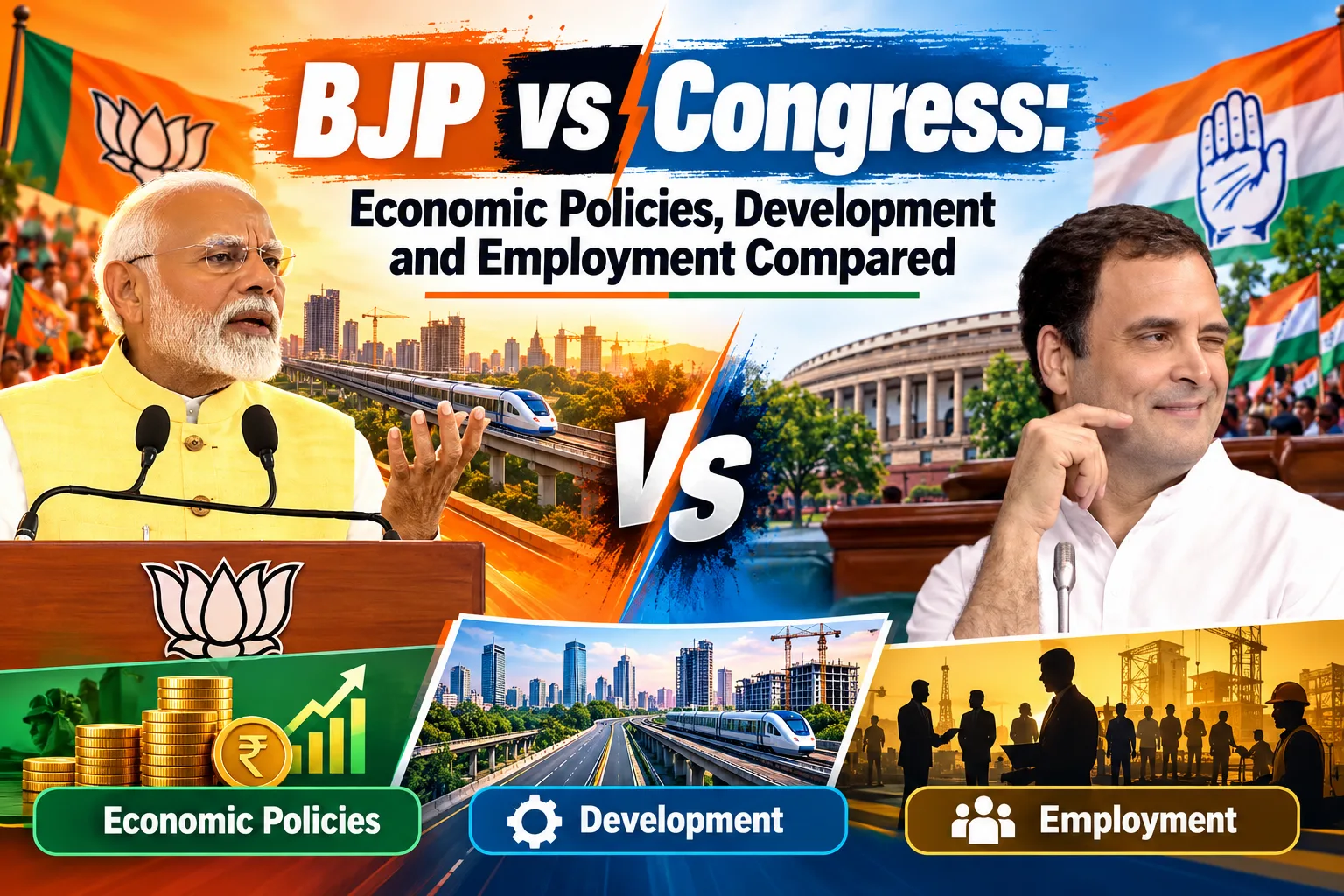
India’s economic future is one of the biggest subjects of political debate. Whenever elections approach, two questions become especially important for voters: which political party can deliver stronger economic growth, and which one can create better employment opportunities? In Indian politics, the Bharatiya Janata Party (BJP) and the Indian National Congress are often at the centre of this discussion.
Both parties have different approaches to economic development, infrastructure, taxation, welfare schemes, industrial growth and job creation. The BJP generally highlights infrastructure expansion, manufacturing, investment, digital development and the continuation of existing welfare programmes. Congress places strong emphasis on employment generation, social security, support for small businesses, economic equality and changes to taxation and labour policies.
However, comparing BJP vs Congress economic policies requires more than looking at election speeches or political claims. It is important to understand their economic priorities, examine their policy proposals and evaluate actual outcomes using reliable data.
This article compares BJP and Congress on economic policies, development, employment, infrastructure, manufacturing, taxation and welfare to help readers understand the key differences.
Understanding the Economic Approach of BJP and Congress
The BJP and Congress have different political and economic histories. Their approaches have also changed over time in response to India’s economic conditions, global developments and public expectations.
The BJP’s recent economic approach focuses on making India a major global economic power through infrastructure investment, manufacturing, digital services, entrepreneurship and private-sector participation. Initiatives such as Make in India, Production Linked Incentive schemes, PM Gati Shakti and Digital India reflect this direction.
Congress, meanwhile, presents its economic approach around employment, inclusive growth, economic justice and strengthening opportunities for small businesses and workers. Its economic policy also draws on its role in India’s 1991 economic liberalisation, while proposing changes to taxation, labour policies and welfare programmes.
The difference is not simply that one party supports development and the other supports welfare. Both discuss economic growth, infrastructure, investment and social support, but they place different emphasis on how these goals should be achieved.
BJP Economic Policies: Infrastructure, Manufacturing and Investment
The BJP’s economic strategy places significant importance on infrastructure development, industrial expansion and improving India’s position in the global economy.
One of its major priorities is increasing investment in roads, highways, railways, airports, ports and other infrastructure. Better infrastructure can reduce transportation costs, improve connectivity and help businesses move goods more efficiently. It can also create employment during construction and support economic activity in connected regions.
The government has also promoted manufacturing through initiatives such as Make in India and Production Linked Incentive schemes. These programmes aim to encourage companies to manufacture products in India, expand production capacity and strengthen domestic supply chains.
Another important part of the BJP’s economic approach is digital development. Digital payment systems, online government services, digital identity infrastructure and technology-based public services have changed how individuals and businesses interact with the economy.
The BJP’s 2024 Lok Sabha manifesto, known as Sankalp Patra, also highlighted the ambition of making India one of the world’s three largest economies. It emphasised manufacturing, infrastructure, startups, MSMEs, tourism, technology and employment opportunities.
However, policy announcements and investment targets should not automatically be treated as completed economic achievements. Their actual impact depends on implementation, private investment, productivity, job creation and the quality of employment generated.
Congress Economic Policies: Employment, Welfare and Economic Equality
Congress places employment generation and economic inclusion at the centre of its economic policy proposals.
Its 2024 manifesto, Nyay Patra, described employment as a major economic priority. It proposed filling vacant government positions, introducing an urban employment programme, supporting MSMEs and creating incentives for businesses that generate regular jobs.
Congress has also emphasised the role of small and medium-sized businesses in employment generation. MSMEs employ workers across manufacturing, trading, services and local industries. Better access to finance, simpler regulations and stable business conditions can help these enterprises expand.
Another important area is social security. Congress has proposed stronger protections for gig workers, unorganised workers, migrant workers and other groups that may not have access to traditional employment benefits.
On taxation, Congress proposed changes to the GST structure, a Direct Taxes Code and a review of certain tax policies. Its stated objective is to make taxation more predictable and reduce the burden on selected categories of taxpayers and businesses.
These proposals reflect a policy approach that gives greater attention to employment quality, worker protection and distribution of economic opportunities. Their effectiveness, however, would depend on funding, administrative capacity and the ability to implement the proposals without discouraging investment.
BJP vs Congress: Economic Policies Compared
The following comparison highlights the broad direction of the two parties’ economic approaches, particularly as reflected in their 2024 national election manifestos.
| Economic area | BJP | Congress |
|---|---|---|
| Economic growth | Focus on making India a leading global economy | Focus on inclusive growth and economic justice |
| Infrastructure | Strong emphasis on highways, railways, airports and connectivity | Supports infrastructure expansion with attention to public services and accountability |
| Manufacturing | Make in India, PLI schemes and domestic production | Manufacturing expansion with employment-linked incentives |
| Employment | Manufacturing, startups, infrastructure and entrepreneurship | Government vacancies, urban employment and MSME-led job creation |
| MSMEs | Credit access, entrepreneurship and business expansion | Easier finance, tax relief and support for job-creating businesses |
| Taxation | Continuation and adjustment of existing tax reforms | Proposed GST changes and a Direct Taxes Code |
| Welfare | Expansion and continuation of major welfare programmes | Greater emphasis on social security and targeted welfare |
| Workers | Skills, entrepreneurship and formalisation | Worker protections, gig-worker rights and employment guarantees |
This comparison describes policy priorities rather than proving which party has delivered better results. The parties have governed in different periods and economic conditions, so their performance must be assessed using comparable data.
Development and Infrastructure: Which Approach Is Different?
Infrastructure development plays a major role in India’s economic growth. Roads, railways, airports, ports, electricity and public transport support businesses and improve access to markets.
The BJP has made infrastructure investment one of its most visible economic priorities. Its approach has included highway expansion, railway modernisation, new airports, logistics improvements and industrial corridors. Programmes such as PM Gati Shakti aim to improve coordination between different infrastructure projects.
Congress has also supported infrastructure development during its periods in government. Its 2024 manifesto proposed modernising railway infrastructure, improving public transport, attracting private investment and strengthening connectivity between rural areas and nearby towns and cities.
The main difference lies in policy emphasis and implementation priorities. The BJP has highlighted large-scale infrastructure creation and logistics connectivity, while Congress has placed additional emphasis on public transport, project accountability and maintaining facilities for ordinary commuters.
For voters, the important questions are practical: Are roads reducing travel time? Are railway services improving? Are infrastructure projects being completed on schedule? Are public facilities affordable and accessible? Are new projects generating sustainable economic activity?
The answers require project-level data rather than political slogans.
Manufacturing and Industrial Growth
Manufacturing is important because it can create employment, increase exports, reduce dependence on imports and support the growth of related industries.
The BJP has promoted manufacturing through Make in India and Production Linked Incentive schemes. These initiatives target industries such as electronics, automobiles, pharmaceuticals, solar equipment and other sectors considered important for domestic production.
The BJP’s policy direction is to attract investment, improve manufacturing capacity and make India a competitive production destination.
Congress also supports manufacturing expansion. Its 2024 manifesto proposed increasing the manufacturing share of GDP, reviewing existing industrial regulations and using employment-linked incentives to encourage companies to hire more workers.
One important difference is the emphasis on the employment impact of industrial policy. BJP’s approach gives considerable attention to production, investment and manufacturing competitiveness. Congress has proposed linking more incentives to regular employment and job creation.
However, manufacturing growth should be measured through more than factory announcements. Important indicators include manufacturing output, capacity utilisation, exports, productivity, wages and the number of sustainable jobs created.
Employment and Unemployment: The Biggest Challenge for Both Parties
Employment remains one of the most important concerns for Indian voters, particularly young people entering the workforce.
India needs jobs across multiple sectors, including manufacturing, construction, agriculture, technology, tourism, healthcare, education, logistics and financial services. The challenge is not only to create more jobs but also to provide stable income, suitable working conditions and opportunities for career growth.
The BJP has highlighted infrastructure investment, manufacturing, entrepreneurship, startups, skill development and private-sector growth as important sources of employment.
Congress has proposed filling government vacancies, creating an urban employment programme, supporting MSMEs and introducing incentives for companies that generate additional regular jobs.
The debate also involves the difference between employment and quality employment. A person working in an informal or low-paying position may be counted as employed, but that does not necessarily mean the person has financial security or access to social protection.
According to the Periodic Labour Force Survey Annual Report 2025, India’s worker population ratio for people aged 15 years and above was estimated at 57.4%, while the labour force participation rate stood at 59.3%. The report also recorded an unemployment rate of 6.5% among educated people aged 15 years and above.
These figures need to be interpreted carefully. The 2025 report introduced changes to the survey’s sampling framework and estimation procedure, so its estimates may not be strictly comparable with earlier annual reports.
This is why employment discussions should use official data, clearly state the age group and measurement method, and avoid comparing unrelated unemployment figures.
Government Jobs vs Private-Sector Employment
Government employment is an important part of the political debate because it offers relatively stable salaries and benefits. However, government vacancies alone cannot meet the employment needs of India’s large workforce.
Congress’s 2024 manifesto proposed filling nearly 30 lakh vacancies in sanctioned central government positions and introducing job calendars to improve recruitment timelines.
The BJP has focused more broadly on private-sector employment through infrastructure, manufacturing, entrepreneurship and investment. Its policy direction also includes expanding opportunities through startups, MSMEs and skill development.
Both approaches address different parts of the employment challenge.
Government recruitment can provide stable jobs in education, healthcare, administration and public services. Private-sector growth can create employment at a much larger scale across industries, although job quality and stability vary.
India needs both. Faster recruitment for essential public services and a stronger private-sector environment can work together to improve employment opportunities.
Welfare Schemes and Support for Common Citizens
Welfare schemes are another major part of the BJP vs Congress economic comparison.
The BJP has focused on expanding and continuing programmes related to food security, housing, healthcare, financial inclusion, electricity, sanitation and support for farmers.
Its 2024 manifesto highlighted the continuation of free food-grain support, expansion of housing initiatives, PM Surya Ghar and healthcare coverage for senior citizens under Ayushman Bharat.
Congress has proposed strengthening social security, expanding worker protections, improving access to welfare and introducing additional employment-related support. Its manifesto also proposed changes to existing programmes and new initiatives for urban workers and vulnerable groups.
Welfare policies can reduce financial pressure on households, but their effectiveness depends on eligibility rules, fund allocation, delivery systems and whether benefits reach the intended recipients.
A useful comparison should examine actual coverage, service quality and beneficiary outcomes rather than simply counting the number of schemes announced.
Taxation and Support for Businesses
Tax policy affects consumers, employees, small businesses and large companies. It also determines how the government collects revenue for public spending.
The BJP introduced major tax and economic changes during its time in power, including the Goods and Services Tax in 2017. Its broader policy direction has included improving tax compliance, expanding digital systems and encouraging investment.
Congress’s 2024 manifesto proposed replacing the existing GST laws with a revised GST framework and introducing a Direct Taxes Code. It also discussed reducing certain tax burdens on MSMEs and creating a more predictable tax environment.
For businesses, the most important factors include tax compliance costs, clarity of rules, access to credit, regulatory stability and the ability to compete.
For ordinary citizens, tax policy should be assessed through its effect on household expenses, disposable income, savings and the cost of essential goods and services.
Neither a lower tax rate nor a higher tax collection automatically proves that an economy is performing better. The broader impact on investment, public services and household finances matters.
Which Party Has a Better Economic Policy?
There is no single answer that can be established through political messaging alone.
The BJP’s economic approach gives strong importance to infrastructure, investment, manufacturing, digital development and India’s global economic position. These priorities can support long-term growth when projects are completed efficiently and investment creates productive employment.
Congress’s economic proposals place greater emphasis on employment generation, social protection, MSMEs, worker rights and changes to taxation. These priorities address concerns around job security, income inequality and the need to make growth more inclusive.
The actual performance of either party should be judged through measurable outcomes. Voters can examine GDP growth, inflation, per-capita income, employment, wages, manufacturing output, exports, infrastructure quality and public debt.
It is also important to remember that India’s economic performance depends on state governments, global market conditions, private investment, international trade, technology and many other factors. A national government influences the economy, but it does not control every outcome.
What Should Indian Voters Consider Before Comparing BJP and Congress?
Before deciding which party has a stronger economic vision, voters should look beyond campaign promises.
They should examine whether the party has explained how its proposals will be funded, whether its employment plans have clear targets, and whether its infrastructure promises include realistic completion timelines.
It is also important to check whether economic growth is reaching smaller towns, rural areas, women, young people and small businesses. A growing economy should create opportunities across different sections of society.
The most useful comparison is one based on policy details, reliable statistics, implementation records and long-term economic outcomes.
Conclusion
The BJP vs Congress economic policy debate reflects two different approaches to India’s development priorities. The BJP places significant emphasis on infrastructure, manufacturing, investment, digital development and global economic growth. Congress highlights employment, economic inclusion, MSME support, worker protection and taxation reforms.
Both parties discuss economic growth and welfare, but they differ in the methods and priorities they propose. For India, the real challenge is to combine strong economic growth with sustainable employment, better wages, productive industries and accessible public services.
Ultimately, the better economic approach is the one that delivers measurable improvements in people’s lives. Voters should judge political parties through verified data, implementation and long-term results rather than promises alone.
Frequently Asked Questions
What is the main difference between BJP and Congress economic policies?
The BJP emphasises infrastructure, investment, manufacturing, digital development and entrepreneurship. Congress places greater emphasis on employment generation, worker protection, MSMEs, economic inclusion and taxation reforms.
Which party focuses more on employment generation?
Both parties discuss employment, but their proposed approaches differ. BJP highlights private-sector growth, manufacturing, infrastructure and entrepreneurship, while Congress has proposed government recruitment, urban employment programmes and employment-linked incentives.
What are the BJP’s major economic initiatives?
Major initiatives associated with the BJP government include Make in India, Production Linked Incentive schemes, PM Gati Shakti, Digital India and infrastructure expansion programmes.
What are the major economic proposals in the Congress 2024 manifesto?
Congress’s 2024 manifesto included proposals for filling government vacancies, introducing an urban employment programme, supporting MSMEs, revising GST and introducing a Direct Taxes Code.
Why is employment an important factor in the BJP vs Congress comparison?
Employment affects household income, living standards, economic security and consumer demand. Comparing job creation, wages, job quality and workforce participation helps voters understand the practical impact of economic policies.
How can voters compare the economic performance of BJP and Congress?
Voters can compare GDP growth, inflation, employment, wages, manufacturing, exports, infrastructure development, public debt and welfare delivery. Data should be compared across similar periods and using consistent measurement methods.