
Mukesh Ambani is expanding Reliance Industries’ presence in India’s consumer market through a growing portfolio of products across food, beverages, personal care, dairy, snacks and digital services. From Campa soft drinks and Independence food products to RasikK fruit juices and Alan’s Bugles snacks, Reliance is attempting to build a strong position in categories traditionally dominated by established Indian and international brands.
The strategy is part of Reliance’s larger ambition to become a major player in India’s fast-moving consumer goods (FMCG) industry. Rather than depending only on its retail stores and telecommunications business, the company is building consumer-facing brands that can reach millions of Indian households.
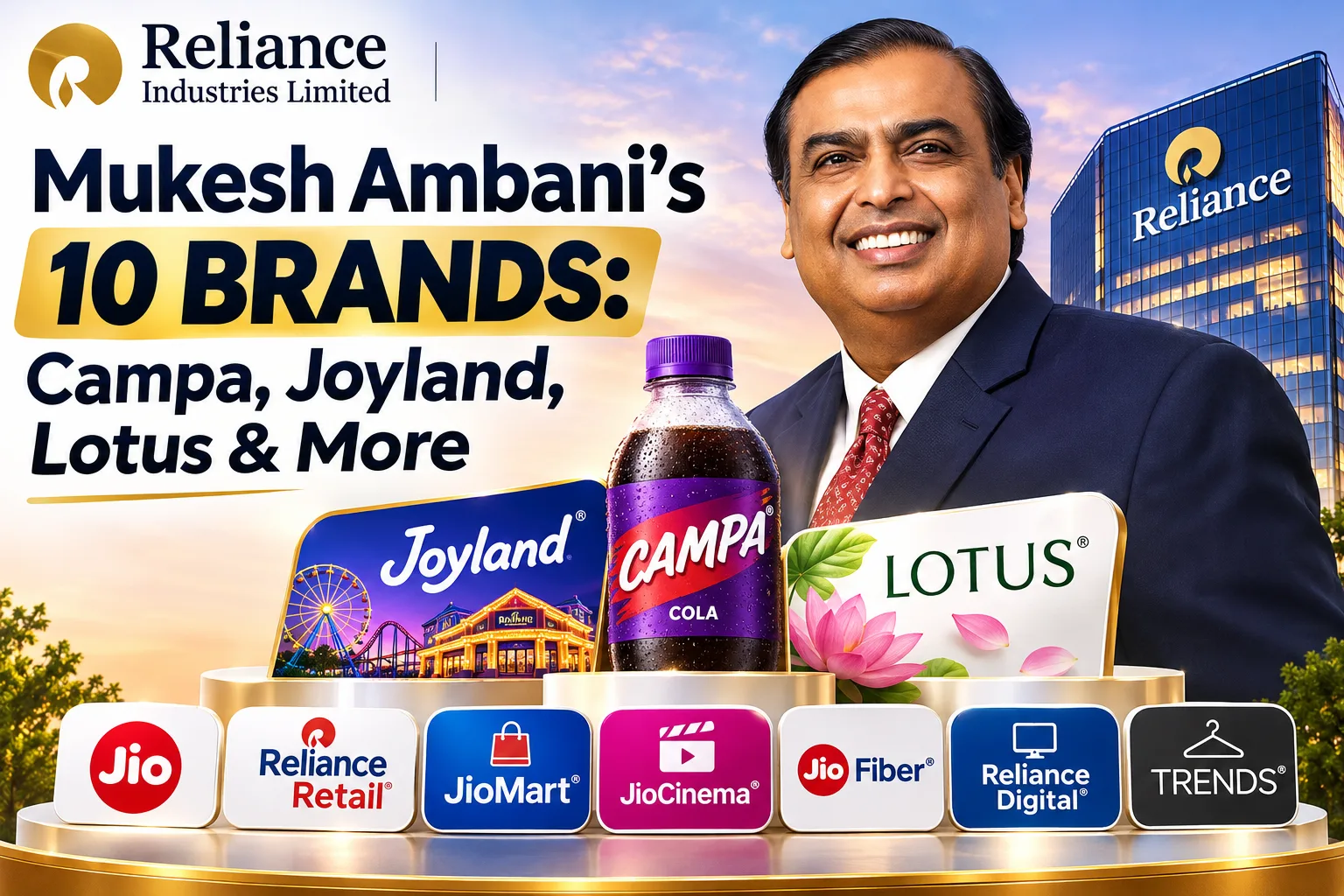
An image circulating on social media lists 10 recently launched brands associated with Mukesh Ambani, including Campa, Independence, RasikK, Joyland, Maliban, Lotus, Alan’s Bugles, Puric, Campa Sure and JioAstro.
However, there is an important distinction: not all these names are newly created brands owned by Reliance. Some are acquired or licensed brands, some are product labels, and some require further verification of their ownership and launch status.
Let’s understand these brands, what they sell, how they fit into Reliance’s business strategy and why Mukesh Ambani is focusing on India’s everyday consumer market.
Mukesh Ambani’s 10 New Brands: Campa, Independence, Joyland, Lotus, Bugles and More
Business News | FMCG Industry | India | November 2026
Mukesh Ambani is taking Reliance Industries beyond telecommunications, retail and energy by building a massive consumer products business. Through Reliance Consumer Products Limited (RCPL), the company is entering everyday product categories that include soft drinks, packaged food, biscuits, chocolates, snacks, personal care, packaged drinking water and dairy beverages.
The strategy is becoming increasingly visible in India’s FMCG market. Campa is challenging established soft drink companies, Independence is expanding into everyday grocery products, Joyland has entered the flavoured milk segment, and Campa Sure is competing in the packaged drinking water market.
Reliance is also bringing established international and regional brands to Indian consumers through acquisitions and partnerships. Maliban biscuits and Bugles corn snacks are examples of this approach, while Lotus Chocolate has become part of Reliance’s consumer products portfolio through a controlling investment.
An interesting development is that the company’s ambitions are no longer limited to physical products. In November 2026, Jio Platforms also entered the digital astrology market with JioAstro, an AI-powered Vedic astrology platform.
A viral list of 10 brands associated with Mukesh Ambani includes Campa, Independence, Raskik, Joyland, Maliban, Lotus, Alan’s Bugles, Puric, Campa Sure and JioAstro. Although the list covers several genuine Reliance-associated businesses, it is important to understand that some are acquired brands, some are partnerships, and others are products or services rather than newly created brands.
Let’s take a closer look at all 10 names, their products, business background and how Reliance is building its consumer business.
Reliance’s Growing Consumer Brand Portfolio
Reliance’s consumer products strategy is being managed through Reliance Consumer Products Limited, the FMCG business associated with Reliance Industries.
RCPL was established in 2022 to develop and expand Reliance’s consumer goods business. It focuses on offering products across everyday consumption categories at competitive prices.
The company has adopted a combination of three strategies:
- Developing new brands for Indian consumers.
- Acquiring established companies and their brands.
- Partnering with international companies to introduce their products in India.
This approach allows Reliance to enter different markets without having to build every brand from the beginning.
The business has also expanded its distribution network through general trade, kirana stores, modern retail and Reliance’s own retail ecosystem.
According to Reliance’s FY2025-26 reporting, RCPL recorded gross revenue of approximately ₹22,000 crore, while Campa generated more than ₹4,700 crore in gross sales and Independence achieved approximately ₹2,600 crore in sales. These figures demonstrate how quickly the consumer products business has expanded. Reliance Retail Performance FY 2025-26+1
1. Campa – Soft Drinks
Category: Carbonated soft drinks and beverages
Campa Brand Identity Packaging Strategy — Nidhi Brand Consulting
nidhibrandconsulting.squarespace.com
Campa is arguably the most recognisable name in Reliance’s consumer products expansion. The brand has a long history in India’s soft drink market and became popular among Indian consumers several decades ago.
Reliance acquired the Campa brand from Pure Drinks and brought it back to the Indian market in 2023 through Reliance Consumer Products.
The relaunch attracted considerable attention because Campa was returning to a market dominated by major international beverage companies.
The company initially focused on making Campa available at competitive prices. Its product portfolio includes different flavours, including Cola, Orange and Lemon, along with additional beverage variants.
Campa’s pricing strategy has been an important part of its market positioning. Reliance wants to attract consumers who are looking for affordable alternatives to established soft drink brands.
The brand has also expanded into different beverage categories, including energy drinks and sports-oriented beverages.
Campa’s growth has been significant. According to Reliance’s FY2025-26 reporting, the brand generated more than ₹4,700 crore in gross sales and became India’s fourth-largest carbonated soft drink brand, with double-digit market share in certain key markets.
This makes Campa one of the most important brands in Reliance’s FMCG strategy.
Its biggest competition comes from Coca-Cola, Pepsi and other established beverage manufacturers.
2. Independence – Atta, Rice, Pulses and Daily Essentials
Category: Grocery and packaged food products
Independence is Reliance’s own consumer goods brand, developed to serve the everyday grocery requirements of Indian households.
Unlike Campa, which focuses primarily on beverages, Independence covers a much wider range of daily-use products.
The brand was introduced in December 2022, initially focusing on Gujarat before expanding into other Indian markets.
Its product portfolio includes:
- Wheat flour and atta
- Rice and other grains
- Pulses and dals
- Edible oils
- Packaged food products
- Other everyday grocery essentials
The main idea behind Independence is to provide consumers with quality products at affordable prices.
India has a large market for everyday grocery products, and millions of households purchase these items regularly. This creates an opportunity for companies that can offer consistent quality, competitive pricing and widespread availability.
Reliance is using its retail infrastructure and distribution network to increase the availability of Independence products.
The brand has also expanded beyond basic staples into additional packaged food categories.
According to Reliance’s FY2025-26 reporting, Independence achieved approximately ₹2,600 crore in sales. The company also highlighted the brand’s recognition among India’s trusted consumer brands.
Independence is particularly important because it allows Reliance to compete in a market where established brands and regional manufacturers already have strong consumer relationships.
3. Raskik – Fruit-Based Beverages
Category: Fruit-based drinks and beverages
6 beverage startups that can keep you fresh and hydrated this summer | YourStory
Raskik, sometimes incorrectly written as RasikK in viral brand lists, is another beverage name associated with Reliance’s consumer products portfolio.
The brand forms part of the company’s broader strategy to expand beyond carbonated soft drinks.
While Campa focuses heavily on the soft drink market, Raskik represents the fruit-based beverage category.
This is an important segment because Indian consumers purchase different types of drinks depending on taste, price, season and consumption preferences.
Fruit-based beverages also allow companies to target customers who may not regularly purchase carbonated soft drinks.
Reliance has built its beverage portfolio through a combination of its own brands, acquisitions and partnerships. Raskik was among the consumer brands added to the company’s portfolio during its expansion phase.
The brand is part of a competitive market that includes established packaged juice and fruit beverage manufacturers.
For Reliance, expanding the beverage portfolio helps increase its presence across different consumption occasions rather than depending entirely on Campa.
However, Raskik should not be confused with a completely new brand launched in 2026. Its association with Reliance goes back to the company’s earlier consumer brand expansion.
4. Joyland – Flavoured Milk
Category: Dairy-based beverages
Joyland is one of Reliance’s newest consumer product launches in 2026. The brand marks the company’s entry into India’s ready-to-drink flavoured milk market.
Reliance Consumer Products launched Joyland flavoured milk in Tamil Nadu on October 14, 2026, at a price of ₹20.
The initial product range includes flavours such as:
- Strawberry
- Vanilla
- Pistachio
The product is made using dairy ingredients and is positioned as an affordable, convenient beverage for consumers.
This launch is particularly interesting because Reliance is entering a category where established brands already have strong market positions.
Some of its competitors include Amul Kool, Mother Dairy, ITC’s Sunfeast Smoodh and Cavin’s.
The company has indicated that Tamil Nadu is the starting point for Joyland, with plans to introduce more flavours and expand into other dairy beverage categories.
The brand could become an important part of Reliance’s beverage strategy because it allows the company to target consumers beyond the traditional soft drink market.
Joyland also demonstrates that Reliance is looking at different consumption categories, including milk-based drinks, rather than relying only on packaged juices and carbonated beverages. The Economic Times+1
5. Maliban – Biscuits and Crackers
Category: Biscuits, cookies, crackers and wafers
Maliban is a well-known Sri Lankan biscuit brand with a history of more than 70 years.
Unlike Campa and Independence, Maliban was not originally created by Reliance. Instead, Reliance Consumer Products entered into a strategic partnership with Maliban Biscuit Manufactories in January 2023 to bring the brand’s products to Indian consumers.
The partnership is part of Reliance’s strategy of introducing established international consumer brands into India.
Maliban is known for several biscuit and bakery product categories, including:
- Biscuits
- Cream biscuits
- Crackers
- Cookies
- Wafers
The brand already has an established presence in Sri Lanka and exports products to international markets.
Reliance believes that bringing Maliban to India will strengthen its position in the packaged biscuit market.
India’s biscuit industry is highly competitive, with companies such as Britannia, Parle and ITC holding strong market positions.
Maliban provides Reliance with an opportunity to enter this market through an established international brand rather than developing a completely new biscuit identity.
The partnership also combines Maliban’s manufacturing and product expertise with Reliance’s distribution network and retail presence.
It is important to understand that Maliban remains a Sri Lankan brand. Reliance’s relationship with the company is based on a strategic partnership, not the creation of a new Reliance-owned biscuit brand. Reliance Industries Limited+1
6. Lotus – Chocolates
Category: Chocolates and confectionery
Lotus Chocolate is another important name in Reliance’s consumer products portfolio.
Lotus Chocolate Company is an Indian chocolate manufacturer that produces different types of chocolate products and confectionery.
Reliance Consumer Products acquired a 51% controlling stake in Lotus Chocolate in May 2023 for an aggregate consideration of ₹74 crore. It also subscribed to preference shares worth ₹25 crore.
This acquisition gave Reliance control of an established chocolate manufacturing business and helped it strengthen its position in the confectionery segment.
The chocolate market in India has traditionally been dominated by major companies such as Mondelez, Nestlé and Ferrero.
By bringing Lotus into its portfolio, Reliance gained access to an existing manufacturing and product ecosystem.
The brand operates in the chocolate and confectionery category, which includes products used for everyday consumption, gifting and special occasions.
The acquisition is also part of a larger strategy to expand Reliance’s presence in food categories that have high repeat-purchase potential.
Lotus is therefore not a newly created chocolate brand by Mukesh Ambani. It is an established Indian company in which Reliance acquired a controlling stake. RIL+1
7. Alan’s Bugles – Corn Chips and Snacks
Category: Western snacks and corn chips
Alan’s Bugles, commonly referred to as Bugles, represents Reliance’s entry into a different part of India’s packaged snacks market.
Bugles is an international corn snack brand owned by General Mills. Reliance Consumer Products partnered with General Mills to introduce the brand in India.
The launch was announced in 2023 and marked an important development in Reliance’s packaged snacks strategy.
Bugles is known for its distinctive cone-shaped corn snacks, which give the product a recognisable appearance compared with conventional potato chips and namkeen.
The brand targets consumers who enjoy western-style packaged snacks.
Its product category competes with several established brands in India’s snacks market, including products from PepsiCo, ITC and other packaged food companies.
The partnership is interesting because Reliance is not required to develop an entirely new snack product from scratch. It can use the recognition and product experience associated with an existing international brand.
For General Mills, the partnership provides access to Reliance’s extensive Indian retail and distribution network.
For Reliance, it adds another international snack brand to its growing portfolio.
An important ownership distinction is that Bugles belongs to General Mills. Reliance is its Indian launch and distribution partner rather than the original owner of the brand. Reliance Industries Limited+1
8. Puric – Personal Hygiene and Home Disinfection
Category: Personal hygiene and home care
Puric is another brand associated with Reliance Retail’s consumer product portfolio.
The viral list describes Puric as a bathing soap brand, but that description is incomplete.
Reliance introduced Puric as a range of personal hygiene and home disinfectant products. The brand was already part of its consumer portfolio during the financial year 2021-22.
At the time of its introduction, the company reported that Puric included more than 20 product stock-keeping units.
This makes Puric different from the newer beverage and food brands in Reliance’s portfolio.
Its focus is on hygiene-related consumer requirements, including products used for personal cleanliness and household disinfection.
The personal and home care market is an important part of India’s FMCG industry because these products are purchased regularly by households.
Puric also fits into Reliance’s strategy of building its own private-label brands across everyday consumption categories.
The company can use its retail network to make these products available to customers through different sales channels.
Therefore, Puric should not simply be described as a newly launched bathing soap brand. It is a broader hygiene-focused brand with a history going back several years. Reliance Industries Annual Report 2021–22+1
9. Campa Sure – Packaged Drinking Water
Category: Packaged drinking water
Campa Sure is another important addition to Reliance’s beverage portfolio.
Reliance Consumer Products introduced Campa Sure to enter India’s packaged drinking water market, which has traditionally been dominated by established companies and regional manufacturers.
The brand was announced in September 2025, with a nationwide rollout beginning in October 2025.
The product is positioned around affordable packaged drinking water and aims to reach consumers across different price segments.
Reliance has focused on working with regional bottling partners to expand production and distribution.
This approach is particularly important in the packaged water business because transportation, bottling capacity and local distribution play major roles in keeping products affordable.
The company has also highlighted multiple stages of processing and purification in its product positioning.
Campa Sure competes in a market where brands such as Bisleri, Kinley and Aquafina already have significant recognition.
However, Reliance has an important advantage: its extensive distribution infrastructure and relationships with retail outlets.
According to the company’s FY2025-26 reporting, Reliance became India’s third-largest branded packaged drinking water player, supported by Campa Sure and Independence Water.
This demonstrates how the company is expanding its presence in everyday hydration products rather than focusing exclusively on soft drinks.
Campa Sure is therefore not just another beverage extension. It is part of Reliance’s wider strategy to enter essential consumer categories. The Economic Times+1
10. JioAstro – AI-Powered Astrology Platform
Category: Digital services and astrology technology
JioAstro is perhaps the most different name on this list because it is not an FMCG product.
Reliance-backed Jio Platforms entered India’s digital astrology market with JioAstro in November 2026.
The platform combines artificial intelligence with traditional Vedic astrology to provide personalised horoscope and birth-chart services.
Unlike the other brands discussed in this article, JioAstro is a digital service rather than a physical consumer product.
Its reported features include:
- Personalised Kundali readings
- Birth chart analysis
- Daily and yearly horoscopes
- AI-based astrology conversations
- D1 and D9 chart analysis
- Panchang information
- Muhurat recommendations
- Personalised astrology reports
The platform uses Swiss Ephemeris calculations to generate birth charts based on a user’s date, time and place of birth.
Another interesting feature is its language support. JioAstro reportedly supports English, Hindi, Marathi and Gujarati.
It also allows users to create multiple family profiles under a single account and download personalised astrology reports in PDF format.
JioAstro enters a competitive market that already includes platforms such as Astrotalk and AstroSage.
However, there is an important limitation regarding its availability. As of November 27, 2026, reports describe the mobile application as an invite-only prototype, with wider public availability and pricing yet to be established.
JioAstro demonstrates that Reliance is exploring digital consumer services beyond telecommunications, entertainment and shopping.
It also shows how the company is experimenting with AI-based applications in categories that have strong cultural relevance in India. Company News – Business Standard+1
Why Is Mukesh Ambani Launching So Many Consumer Brands?
Reliance’s expansion into these categories is not a random collection of product launches. It is part of a larger business strategy to become one of India’s leading FMCG companies.
There are several reasons behind this approach.
1. India’s Massive FMCG Market
India has a huge population with regular demand for packaged food, beverages, personal care and household products.
Unlike products purchased occasionally, many FMCG products are consumed daily or weekly.
This creates opportunities for companies that can build affordable products and establish strong distribution networks.
Reliance wants to become a familiar name in Indian households, not just through Jio and Reliance Retail but also through everyday products.
2. Competing With Established Brands
Reliance is entering categories where established companies already have significant market share.
| Reliance-associated brand | Major competing brands |
|---|---|
| Campa | Coca-Cola, Pepsi |
| Independence | Aashirvaad, Fortune, Tata Sampann |
| Raskik | Real, Tropicana, other fruit beverage brands |
| Joyland | Amul Kool, Mother Dairy, Smoodh |
| Maliban | Britannia, Parle, Sunfeast |
| Lotus Chocolate | Cadbury, Nestlé, Ferrero |
| Bugles | Lay’s, Bingo, other packaged snacks |
| Puric | Dettol, Savlon, other hygiene brands |
| Campa Sure | Bisleri, Kinley, Aquafina |
The competition is not limited to pricing. Product quality, consumer trust, availability and repeat purchases will determine whether these brands can build long-term market positions.
3. Affordable Pricing Strategy
One of Reliance’s biggest strengths is its ability to operate across different parts of the retail supply chain.
The company can use its retail presence, distribution network and manufacturing partnerships to expand product availability.
Its consumer products strategy focuses on offering quality products at competitive prices.
Campa’s entry into the soft drink market is a good example of this approach.
Similarly, Joyland’s ₹20 flavoured milk launch shows how Reliance is attempting to enter established consumer categories with accessible pricing.
4. Strong Distribution Network
A consumer brand cannot become successful simply by launching an attractive product.
It must be available in neighbourhood grocery shops, supermarkets, local retail stores and online shopping platforms.
Reliance has an existing retail ecosystem that can support the expansion of its consumer brands.
According to its FY2025-26 reporting, RCPL expanded its distribution reach to more than 3 million outlets through over 5,000 distributors.
This distribution network gives the company an important advantage when introducing products in new markets. Reliance Retail Performance FY 2025-26+1
How Big Is Reliance’s FMCG Business in 2026?
Reliance’s consumer products business has grown considerably since its establishment.
Some of its FY2025-26 reported figures highlight the scale of its expansion.
₹22,000 Cr
RCPL gross revenue
₹4,700+ Cr
Campa gross sales
₹2,600 Cr
Independence sales
3 Million+
Distribution outlets
FY2025-26 figures reported by Reliance Industries. Revenue and brand sales are different financial measures.
These figures show that Reliance is no longer treating consumer products as a small extension of its retail business.
It is developing FMCG as a major business vertical with ambitions to compete with established companies across multiple categories.
Are All These Brands Actually Owned by Mukesh Ambani?
This is an important question because the viral list can create a misleading impression that Reliance has independently created all 10 brands.
That is not correct.
Here is the ownership and business relationship explained more clearly.
| Brand | Relationship with Reliance |
|---|---|
| Campa | Acquired brand |
| Independence | Reliance-developed brand |
| Raskik | Acquired brand |
| Joyland | Reliance consumer product brand |
| Maliban | Strategic partnership |
| Lotus Chocolate | 51% controlling stake acquired |
| Bugles | General Mills brand; Reliance is its Indian launch partner |
| Puric | Reliance’s own hygiene brand |
| Campa Sure | Reliance consumer product brand |
| JioAstro | Jio Platforms digital service |
This distinction matters because acquiring an established brand, creating a new brand and entering a partnership are three different business strategies.
Mukesh Ambani is leading the larger Reliance business, but these brands and services operate through different Reliance companies and business arrangements.
What Could Be Next for Reliance’s Consumer Brands?
Reliance’s consumer business is likely to continue expanding into additional categories.
The company has already demonstrated interest in beverages, packaged food, chocolates, snacks, personal care, dairy products and household essentials.
Its future growth could come from several areas.
Expansion of Campa: The company could continue introducing new flavours, beverage variants and distribution partnerships to increase Campa’s reach.
More dairy products: Joyland’s launch indicates that Reliance is exploring opportunities in ready-to-drink dairy beverages and other dairy-based products.
Expansion of packaged foods: Independence and other food brands could receive additional product variants as Reliance expands its presence in the grocery market.
International brand partnerships: The Maliban and Bugles partnerships demonstrate that Reliance is interested in bringing established international brands to India.
AI-powered digital services: JioAstro represents another direction for the wider Reliance ecosystem, with artificial intelligence being used to develop new consumer-facing services.
The company has also discussed a longer-term ambition of reaching ₹1 lakh crore in RCPL revenue by FY2030.
This is a major target, and achieving it will require continued expansion, manufacturing investment, consumer trust and consistent product quality. Reliance Industries Limited+1
Frequently Asked Questions (FAQs)
Which brands has Mukesh Ambani launched recently?
Some of the brands and products associated with Reliance’s expanding consumer portfolio include Campa, Independence, Raskik, Joyland, Maliban, Lotus Chocolate, Bugles, Puric and Campa Sure. JioAstro is a separate digital service introduced by Jio Platforms.
Is Campa owned by Mukesh Ambani?
Campa is part of Reliance Consumer Products Limited. Reliance acquired the brand from Pure Drinks and relaunched it in India in 2023.
What is Independence by Reliance?
Independence is a Reliance-developed grocery and FMCG brand offering products such as atta, rice, pulses, edible oils and other everyday essentials.
What is Joyland by Reliance?
Joyland is Reliance Consumer Products’ flavoured milk brand, launched in Tamil Nadu in October 2026. Its initial range includes strawberry, vanilla and pistachio flavours, with a reported price of ₹20.
Is Maliban owned by Mukesh Ambani?
No. Maliban is a Sri Lankan biscuit brand. Reliance Consumer Products entered into a strategic partnership with Maliban in 2023 to bring its products to Indian consumers.
Does Mukesh Ambani own Lotus Chocolate?
Reliance Consumer Products acquired a 51% controlling stake in Lotus Chocolate Company in May 2023, making it part of the Reliance consumer products portfolio.
What is Campa Sure?
Campa Sure is Reliance’s packaged drinking water brand, introduced in 2025. It is part of the company’s expansion into India’s packaged water market.
What is JioAstro?
JioAstro is an AI-powered Vedic astrology platform launched by Jio Platforms in November 2026. It offers personalised Kundali readings, horoscope analysis, birth charts and other astrology-related services.
What is Puric by Reliance?
Puric is a Reliance hygiene brand covering personal hygiene and home disinfection products. It is not simply a newly launched bathing soap brand.
How much revenue does Reliance Consumer Products generate?
Reliance reported approximately ₹22,000 crore in gross revenue for its consumer products business in FY2025-26.
Conclusion
Mukesh Ambani’s expansion into India’s consumer products market represents one of Reliance’s most interesting business strategies.
From bringing back the iconic Campa brand to introducing Independence grocery products, launching Joyland flavoured milk and expanding into packaged drinking water with Campa Sure, the company is building a portfolio that targets everyday Indian consumers.
Its strategy also includes partnerships with international brands such as Maliban and General Mills’ Bugles, along with investments in established businesses such as Lotus Chocolate.
The arrival of JioAstro further demonstrates how Reliance is exploring new consumer-facing opportunities beyond physical products.
The bigger objective is clear: Reliance wants its brands to become part of everyday Indian life.
However, the real challenge will be maintaining product quality, building consumer loyalty and competing with companies that have spent decades establishing themselves in these markets.
If Reliance successfully executes this strategy, its consumer products business could become one of the most important growth engines within the wider Reliance ecosystem.